
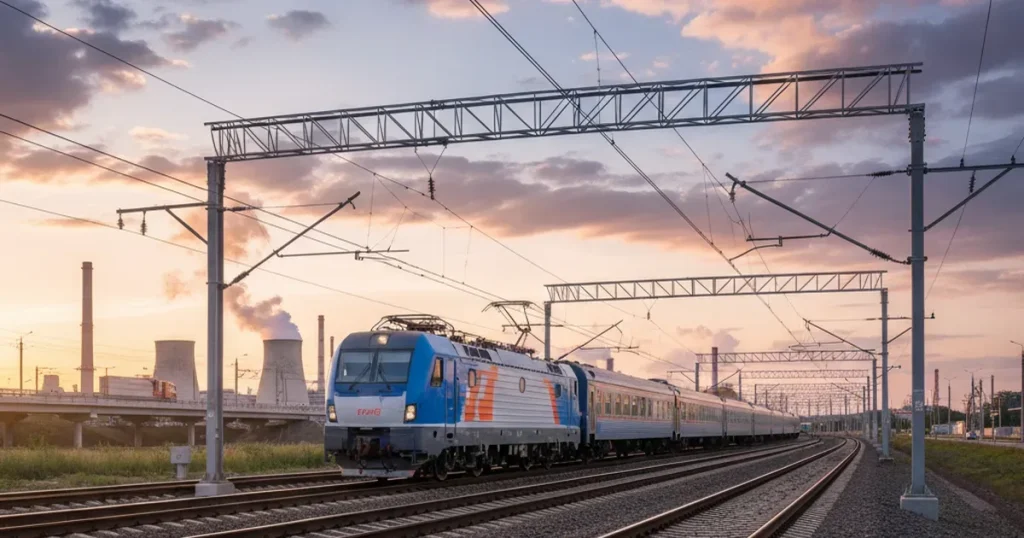
Few infrastructure stories in the world move as fast — or carry as much consequence — as the electrification of India’s railways. What once took decades to cover a few hundred kilometres is now advancing at more than 15 kilometres a day. As of January 2026, Indian Railways has electrified approximately 99.4% of its entire broad-gauge network, covering 69,744 route kilometres out of a total 70,117. The final stretch of roughly 374 route kilometres is actively under construction.
This is not just an engineering achievement. It is a signal of where India’s infrastructure strategy is heading — toward cleaner, faster, and more economically efficient transport. For travellers and freight operators alike, an electrified network means better trains, more reliable schedules, and a significantly smaller carbon footprint. Understanding where this mission stands today, and where it is going, is what this article is all about.
A Century in the Making: How Rail Electrification Began in India
India’s relationship with electric trains is older than most people realise. The country’s first electric train ran on 3 February 1925, connecting Bombay Victoria Terminus (now Chhatrapati Shivaji Maharaj Terminus) and Kurla on the Great Indian Peninsula Railway’s Harbour Line. It used a 1,500V DC system and covered a modest stretch — but it marked a historic turning point.
Progress was slow for decades. By Independence in 1947, only about 388 route kilometres had been electrified. By the year 2000, electrified tracks still accounted for just 24% of the network — a fraction of what India needed. The pace picked up slightly through the 2000s, but the real transformation began after 2014, when the government declared electrification a national mission.
Between 2004 and 2014, the average rate of electrification was just 1.42 km per day. From 2019 to 2025, that number jumped to more than 15 km per day — a tenfold increase in pace. By the end of 2024, over 96% of the broad-gauge network was electrified. In 2025 alone, thousands more route kilometres were added, pushing the figure past 99%.
Mission 100% Electrification: Where Things Stand in 2026
The official target is simple: electrify every single kilometre of India’s broad-gauge rail network. As of late January 2026, that goal is tantalizingly close. Here is a snapshot of current progress across the country’s 18 railway zones:
| Railway Zone / State | Electrification Status | Notes |
|---|---|---|
| Central, Eastern, Northern, Western Railways | 100% | Fully complete; zero diesel traction on mainlines |
| South Central, South Eastern, Konkan Railway | 100% | All major intercity corridors electrified |
| North Western Railway (Rajasthan zone) | >95% | ~93 route km remaining; desert terrain challenges |
| Southern Railway (Tamil Nadu / Karnataka) | >95% | 117 km (TN) + 151 km (KA) pending; ghat sections |
| Northeast Frontier Railway (Assam) | >95% | ~197 km remaining; NFR electrified 1,342+ km in FY25-26 |
| Konkan Railway (Goa section) | Near-Complete | Only 16 km remaining; completion expected in 2026 |
A total of 14 railway zones and 25 states and Union Territories have already achieved 100% electrification. The five states with outstanding work — Rajasthan, Tamil Nadu, Karnataka, Assam, and Goa — account for just 574 combined route kilometres, less than 1% of the entire network.
Northeast Frontier Railway: A Story of Rapid Progress
One of the most impressive recent chapters in India’s electrification story is happening in the Northeast. The Northeast Frontier Railway (NFR) — which covers Assam, Tripura, Manipur, Arunachal Pradesh, and parts of West Bengal and Bihar — electrified over 1,342 route kilometres in financial year 2025-26 alone, including key sections in Assam, Bihar, Tripura, and Arunachal Pradesh.
The Tinsukia Division in Assam led all NFR divisions, contributing 663 route kilometres of electrified track. This is particularly significant because the Northeast has historically been the most challenging region for railway infrastructure — difficult terrain, dense forest cover, frequent flooding, and complex logistics have all slowed progress over the decades.
For travellers curious about what the Northeast rail network looks like today, our guide to Northeast India Railways: Regional Routes, Scenic Journeys & Travel Guide covers the full picture — from Guwahati to Tripura and beyond.
Why Electrification Matters: The Real-World Impact
It is easy to get lost in route kilometre statistics. The more important question is: what does electrification actually mean for Indian travellers and for the country?
Faster, More Reliable Trains
Electric locomotives accelerate more quickly and more smoothly than diesel engines. This directly improves journey times and reduces the gap between scheduled and actual departure times. Trains like the Vande Bharat Express — India’s fastest semi-high-speed train — are only possible on fully electrified corridors. As electrification reaches the last remaining sections, more routes become eligible for speed upgrades.
Dramatically Lower Operating Costs
Electric traction is roughly 70% more economical than diesel traction for Indian Railways. Diesel fuel is imported, making it subject to global oil price volatility and currency risk. Electric power, especially when paired with India’s growing renewable energy capacity, is both cheaper and more price-stable. This frees up capital that the Railways can reinvest in better coaches, station upgrades, and new lines.
A Measurable Climate Benefit
Rail transport already emits far less CO₂ than road transport — roughly 11.5 grams of CO₂ per tonne-kilometre for trains versus about 101 grams for road freight. Switching from diesel to electric traction cuts that figure even further, especially as the national grid incorporates more renewable energy. Indian Railways has already commissioned 898 MW of solar power at 2,626 stations, with 629 MW of that directly supporting traction.
Energy Security
Reducing dependence on imported diesel fuel is a significant strategic benefit. As India expands domestic solar and wind capacity, an electrified railway becomes increasingly energy self-sufficient — and the cost per kilometre of running trains keeps falling.
🌍 India vs the World: India’s 99.4% broad-gauge electrification far outpaces comparable economies — UK (39%), Russia (52%), China (82%), Germany (~50%), France (~60%), and Spain (~67%). India is on course to hold the title of the world’s largest fully electrified broad-gauge railway network.
How India Got Here: Technology & Scale
The speed of India’s electrification surge in the last decade did not happen by accident. Two key technological shifts made it possible.
The first was the adoption of cylindrical mechanised foundations for overhead electrification (OHE) support poles, replacing older labour-intensive methods. These can be installed faster, with greater consistency and lower manual effort — important when you are wiring thousands of kilometres of track simultaneously.
The second was the deployment of Automatic Wiring Trains — specialised machines that simultaneously install both the catenary wire and the contact wire with precise, uniform tension. This ensures quality while dramatically reducing the time needed to wire each kilometre of track.
Between 2014 and 2025, Indian Railways added 46,900 route kilometres of electrification — a figure that roughly equals the entire railway network of Germany, accomplished in just over a decade.
Electrification & the Bigger Railway Modernisation Picture
Rail electrification does not exist in isolation — it is one piece of a much larger transformation of Indian Railways.
The Dedicated Freight Corridor (DFC) is entirely electric and represents one of the most significant infrastructure investments in India’s history. By separating freight from passenger traffic on electrified dedicated lines, the DFC dramatically increases freight speeds while freeing up the main network for faster passenger services.
The Jammu & Kashmir rail projects — including the world’s highest railway bridge over the Chenab River — are also entirely designed for electric operation, future-proofing connectivity in one of the country’s most challenging geographies.
On the passenger side, fully electrified corridors between major city pairs enable high-quality train services. The Chennai to Bangalore rail corridor, the New Delhi to Mumbai mainline, and the Howrah to Chennai route are all fully electrified today, supporting multiple daily express and superfast services.
Even iconic leisure routes have benefited. The Mumbai to Goa Konkan Railway, one of India’s most scenic train journeys, now runs entirely under the wire.
What Happens After 100%?
Reaching 100% electrification will be a milestone — but it will also be the starting gun for the next phase. Here is what the completion of electrification unlocks:
- Phase-out of diesel locomotives on mainlines: Indian Railways has been progressively retiring diesel locos on electrified sections. Full electrification enables a complete transition to electric fleets across the broad-gauge network, cutting maintenance complexity.
- Higher sectional speeds: Electrification combined with track improvements enables speed upgrades. Indian Railways has already raised speeds to 130 km/h on 599 track km of the Golden Quadrilateral and Golden Diagonal corridors, with further upgrades planned.
- Expansion of semi-high-speed services: More electrified routes means more corridors eligible for upgraded semi-high-speed trains — a category that includes Vande Bharat and the new Amrit Bharat Express.
- Green hydrogen pilots: Indian Railways has begun exploring hydrogen-powered trains as a future option for narrow-gauge and heritage routes where overhead electrification is impractical — including mountain railways.
- Further solar and storage integration: With a fully electric traction network, Indian Railways can increasingly source traction power directly from its own solar installations and from grid-scale storage, reducing costs further.
The Mumbai–Ahmedabad High Speed Rail corridor — India’s first bullet train project — is also being built with full electric infrastructure as its backbone, representing the next frontier beyond conventional electrification. [Guide to Mumbai–Ahmedabad High Speed Rail — coming soon]
India Rail Electrification: Key Milestones at a Glance
| Year / Period | Milestone |
|---|---|
| 1925 | First electric train: Bombay VT to Kurla (1,500V DC) |
| 1947 | 388 route km electrified at Independence |
| 2000 | 24% of network electrified |
| 2014 | Mission 100% Electrification declared; pace: 1.42 km/day |
| 2017 | 40% electrification achieved |
| 2024 (end) | 96%+ of broad-gauge network electrified |
| Nov 2025 | 69,427 route km electrified (99.2%); pace: 15 km/day |
| Jan 2026 | 69,744 route km electrified (99.4%); final 373 km in progress |
| 2026 (target) | 100% broad-gauge electrification |
Frequently Asked Questions
Q. What percentage of India’s rail network is electrified in 2026?
A. As of January 2026, approximately 99.4% of India’s broad-gauge rail network — around 69,744 route kilometres out of a total 70,117 route kilometres — has been electrified. This makes India one of the most extensively electrified railway networks in the world.
Q. Which states still have pending rail electrification work in India?
A. Five states have residual sections yet to be electrified: Rajasthan (93 route km), Tamil Nadu (117 route km), Karnataka (151 route km), Assam (197 route km), and Goa (16 route km). Together these total just 574 route kilometres — less than 1% of the network.
Q. When did Indian Railways start its electrification drive?
A. India’s first electric train ran on 3 February 1925, between Bombay Victoria Terminus and Kurla, using a 1,500V DC system. The modern push to 100% electrification accelerated dramatically after 2014.
Q. How does India’s rail electrification compare to other countries?
A. India’s ~99.4% broad-gauge electrification surpasses many major economies: UK (39%), Russia (52%), China (82%), France (~60%), Germany (~50%), and Spain (~67%). India is on track to become the world’s largest fully electrified broad-gauge rail network.
Q. What are the main benefits of railway electrification in India?
A. Key benefits include a roughly 70% reduction in operating costs over diesel, an 89% lower carbon footprint compared to road freight, faster train acceleration, lower fuel import bills, reduced maintenance needs, and better integration with renewable energy sources.
Q. How much solar power has Indian Railways installed alongside electrification?
A. By November 2025, Indian Railways had commissioned 898 MW of solar power across 2,626 stations. Around 629 MW (about 70%) directly supports electric traction, while the remaining 269 MW powers stations, workshops, and railway quarters.
🔍 Explore More on Road Rail Infra
- India’s Dedicated Freight Corridor (DFC) — 2026 Updates
- Jammu & Kashmir Rail Projects: Bridges, Routes & Progress
- Northeast India Railways: Regional Routes & Travel Guide
- Chennai to Bangalore Train Route — Complete Travel Guide
- Mumbai to Goa Train — Konkan Railway Guide
Frequently Asked Questions
What is Mission 100% electrification of Indian Railways?
Indian Railways aims to electrify 100% of its broad gauge network. As of 2026, over 97% is electrified — making Indian Railways one of the world’s largest electrified rail networks.
What are the benefits of railway electrification in India?
Electrification eliminates diesel fuel costs (saving Rs 15,000+ crore annually), reduces carbon emissions, increases train speed capacity, and enables regenerative braking that feeds energy back to the grid.
When did Indian Railways complete electrification?
Indian Railways achieved near-complete broad gauge electrification in 2024, covering over 63,000 route km. The remaining sections in remote NE areas are targeted for completion by 2026-27.
What type of electric traction does Indian Railways use?
Indian Railways primarily uses 25kV AC overhead traction for mainline trains. Metro systems use 750V DC third rail or 25kV AC overhead depending on the corridor.
How does electrification reduce railway costs?
Electric traction is 3-4x cheaper per unit of energy than diesel. It also has lower maintenance costs — electric locomotives have fewer moving parts than diesel engines.
What happens to diesel locos after full electrification?
Diesel locomotives will continue to be used on non-electrified branch lines, last-mile freight movements, and as backup. Many will be retrofitted or reassigned to maintenance and shunting duties.
Is Indian Railways switching to hydrogen trains?
Yes. Indian Railways is piloting hydrogen fuel cell trains (HyDEMU) on a few non-electrified routes. The first hydrogen train trial took place in 2023. Commercial deployment is planned for 2026-28.