
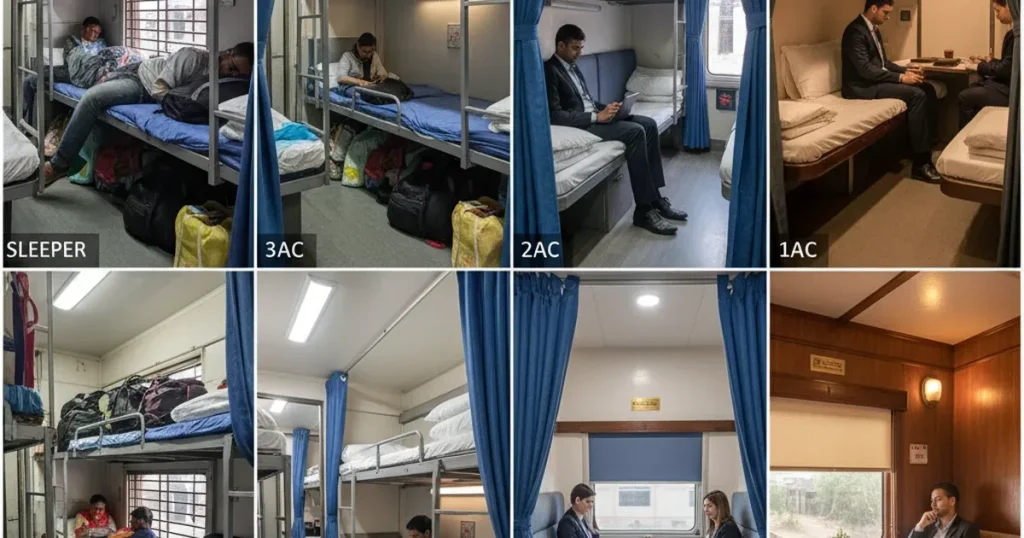
Overview: All Indian Train Classes at a Glance
| Class Code | Full Name | AC? | Berths/Seats | Bedding | Relative Fare |
|---|---|---|---|---|---|
| 1A | First Class AC | Yes | 2 or 4 per cabin | Yes | Highest |
| 2A | AC 2-Tier | Yes | 2-tier | Yes | High |
| 3A | AC 3-Tier | Yes | 3-tier | Yes | Moderate |
| 3E | AC 3-Tier Economy | Yes | 3-tier (denser) | Yes | Low-Moderate |
| SL | Sleeper Class | No | 3-tier | No | Low |
| CC | AC Chair Car | Yes | Reclining seats | No | Moderate |
| 2S | Second Sitting | No | Bench seats | No | Cheapest |
1. First Class AC (1A) — Luxury on Rails
1A, or First Class Air-Conditioned, is the most premium class available on Indian Railways — a moving hotel room with complete privacy.- Cabins: 2-berth private coupes and 4-berth lockable cabins — the only class with lockable doors
- Bedding: Clean pillow, sheets, blanket, and hand towel provided
- Privacy: Highest among all classes
- Fare: Approximately Rs 4,000–7,000 for Delhi–Mumbai
2. AC 2-Tier (2A) — Best Balance of Comfort and Privacy
2A is the sweet spot — significantly more comfortable than 3AC, with better privacy, at a fraction of the 1AC price.- Berths: 2-tier layout — Upper and Lower berths (no middle berth)
- Privacy: Curtains separate each bay
- Bedding: Pillow, sheets, blanket, and hand towel provided
- Fare: Approximately Rs 2,000–2,500 for Delhi–Mumbai
3. AC 3-Tier (3A) — Most Popular AC Class in India
3A is the most booked AC class on Indian Railways — a perfect blend of affordability and comfort.- Berths: 3-tier layout — Upper, Middle, Lower plus side berths
- Bedding: Pillow, sheets, blanket provided
- Coach capacity: 64–72 passengers
- Fare: Approximately Rs 1,200–1,600 for Delhi–Mumbai
4. AC 3-Tier Economy (3E) — Newest Budget AC Class
Introduced under the new-generation train programme, 3E offers air-conditioned travel cheaper than standard 3AC. Currently available on Vande Bharat Sleeper Express and select premium trains.- Berths: 3-tier, denser configuration with more passengers per coach
- Fare: 10–15% cheaper than 3AC on the same route
5. Sleeper Class (SL) — The Backbone of Indian Railways
SL is non-AC and the most economical option for overnight long-distance journeys.- Berths: 3-tier layout — Upper, Middle, Lower plus side berths
- Bedding: Not provided — bring your own
- Ventilation: Fans and open windows (no AC)
- Fare: Approximately Rs 500–700 for Delhi–Mumbai
6. AC Chair Car (CC) — Best for Daytime Short Trips
CC is found on Shatabdi Express, Jan Shatabdi, and InterCity trains. Cushioned reclining seats in a 2×3 configuration. No berths — purely for daytime journeys up to 400–500 km. Best for: Day travellers on routes like Chennai to Bangalore and Delhi to Agra.7. Second Sitting (2S) — Ultra-Budget Reserved Seating
2S is non-AC with reserved bench-style seating. No berths, no bedding. Ideal for very short journeys under 3–4 hours. Best for daily commuters — not recommended for overnight travel.Which Train Class Should You Choose?
| Your Situation | Recommended Class |
|---|---|
| Long overnight journey, tight budget | Sleeper (SL) |
| Long overnight journey, want AC | 3AC (3A) |
| Family trip with elderly or children | 2AC (2A) |
| Business travel or maximum privacy | 1AC (1A) |
| Day trip under 500 km | AC Chair Car (CC) |
| AC travel on the tightest budget | 3E Economy |
| Very short journey, any budget | Second Sitting (2S) |
Fare Comparison: Delhi to Mumbai (Approximate 2026)
| Class | Approx. Fare (Rs) |
|---|---|
| Sleeper (SL) | 500 – 700 |
| 3AC (3A) | 1,200 – 1,600 |
| 3E Economy | 1,000 – 1,400 |
| 2AC (2A) | 2,000 – 2,500 |
| 1AC (1A) | 4,000 – 7,000 |
Expert Tips
- Book early for lower berths: In 3AC and 2AC, lower berths go first. Book 60–120 days in advance.
- Rajdhani and Shatabdi trains do not have Sleeper class — 3AC is the base class on Rajdhani.
- Senior Citizens and Women: Lower berths reserved under special quotas on IRCTC.
- Vande Bharat Sleeper (launching 2026) will feature 1AC, 2AC, and 3E — check Vande Bharat routes and updates.
- Check PNR and train running status before your journey to stay updated.
Frequently Asked Questions
What is the difference between Sleeper and 3AC in Indian Railways?
Which is the best train class for a family trip in India?
What does 1AC (First Class AC) offer in Indian trains?
Is 3AC Economy (3E) the same as 3AC?
What is AC Chair Car (CC) and when should I choose it?
How much more expensive is 2AC compared to Sleeper class?
Can I book food in all train classes?
Frequently Asked Questions
What are the train classes in Indian Railways?
Indian Railways has 8 classes: 1AC (First Class AC), 2AC (2-Tier AC), 3AC (3-Tier AC), 3E (3AC Economy), CC (AC Chair Car), EC (Executive Chair Car), SL (Sleeper), and 2S (Second Sitting).
What is the difference between Sleeper and 3AC?
Sleeper class has open berths with no AC, fans only, and costs 40-60% less than 3AC. 3AC has air conditioning, curtained berths, and bedrolls provided. For overnight journeys, 3AC is significantly more comfortable.
Which is the cheapest train class in India?
2S (Second Sitting) is the cheapest class — unreserved seating with no berths, suitable for short daytime journeys only. For overnight travel, SL (Sleeper) is the most affordable reserved option.
What is 3AC Economy class?
3E (3AC Economy) is a newer class introduced in Vande Bharat and modern trains. It has 83 berths per coach vs 72 in standard 3AC, slightly narrower berths, and fares about 8% lower than standard 3AC.
Is 1AC worth the cost on Indian trains?
1AC is worth it for business travel or trips where privacy and comfort matter — you get a fully enclosed cabin with 2 or 4 berths, premium bedding, and dedicated attendant service. Fares are 3-4x higher than 3AC.
How do I choose the right train class?
For journeys under 4 hours: CC or 2S. Overnight under 800 km: SL or 3AC. Overnight 800+ km or comfort-priority: 2AC or 1AC. Budget family travel: 3AC or 3E.
Do all trains have all classes?
No. Express trains typically have SL, 3AC, 2AC, 1AC. Vande Bharat has CC and EC only. Local and passenger trains have 2S and sometimes SL. Premium trains like Rajdhani skip SL class.