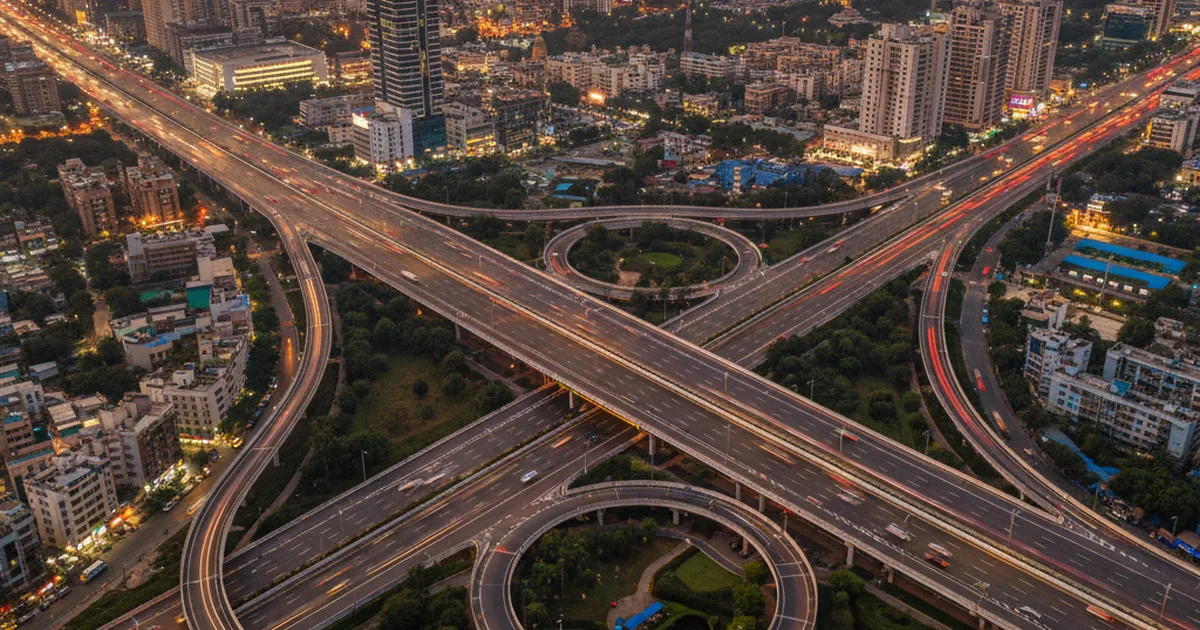

India’s major cities are choking. Delhi, Mumbai, Bengaluru, and Chennai together account for hundreds of thousands of trucks passing through their urban cores every day — adding to congestion, pollution, and urban infrastructure strain. The government’s answer: a new generation of ring roads, bypasses, and peripheral expressways that route through-traffic around city limits. In 2026, several of these projects are at critical stages of construction or just opening. Here’s the complete guide to India’s most important ring road and bypass projects.
Table of Contents
- Why India Needs Ring Roads and Bypasses
- Delhi — Ring Roads & Peripheral Expressway
- Bengaluru — Business Corridor (BBC/PRR)
- Chennai — Peripheral Ring Road (CPRR)
- Mumbai — Ring Routes & Coastal Road
- Other Cities: Hyderabad, Pune, Kolkata
- Comparison Table: Major Ring Road Projects
- Impact on Freight, Travel Times & Urban Development
- Frequently Asked Questions
Why India Needs Ring Roads and Bypasses
India’s urban highway strategy is undergoing a major shift. According to a 2026 Ministry of Road Transport and Highways (MoRTH) document, the government is now prioritising elevated corridors, ring roads, and bypasses as its primary tool for urban decongestion — moving away from the era of simply widening existing urban roads, which has reached its practical limits in most large cities.
The core problem: national highways often pass directly through the centres of India’s cities. A truck driving from Delhi to Chennai on NH-44 passes through Nagpur’s urban core. A container moving from Mumbai to Pune squeezes through Pune’s congested city streets. Ring roads solve this by creating an outer loop that allows long-distance traffic to bypass the city entirely — reducing urban congestion, lowering logistics costs, and freeing up inner-city road capacity for local travel.
Delhi — Ring Roads & Peripheral Expressway
Delhi has the most layered ring road system of any Indian city, with three concentric loops:
Inner Ring Road
The Inner Ring Road (about 49 km) circles the inner urban core of Delhi, connecting major radial corridors. It is fully built and heavily congested — largely serving intra-city movement now.
Outer Ring Road
The Outer Ring Road (about 56 km) forms a wider loop around central Delhi. Several stretches have been elevated and widened in recent years to ease congestion. It remains a critical freight and commuter corridor.
Delhi Peripheral Expressway (KMP / KGP)
The most significant outer bypass is the Kundli–Manesar–Palwal (KMP) Expressway — a 135.6 km, 6-lane access-controlled expressway forming Delhi’s western and southern bypass. Combined with the Kundli–Ghaziabad–Palwal (KGP) Expressway on the eastern side, these two form a complete ring around Delhi — allowing through-traffic (especially freight) to bypass the NCR entirely. Both are operational and toll-based via FASTag. Delhi’s “3rd Ring Road” (the Capital Region Ring Road — a 100+ km, 6-lane access-controlled corridor connecting key national highways) is also under development, with sections targeted for completion in late 2025–2026.
Bengaluru — Business Corridor (BBC/PRR)
Bengaluru’s outer ring road situation has been contentious for years. The Bengaluru Business Corridor (BBC) — previously known as the Peripheral Ring Road (PRR) — is a proposed 117 km, 12-lane tolled expressway designed to run around Bengaluru, connecting Tumakuru Road (NH-48) to Hosur Road (NH-44) and Sarjapur Road. The project was approved in October 2025 and is now at early construction/land acquisition stages.
The BBC will divert traffic away from Bengaluru’s saturated Outer Ring Road (ORR) — which despite being built as a bypass, is now one of the most congested stretches in the city due to rapid development along its corridor. The new BBC aims to provide the true outer bypass that the ORR once was designed to be. For the tech corridor connecting Whitefield, Electronic City, and the northern IT clusters, this project is transformational — reducing logistics costs for Bengaluru’s massive export-driven IT and manufacturing economy.
Chennai — Peripheral Ring Road (CPRR)
The Chennai Peripheral Ring Road (CPRR) is a 132.87 km, 6-lane expressway connecting Ennore Port in the north to Mamallapuram in the south. It bypasses Chennai’s urban core and creates a critical link between Chennai’s northern industrial port zone and its southern IT and auto-manufacturing corridor. The project is funded partly by the Asian Infrastructure Investment Bank (AIIB) and is estimated to cost approximately ₹11,000 crore.
As of 2026, the CPRR is in advanced construction stages. Sections 2 and 3 (which received AIIB financing) are progressing well. The full road was estimated to be ready by early 2026, though some sections may extend slightly beyond that. When complete, it will dramatically ease freight movement between Chennai Port, Ennore Port, and the southern manufacturing clusters — particularly for the automobile industry, which relies heavily on road-based component logistics in the Chennai region.
Mumbai — Ring Routes & Coastal Road
Mumbai’s geography — a peninsula — makes a traditional ring road impossible. Instead, Mumbai’s bypass strategy relies on a combination of expressways and tunnels:
- Mumbai Coastal Road — an 10.58 km sea-facing freeway on the western coast of Mumbai, now partially open. It connects Marine Drive to Worli and will extend to connect the Bandra-Worli Sea Link, dramatically cutting travel times in south Mumbai.
- Mumbai Trans Harbour Link (Atal Setu) — India’s longest sea bridge (21.8 km), connecting Mumbai to Navi Mumbai. Opened in January 2024, it has reduced travel time between the two cities from 60+ minutes to under 20 minutes.
- MTHL + Pune Expressway — Together, these allow traffic from the east (Navi Mumbai, Thane, Pune) to bypass central Mumbai for most freight and inter-city travel purposes.
Mumbai’s ongoing ring road equivalent is also served by the Mumbai Nagpur Samruddhi Mahamarg — a 701 km, 8-lane expressway completed in 2023 that allows traffic to bypass Mumbai’s eastern hinterland entirely when travelling between Maharashtra’s coast and its interior.
Other Cities: Hyderabad, Pune, Kolkata
Hyderabad — Outer Ring Road (ORR)
Hyderabad’s 158 km Outer Ring Road (ORR) is one of India’s most successful urban bypass projects — an 8-lane access-controlled toll road that circles the city and connects all major radial highways. The ORR is now being extended further and designated as part of the national highway network to handle growing freight volumes from Hyderabad’s expanding pharma and IT export industries.
Pune — Ring Road
Pune’s Ring Road project — a 128.8 km bypass around the city — has been in planning and land acquisition phases for several years. As of 2026, construction has begun on portions of the route. Pune’s rapid growth as a manufacturing and IT hub has made the ring road increasingly urgent, as NH-48 congestion through the Pune urban area remains severe.
Kolkata — Bypass & Ring Road
The EM Bypass and the Eastern Metropolitan Bypass serve as Kolkata’s primary traffic diversion routes. A more comprehensive bypass connecting NH-12 and NH-16 is under planning, though land acquisition in the densely populated eastern corridor remains a challenge. The Eastern Dedicated Freight Corridor terminating near Kolkata has reduced some road freight pressure on the city’s bypass corridors.
Comparison Table: Major Ring Road Projects in India
| City | Project | Length | Status (2026) | Lanes |
|---|---|---|---|---|
| Delhi | KMP + KGP Expressway (full ring) | ~270 km combined | Operational | 6 |
| Delhi | Capital Region Ring Road | 100+ km | Under construction | 6 |
| Bengaluru | BBC (Bengaluru Business Corridor) | 117 km | Early construction (approved Oct 2025) | 12 |
| Chennai | Chennai Peripheral Ring Road (CPRR) | 132.87 km | Advanced construction | 6 |
| Mumbai | Coastal Road + Atal Setu | 10.58 km + 21.8 km | Partially operational | 6–8 |
| Hyderabad | Outer Ring Road (ORR) | 158 km | Fully operational | 8 |
| Pune | Pune Ring Road | 128.8 km | Land acquisition / early construction | 6–8 |
Impact on Freight, Travel Times & Urban Development
Ring roads and bypasses deliver compounding benefits. In cities like Hyderabad — where the ORR has been operational since 2008 — the impact is well-documented: freight trucks no longer need to navigate urban cores, reducing city-centre congestion and cutting logistics costs. New industrial parks, warehousing clusters, and residential developments have sprung up along ring road corridors, effectively extending the economic footprint of the city outward.
The same pattern is expected for Bengaluru, Chennai, and Pune as their ring road projects complete. India’s broader NHAI expansion programme explicitly prioritises ring roads and bypasses as a key pillar of urban decongestion strategy through 2030.
Frequently Asked Questions
What is the difference between a ring road and a bypass?
A bypass is a road that routes traffic around a specific city or town, usually as a shorter diversion on an existing highway. A ring road is a circular road that forms a complete loop around a city, connecting all radial highways and allowing traffic to travel from one side of the city to another without entering the urban core. Ring roads are typically longer and more comprehensive than bypasses.
Is the KMP Expressway around Delhi toll-free?
No. The Kundli–Manesar–Palwal (KMP) Expressway is a tolled expressway. FASTag is mandatory, and toll rates vary by vehicle category. It provides significant time savings for vehicles bypassing Delhi on the west and south.
When will Bengaluru’s BBC ring road be complete?
The Bengaluru Business Corridor (BBC) was approved in October 2025 and is in early construction and land acquisition stages as of 2026. Given the typical timeline for a project of this scale, substantial completion is realistically expected by 2028–2030.
Does Mumbai have a ring road?
Not in the traditional sense, given Mumbai’s peninsular geography. Instead, Mumbai’s bypass network relies on expressways (Mumbai–Pune Expressway, Samruddhi Mahamarg), sea links (Atal Setu), and the Coastal Road to distribute traffic around and into the city. A conventional circular ring road is not feasible given the Arabian Sea on the west and Thane Creek on the east.
Which city has India’s best ring road?
Hyderabad is widely considered to have India’s most successful ring road — the 158 km, 8-lane Outer Ring Road (ORR), which has been operational since 2008 and has significantly reduced urban congestion while catalysing massive industrial and residential development along its corridor. Delhi’s KMP+KGP combination is a close second for sheer scale and freight impact.
How do ring roads help reduce logistics costs?
Ring roads allow trucks to avoid urban congestion, which reduces fuel consumption, travel time, and vehicle wear. Studies of Indian ring road projects show freight trucks save 2–4 hours per trip when using a functional bypass versus the urban route — translating to significant per-kilometre cost savings for logistics operators and, ultimately, lower consumer prices for goods transported by road.