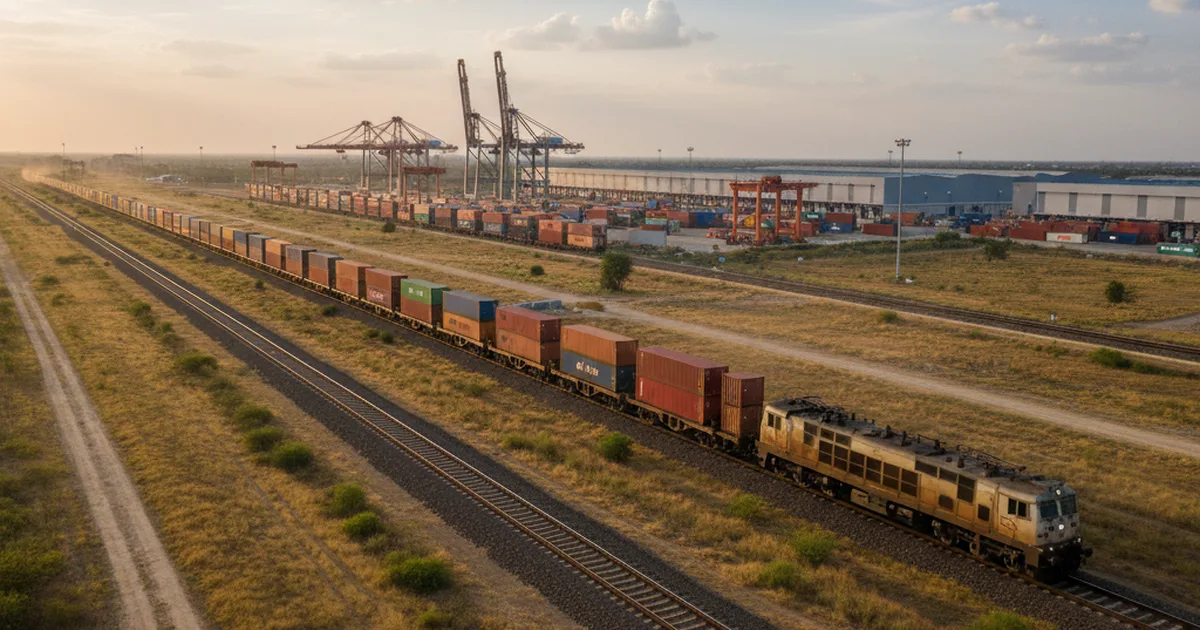

India’s freight rail network is in the middle of a quiet revolution. The Dedicated Freight Corridor (DFC) programme — one of the most ambitious infrastructure projects in the country’s history — has crossed a series of major milestones heading into 2026, and the government has already announced bold plans to expand the network further. Whether you follow infrastructure news for business, investment, or sheer curiosity, here’s everything you need to know about the latest DFC developments.
What Is the Dedicated Freight Corridor — and Why Does It Matter?
For decades, India’s railways struggled with a fundamental tension: the same tracks had to carry both passenger trains and enormous freight loads. This meant delays on both sides — your express train waited for a coal wagon to clear, while a container shipment sat idle because a Rajdhani had priority. The DFC was designed to break this deadlock.
The Dedicated Freight Corridor Corporation of India (DFCCIL) was set up to build and operate a network of high-speed, high-capacity freight-only rail lines. These tracks use heavier rails (capable of handling a 32.5-tonne axle load, compared to the standard 25 tonnes), electrified infrastructure, and advanced signalling to move goods faster and more reliably than ever before.
The result? Freight trains that once crawled at 25–35 km/h now regularly achieve average speeds above 50 km/h on operational sections — with peak speeds on the Eastern DFC touching 99 km/h on the New Khurja–New Bhaupur stretch. That’s a transformation, not just an upgrade.
To understand how freight movement fits into India’s broader rail story, explore our guide to the New Delhi to Mumbai Train Route, which runs parallel to the Western DFC corridor.
2,843 km Combined EDFC + WDFC Length
96.4% Network Commissioned (Dec 2025)
892 Record Trains in a Single Day (Jan 2026)
2,100 km New Dankuni–Surat DFC (Announced)
Where Things Stand: Eastern and Western DFC in 2026
Eastern Dedicated Freight Corridor (EDFC)
The Eastern DFC runs 1,337 km from Ludhiana in Punjab to Sonnagar in Jharkhand. Construction on this corridor wrapped up in early 2024, and it has been fully operational since April 2024. The EDFC primarily serves mineral and coal traffic originating from eastern India, connecting mines and power plants to consumption centres in the north and west.
Western Dedicated Freight Corridor (WDFC)
The Western DFC spans 1,506 km between Jawaharlal Nehru Port Terminal (JNPT) in Mumbai and Dadri in Uttar Pradesh. As of December 2025, approximately 96.4% of the combined DFC network had been commissioned — with the short remaining stretch of the WDFC targeted for completion by March 2026. Once complete, this corridor will enable seamless container movement from India’s busiest port directly into the heartland of north India.
💡 Key Fact: In January 2026, DFCCIL set its highest-ever single-day interchange record — handling 892 trains across the combined DFC network, surpassing the previous record of 865 trains set just days earlier.
Traffic Growth: A Sign of Real Impact
The numbers tell a compelling story. Daily freight traffic on the DFC network climbed from an average of 247 trains per day in 2023-24 to 352 trains per day in 2024-25. By February 2025, average daily traffic had reached 371 trains. As more industries and logistics operators adopt the DFC for their supply chains, these figures are only expected to climb.
The Biggest News: A New DFC Announced in Budget 2026
The Union Budget 2026-27, presented by Finance Minister Nirmala Sitharaman on February 1, 2026, carried a headline announcement for India’s freight sector: a brand-new Dedicated Freight Corridor connecting Dankuni in West Bengal to Surat in Gujarat.
This roughly 2,100-km corridor is a strategic game-changer. Here’s why it matters:
- It bridges the existing networks. Currently, the Eastern DFC terminates at Dankuni and the Western DFC at Dadri (near Delhi). The new Dankuni–Surat corridor will link these two networks, forming a continuous freight spine running across northern and central India.
- It connects two industrial powerhouses. Gujarat is India’s manufacturing and export leader; West Bengal and the eastern states are rich in minerals, agriculture, and growing industrial output. A direct freight link between them reduces dependency on road transport and cuts logistics timelines significantly.
- It supports the National Logistics Policy. India has set a target to reduce logistics costs from around 14–16% of GDP to single digits. Dedicated corridors like this one are central to achieving that goal.
- It decongests passenger lines. By diverting bulk cargo off shared tracks, the new corridor will improve punctuality and safety for passenger services running through central India.
Following the budget announcement, the Railway Board directed expedited implementation of the Dankuni–Surat DFC in February 2026, with Railway Minister Ashwini Vaishnaw emphasising the importance of timely execution.
Three More Corridors in the Pipeline
The Dankuni–Surat DFC is just one piece of a much larger plan. India is also in the process of preparing Detailed Project Reports (DPRs) for three additional freight corridors:
- North-South Corridor — linking northern industrial regions with southern port cities
- East-Coast Corridor — connecting the eastern seaboard for port-led freight movement
- East-West Corridor — enabling cross-country bulk cargo flows
The combined estimated investment for these three corridors is in the range of ₹2 lakh crore. While none of them have been formally sanctioned yet, their DPRs are under review, and India’s stated goal of becoming a global trade hub by 2047 makes their eventual approval highly likely.
📌 [Future Content Opportunity: “North-South and East-Coast DFC Route Maps & Impact Analysis”] — A deep-dive into how these proposed corridors will reshape India’s logistics geography.
Technology Behind the Tracks: What Makes DFC Different
It’s not just about new lines. The DFC has introduced a generation of freight technology to Indian Railways that was previously absent from the network.
Double-Stack Container Trains
The higher clearance profile on DFC tracks allows trains to carry containers stacked two levels high — dramatically increasing the cargo volume per journey and reducing per-unit logistics costs for shippers.
High-Power Locomotives
The corridors use specially developed locomotives — including the WAG-12, a 12,000 HP electric locomotive developed by Alstom, one of the most powerful freight engines in the world. The WAG-9HH (9,000 HP), developed at Chittaranjan Locomotive Works, is also deployed on the Western DFC.
Advanced Safety with Kavach
Indian Railways has integrated the indigenously developed Kavach Automatic Train Protection (ATP) system across its network, including DFC lines. Kavach prevents signal-passing accidents and enables safe, dense traffic operations — critical when running nearly 900 trains a day.
Gati Shakti Cargo Terminals
To maximise DFC usage, the government launched the Gati Shakti Multi-Modal Cargo Terminal (GCT) policy in December 2021. Over 120 GCT locations have already been commissioned across Indian Railways, with five specifically on DFC lines — providing mechanised loading, unloading, and seamless multimodal connectivity.
📌 [Future Content Opportunity: “Gati Shakti Cargo Terminals: Complete List, Locations & How to Use Them”]
What This Means for India’s Economy and Everyday Life
You might be wondering — why should this matter to someone who isn’t in the logistics industry? The answer is: because cheaper and faster freight movement eventually reaches every household.
When it costs less to move goods from a factory in Gujarat to a warehouse in Uttar Pradesh, those savings feed through to the price of everything — from cement and fertiliser to consumer goods and food. Reliable freight infrastructure also encourages manufacturers to invest in India rather than importing finished goods, creating jobs and industrial capacity.
At the same time, by moving freight trains off the shared network, passenger train punctuality improves. Intercity express and mail trains no longer have to wait for a 90-wagon coal rake to clear. If you’ve ever sat aboard a delayed Shatabdi or Rajdhani wondering why you’re standing still in the middle of nowhere, the DFC is part of the long-term answer.
For travellers planning journeys on routes parallel to these corridors, our guides to the Howrah to Chennai Train Route and the Delhi–Mumbai Expressway Road Trip offer useful context on how road and rail infrastructure work alongside each other.
Looking Ahead: India’s Freight Rail Ambition in 2026 and Beyond
India’s DFC story is still in its early chapters. The completion of the Western DFC in 2026, the launch of planning for the Dankuni–Surat corridor, and the pipeline of three more proposed routes all point toward a freight rail network that will look very different a decade from now.
Key things to watch in the coming months:
- Formal completion and inauguration of the remaining WDFC section
- Detailed engineering and alignment work on the Dankuni–Surat DFC
- Sanction status of the North-South, East-Coast, and East-West corridors
- Growth in private freight terminal (GCT) investment alongside DFC lines
- Further expansion of double-stack and high-axle-load operations
For those interested in the broader story of India’s infrastructure push — including major road projects running alongside these rail corridors — our coverage of the Delhi–Mumbai Expressway shows how road and rail are both being upgraded in tandem.
📌 [Future Content Opportunity: “DFCCIL vs Indian Railways: How the Two Systems Work Together”]
Frequently Asked Questions About India’s Dedicated Freight Corridors
What is the Dedicated Freight Corridor (DFC) in India?
The DFC is a network of high-capacity electric railway lines built exclusively for freight trains. Managed by DFCCIL, it currently includes two main corridors — the Eastern DFC (Ludhiana to Sonnagar, 1,337 km) and the Western DFC (Dadri to JNPT, 1,506 km) — designed to cut logistics costs and free up passenger rail capacity.
What is the current status of the Western DFC in 2026?
As of early 2026, the Western DFC is over 96% commissioned. The final remaining section of the JNPT–Dadri stretch was targeted for completion by March 2026, bringing the full 2,843-km combined network to near-complete operational status.
What is the new Dankuni–Surat Dedicated Freight Corridor?
Announced in the Union Budget 2026-27, the Dankuni–Surat DFC will span approximately 2,100 km, linking West Bengal’s Dankuni with Gujarat’s Surat. It will bridge India’s existing Eastern and Western DFC networks, creating one continuous freight spine across northern and central India.
How fast do trains run on the DFC?
Freight trains on the Eastern DFC have achieved average speeds of up to 99 km/h on key sections — far above the 25–35 km/h speeds typical on the conventional shared network. Higher axle load capacity and double-stack container capability further boost overall efficiency.
How many trains use the DFC network each day?
Daily traffic grew from 247 trains per day in 2023-24 to 352 trains per day in 2024-25. In January 2026, DFCCIL set a new single-day record with 892 trains handled across the combined EDFC and WDFC network.
Which other new freight corridors are planned?
India is preparing DPRs for three additional corridors: the North-South Corridor, the East-Coast Corridor, and the East-West Corridor. These projects are in the planning stage, with a combined estimated value of around ₹2 lakh crore.
Frequently Asked Questions
What is India’s Dedicated Freight Corridor?
The Dedicated Freight Corridor (DFC) is a rail infrastructure project creating two exclusive high-capacity freight rail lines: the Eastern DFC (1,337 km, Ludhiana to Sonnagar) and Western DFC (1,504 km, Ludhiana to JNPT Mumbai).
When was the DFC completed?
The Western DFC (New Panapura to New Rewari section) was inaugurated in January 2021. Most of both corridors are now operational as of 2026, with final sections completing.
How fast do freight trains run on the DFC?
DFC is designed for trains running at 100 km/h (vs 25-50 km/h on the general network), with double-stack containers allowed. This significantly reduces freight transit times.
How does the DFC benefit Indian logistics?
The DFC reduces freight transit times by 40-50%, reduces logistics costs, frees up passenger line capacity by removing freight trains, and enables double-stack containers that double cargo per trip.
What is the DFCCIL?
Dedicated Freight Corridor Corporation of India Limited (DFCCIL) is the SPV under the Ministry of Railways responsible for building, maintaining, and operating the DFC network.
Will the DFC be extended?
Yes. Phase 2 plans include East Coast Corridor (Kharagpur to Vijayawada), South Coast Corridor, and East-West Corridor. These will further integrate India’s freight rail network.
How does the DFC improve port connectivity?
The Western DFC directly connects to JNPT (Jawaharlal Nehru Port, Mumbai) and other Gujarat ports, enabling seamless port-hinterland freight movement and reducing truck congestion around port areas.
Comments (8) on "India’s Dedicated Freight Corridor (DFC) Updates 2026: New Corridors, Record Milestones & What’s Next"
Comments are closed.