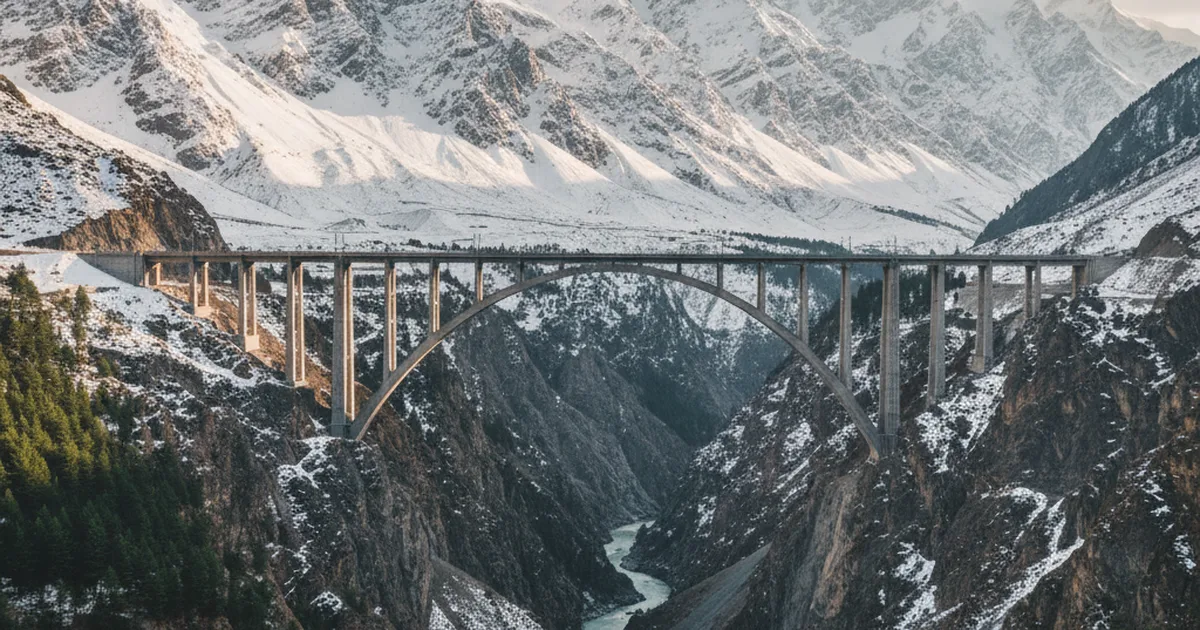

Few infrastructure stories in the world are as dramatic — or as long in the making — as the railway coming to Jammu & Kashmir. Carved through some of the most unforgiving Himalayan terrain on earth, India’s mission to connect the Kashmir Valley to the national rail grid is a story of towering bridges, seemingly endless tunnels, and engineering feats that have no real precedent anywhere on the planet.
Whether you are a traveler planning a future journey, a rail enthusiast following India’s biggest infrastructure push, or simply someone curious about what it actually takes to lay tracks through the Himalayas — this guide covers everything you need to know about Jammu & Kashmir’s regional rail projects, the routes that exist today, and what the completed network will look like.
272 km USBRL Total Length
35+ Tunnels on Route
359 m Chenab Bridge Height
927 km Delhi–Srinagar by Rail (future)
~12.75 km Longest Tunnel (T-49)
Why Does Jammu & Kashmir Still Not Have a Complete Rail Network?
It is a reasonable question. India has one of the largest railway networks in the world, yet for most of independent India’s history, the Kashmir Valley remained completely cut off from it. The answer is geography. The Pir Panjal and Greater Himalayan ranges form a wall of rock, gorges, and fault lines that has frustrated engineers for decades. Conventional railway construction — the kind that works across India’s plains — simply cannot be copy-pasted here.
The Udhampur–Srinagar–Baramulla Rail Link, more commonly known as the USBRL project, was declared a project of national importance by the Indian government and has been under construction since 2002. Progress has been slow, expensive, and technically extraordinary in equal measure. But it is now closer to full completion than ever before.
For context on how India has tackled other ambitious mountain railway corridors, the Kalka–Shimla mountain railway — a UNESCO World Heritage route — offers a fascinating historical comparison of how the British-era engineers solved a similar (though far smaller scale) challenge in the Himachal Pradesh hills.
The USBRL Project: India’s Most Ambitious Railway
The USBRL spans 272 kilometres and links Udhampur in the Jammu region to Baramulla in the Kashmir Valley. It passes through Katra (the base town for the Vaishno Devi pilgrimage), the Pir Panjal range, Banihal, Qazigund, Anantnag, and Srinagar before terminating at Baramulla near the Line of Control.
The project is split into several sections, and progress has been uneven. The eastern portion — from Udhampur to Katra — was completed and opened for passenger services in 2014. The western section, from Banihal through the Kashmir Valley to Baramulla, has been operational since 2013. The critical missing link — the 111-km Banihal–Katra section through the most difficult terrain — is the final piece of the puzzle. This is where the Chenab Bridge, the Anji Khad Bridge, and Tunnel T-49 all sit.
Key insight: Once the Banihal–Katra section opens, it will be possible to board a train in New Delhi and travel all the way to Baramulla in the Kashmir Valley without changing trains — a journey that was unthinkable just two decades ago.
The Sections at a Glance
| Section | Distance | Status (2026) | Key Feature |
|---|---|---|---|
| Udhampur – Katra | 25 km | ✅ Operational (2014) | Gateway to Vaishno Devi |
| Katra – Banihal | 111 km | 🔧 Final Phase | Chenab Bridge, Anji Viaduct, T-49 Tunnel |
| Banihal – Qazigund | 18 km | ✅ Operational (2013) | Pir Panjal Railway Tunnel (11 km) |
| Qazigund – Baramulla | 118 km | ✅ Operational (2009–2014) | Passes through Srinagar, Sopore |
The Chenab Bridge: A Railway Record That Belongs to the World
No discussion of Jammu & Kashmir’s rail projects is complete without talking about the Chenab Rail Bridge. Standing 359 metres above the Chenab River — that is taller than the Eiffel Tower — it holds the title of the world’s highest railway bridge. The arch bridge spans 1,315 metres and has been engineered to withstand winds of up to 260 km/h, earthquakes measuring up to 8 on the Richter scale, and even blast forces.
The Chenab Bridge is not just a record-setter for its own sake. It is a functional solution to an impossible problem: the Chenab Gorge drops so steeply that there was simply no other way to cross it. A conventional bridge at river level would have required approach gradients that no loaded train could safely climb. The arch design at near-mountain height was the only viable answer.
Construction of the bridge involved over 28,000 tonnes of structural steel and took the better part of a decade. Engineers used cable-supported cantilever construction — a technique borrowed from some of the world’s most complex suspension bridge projects — to piece together the arch without scaffolding from below, as the gorge is too deep for that to be feasible.
Regional Routes Currently Operating in J&K
While the missing Katra–Banihal link gets most of the attention, there is already a meaningful rail presence in the region that many travellers overlook. Here is a breakdown of what you can actually travel on today.
Jammu Tawi – The Main Gateway
Jammu Tawi is the primary railway junction for the Jammu region and connects directly to most major Indian cities. Several premium and express trains run between New Delhi and Jammu Tawi, including the Rajdhani Express, the Jammu Mail, and the Uttar Sampark Kranti Express. Journey time from Delhi is approximately 7 to 9 hours depending on the train. From Jammu Tawi, trains extend to Udhampur and Katra.
If you are planning a train journey across India’s northern rail network, the New Delhi to Mumbai train route guide gives a useful look at how Indian Railways structures its long-distance corridors — a useful comparison for understanding where J&K fits into the national network.
Katra – The Vaishno Devi Terminus
Katra station, opened in 2014, serves millions of pilgrims annually who visit the Vaishno Devi shrine. Direct trains from Delhi, Mumbai, Kolkata, and several other major cities now reach Katra, significantly reducing road congestion on the Jammu–Katra highway during peak pilgrimage seasons.
Kashmir Valley: Banihal to Baramulla
The operational stretch of the Kashmir Valley railway runs 136 kilometres from Banihal through Qazigund, Anantnag, Srinagar, Budgam, and Sopore to Baramulla. This section, while not yet connected to the main Indian network, runs daily local passenger services. The Pir Panjal Railway Tunnel — at 11.2 km, one of India’s longest — carries the line between Banihal and Qazigund through the mountain range that separates Jammu from Kashmir.
Key stops on this valley corridor include:
- Banihal – Southern entry into the valley, currently end of the connected rail section
- Anantnag – Major town in the South Kashmir region
- Srinagar – The capital of Jammu & Kashmir, central hub on this line
- Sopore – Known as the “Apple Town” of Kashmir
- Baramulla – Western terminus, near the Line of Control
Engineering Challenges That Make This Project Unique
The Katra–Banihal section has been called one of the most difficult railway projects ever attempted anywhere in the world. Here is why:
- Hard Rock Tunnelling: The Himalayas present some of the hardest and most unpredictable rock formations on earth. Several tunnels required blasting strategies not previously used on Indian railway projects.
- Seismic Activity: J&K sits in Seismic Zone IV-V, meaning all structures — bridges, viaducts, and tunnels — must be designed to survive major earthquakes.
- Extreme Elevation Changes: The route climbs from roughly 600 metres at Katra to over 1,700 metres in the mountains, requiring careful gradient management throughout.
- Avalanche and Landslide Risk: Many sections pass through zones prone to heavy snowfall and seasonal landslides, requiring protective structures over exposed track sections.
- Restricted Access: Construction machinery and materials had to be brought into remote mountain locations where roads either did not exist or were too narrow — adding months to timelines and significantly raising costs.
For readers interested in how India handles mountain railway engineering more broadly, the Northeast India railways expansion provides another compelling case study — where Indian Railways is simultaneously tackling difficult terrain across eight Northeastern states under similarly challenging conditions.
What the Completed Network Will Mean for Travelers
The completion of the Katra–Banihal link will transform travel to Kashmir in ways that are difficult to overstate. Currently, the only all-weather surface route between Jammu and the valley is the Jammu–Srinagar National Highway, which is regularly closed by landslides, snowfall, and fog, cutting the valley off for days at a time. A functioning rail connection will change that entirely.
Here is what becomes possible once the full corridor opens:
- A direct train journey from New Delhi to Srinagar for the first time in history
- Reliable, all-weather connectivity for Kashmir’s 7 million-plus residents
- Significantly lower freight costs for goods entering and leaving the valley
- Faster, safer access for pilgrims heading to Vaishno Devi and Amarnath
- A major boost to Kashmir’s tourism industry, opening it to rail travelers from across India
Travel planning tip: If you are planning a journey to Kashmir after the full corridor opens, the route from Delhi will likely pass through Jammu Tawi, Udhampur, and Katra before entering the tunnels and viaducts of the mountain section. Expect the Delhi–Srinagar rail journey to take approximately 12 to 14 hours once fully operational — comparable to the current flight time plus airport transit, but at a fraction of the cost.
Other Rail Infrastructure Developments in J&K
Jammu Ring Railway
Plans have been floated for a ring railway around Jammu city to ease road congestion and improve suburban connectivity. While this project is at a planning stage, it reflects the broader intent to build out J&K’s rail network beyond the USBRL trunk line. [Future article: Jammu suburban rail and ring railway — planned internal link]
Station Redevelopment
Under Indian Railways’ nationwide station redevelopment initiative, both Jammu Tawi and Katra stations are being upgraded with modern passenger amenities, better waiting areas, improved accessibility features, and enhanced safety systems. Srinagar station is also slated for significant upgrades once the full network connection is in place. [Future article: Indian Railways station redevelopment programme — planned internal link]
Freight Corridor Potential
Beyond passenger travel, the completed J&K railway will unlock a freight corridor that does not currently exist in usable form. Fresh produce from Kashmir’s orchards — apples, saffron, walnuts, cherries — currently travel by road at high cost and with frequent spoilage. A refrigerated rail freight option would be transformative for Kashmiri farmers and producers.
J&K Rail Projects in the Broader Indian Railway Picture
It is worth situating the J&K projects within India’s wider rail infrastructure story. Across the country, Indian Railways is simultaneously expanding into the Northeast (where new lines are reaching Manipur and Arunachal Pradesh for the first time), building dedicated freight corridors, and upgrading existing trunk routes to run higher-speed services.
The Jammu–Srinagar rail link sits alongside projects like the Delhi to Shimla railway journey as an example of Indian Railways’ commitment to connecting mountain communities that were historically dependent on road or air travel alone. The J&K project is simply the most ambitious — and the most technically challenging — of all of them.
For those interested in India’s road infrastructure running parallel to these rail projects, the Delhi–Mumbai Expressway guide shows how India’s surface transport revolution is happening simultaneously across both rail and road networks.
Final Thoughts: A Journey Worth Waiting For
The story of Jammu & Kashmir’s railway is ultimately a story about patience and ambition. It took decades of planning, billions of dollars of investment, and some of the most technically gifted engineers India has ever produced. But the result — a rail corridor through terrain that once seemed completely impenetrable — will stand as one of the great infrastructure achievements of the 21st century.
When the day comes that you can board a train in Delhi and watch the Himalayan peaks slide past your window all the way to Srinagar, remember: it took a world-record bridge 359 metres in the air and 35 tunnels bored through solid rock to make that window view possible.
Stay tuned to Road Rail Infra’s railways section for updates as the final sections of the USBRL near completion and trial runs begin.
Frequently Asked Questions
Is there a train route from Jammu to Srinagar?
Not yet by a single direct train. The USBRL project is still completing the Banihal–Katra section. Currently, trains run from Delhi/Jammu Tawi to Katra (via Udhampur), and separately from Banihal to Baramulla through the Kashmir Valley. Once the missing link is complete, a through journey from Delhi to Srinagar will become possible for the first time.
What is the Chenab Bridge and why is it significant?
The Chenab Rail Bridge is the world’s highest railway bridge at 359 metres above the Chenab River — taller than the Eiffel Tower. It is a core component of the USBRL and is built to withstand earthquakes, extreme winds, and blast forces. Its arch design was the only feasible engineering solution for crossing the deep Chenab Gorge.
When will the Jammu to Srinagar train be completed?
As of 2026, the critical Katra–Banihal section is in its final phase of construction, with tunnel and viaduct work nearing completion. Indian Railways has indicated this section is a top priority. Once trial runs are cleared, the full Delhi–Srinagar rail corridor will be operational.
Which trains currently run in Jammu & Kashmir?
Major trains serving the region include the Rajdhani Express, Jammu Mail, and Uttar Sampark Kranti Express between Delhi and Jammu Tawi. Services also operate from Jammu Tawi to Udhampur and Katra. In the Kashmir Valley, daily local trains run on the Banihal–Baramulla section via Anantnag, Srinagar, and Sopore.
How many tunnels are on the Jammu & Kashmir railway?
The USBRL project includes over 35 tunnels across its 272-km route. The longest, Tunnel T-49, runs approximately 12.75 km through the Pir Panjal range and is among the longest railway tunnels in India. The existing Pir Panjal Railway Tunnel on the operational Banihal–Qazigund section is 11.2 km long.
Why is building a railway in Jammu & Kashmir so challenging?
The combination of extreme altitude changes, hard Himalayan rock, active seismic zones, avalanche-prone slopes, and very limited road access for construction equipment makes J&K one of the most difficult railway environments on earth. Engineers have had to deploy techniques not previously used on Indian rail projects to overcome these obstacles.
Frequently Asked Questions
What are the major rail projects in Jammu & Kashmir?
Key J&K rail projects include the Udhampur-Srinagar-Baramulla Rail Link (USBRL), the Banihal-Qazigund tunnel, the iconic Chenab Bridge (world’s highest rail bridge), and ongoing work towards connecting Katra to Banihal.
When will train service reach Srinagar?
The Banihal-Katra section of the USBRL project, including the Chenab and Anji bridges, is targeted for completion by 2026-27. This will finally connect Srinagar to the Indian mainland rail network.
What is the Chenab Bridge?
The Chenab Bridge is the world’s highest rail bridge at 359 metres above the Chenab river — taller than the Eiffel Tower. It is part of the USBRL project and was structurally completed in 2022.
Who is building the J&K rail projects?
The J&K rail projects are built by KRCL (Konkan Railway Corporation Limited) and various IRCON/Afcons consortiums. NHIDCL oversees broader NE and border region connectivity.
What is the USBRL project?
USBRL (Udhampur-Srinagar-Baramulla Rail Link) is a 272 km rail line in J&K being built through extremely difficult Himalayan terrain. It includes 38 tunnels and 927 bridges, including the Chenab Bridge.
How many tunnels does the USBRL have?
The USBRL project involves 38 tunnels covering over 119 km of the 272 km total route — nearly half the distance underground. The longest single tunnel is the 12.75 km T-49 tunnel.
Will the J&K rail link help tourism?
Yes. Direct rail connectivity to Srinagar will transform Kashmir tourism by making it accessible year-round and reducing dependence on Jammu-Srinagar highway, which is frequently closed due to landslides and snowfall.
Comments (7) on "Jammu & Kashmir Rail Projects: Regional Routes, Record-Breaking Bridges & What’s Coming"
Comments are closed.