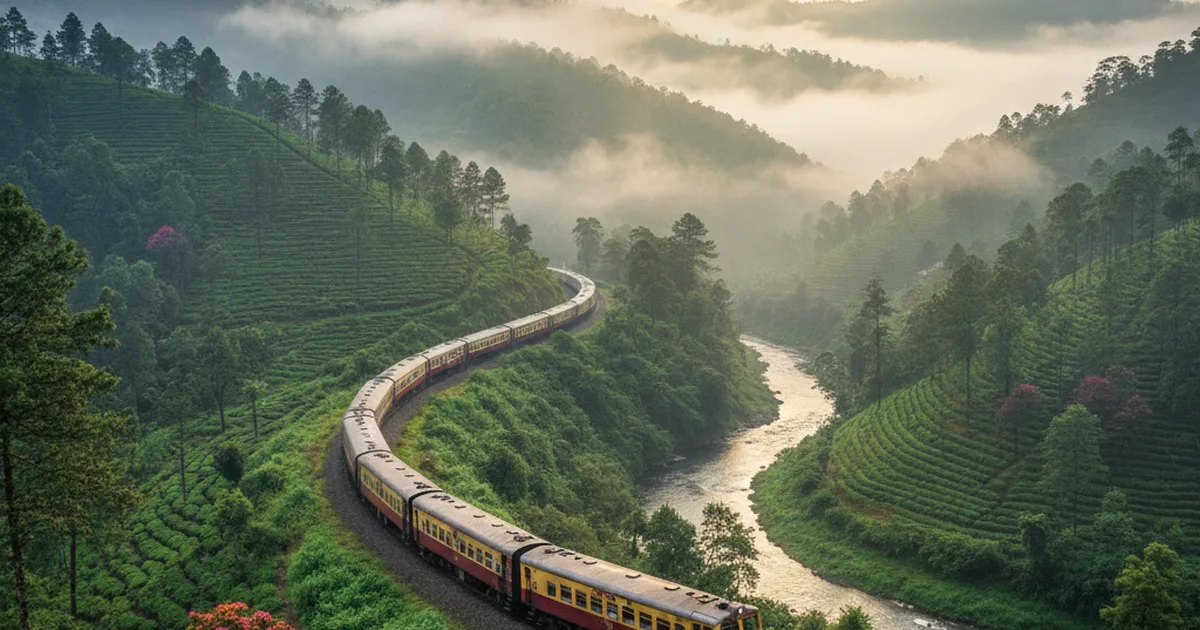

The northeastern region of India — comprising Assam, Arunachal Pradesh, Meghalaya, Manipur, Mizoram, Nagaland, Tripura, and Sikkim — has historically been connected to the rest of the country through a narrow land corridor in West Bengal, known as the “Chicken’s Neck” or Siliguri Corridor. For railways, this bottleneck made connectivity both challenging and strategic.
Over the past decade, Indian Railways — through its Northeast Frontier Railway (NFR) zone — has made massive investments to bring more of the region onto the rail map. New lines are being laid into previously inaccessible terrain, existing routes are being upgraded for faster travel, and heritage corridors are being preserved for tourism. For anyone traveling this part of India, the train is often the most comfortable, affordable, and rewarding option.
If you are already familiar with India’s scenic mountain railways, the New Jalpaiguri to Darjeeling train route gives you a brilliant starting point — it sits right at the doorstep of the Northeast and is a UNESCO World Heritage rail journey in its own right.
Key Regional Routes of Northeast India Railways
Here is a breakdown of the most important and well-traveled railway routes across the northeastern region:
| Route | Distance (approx.) | Key States Covered | Notable Feature |
|---|---|---|---|
| New Jalpaiguri → Guwahati | ~440 km | West Bengal, Assam | Gateway to Northeast |
| Guwahati → Dibrugarh | ~480 km | Assam | Brahmaputra Valley, Tea Gardens |
| Guwahati → Agartala | ~1,600 km (via Lumding) | Assam, Tripura | Barak Valley, Jungle Terrain |
| Lumding → Sabroom | ~500 km | Assam, Tripura | Dense Hill Forests, Tunnels |
| Rangiya → Murkongselek | ~450 km | Assam, Arunachal Pradesh | Foothills of Eastern Himalayas |
| Jiribam → Imphal (under construction) | ~111 km | Manipur | World’s tallest railway pier bridge |
Guwahati: The Heart of Northeast India’s Rail Network
If Northeast India’s rail network has a beating heart, it is Guwahati. The city’s two primary stations — Guwahati Railway Station and Kamakhya Junction — together handle hundreds of trains daily. Long-distance express trains from New Delhi, Mumbai, Kolkata, and Chennai all converge here before fanning out deeper into the Northeast.
Major Trains Operating Through Guwahati
- Rajdhani Express (12235/12236) — New Delhi to Dibrugarh, the flagship train of this corridor
- Saraighat Express — Howrah to Guwahati, one of the oldest and most beloved trains on this route
- North East Express — Anand Vihar to Dibrugarh, covering the full stretch of the region
- Brahmaputra Mail — A heritage overnight express connecting Kolkata to the Brahmaputra valley
- Intercity Express — Guwahati to Dibrugarh daily service for shorter hops within Assam
For those entering the Northeast from the east coast, the Howrah to Chennai train route page on Road Rail Infra offers useful context on how India’s major rail corridors interconnect — and how to plan a multi-leg journey that eventually brings you north and east.
The Guwahati to Dibrugarh Corridor: Assam’s Lifeline Route
Stretching nearly 480 kilometers along the southern bank of the Brahmaputra River, the Guwahati–Dibrugarh corridor is the most important intra-state railway in all of Northeast India. Towns like Nagaon, Lumding, Furkating, Jorhat, Mariani, and Tinsukia appear along this stretch, each one a cultural and commercial hub in its own right.
This is tea country. On either side of the tracks, you will see sprawling tea estates that supply some of the world’s finest Assam tea. Sunrise journeys along this route are particularly memorable — the early morning light settles over the estates in shades of amber and gold, while laborers move between rows of tea bushes with baskets on their backs.
Travel Tip: If you are traveling to Dibrugarh and want to experience the Brahmaputra up close, consider crossing the river by ferry from Neamati Ghat to Majuli — Asia’s largest river island — before doubling back to the railway. It adds half a day to your trip but is absolutely worth it.
Lumding–Agartala: Connecting the Deep Northeast
One of the most historically complex railway routes in the region is the Lumding–Agartala corridor. For decades, getting from Guwahati to Tripura’s capital Agartala by train meant a 1,600-kilometer detour through Bangladesh or a very long journey through Assam’s hill districts. The completion of the Jiribam-Imphal project is the modern chapter, but the Lumding–Sabroom line — threading through the dense Barak Valley — remains the working backbone of Tripura’s railway connection.
The landscape along this stretch is dramatically different from the Brahmaputra valley. You are now in hill country. Tunnels cut through forested ridges, rivers appear suddenly below iron bridges, and the track winds around sharp curves with jungle pressing in from all sides. It is rough, raw, and completely unforgettable.
The Jiribam–Imphal Rail Project: Manipur’s Big Moment
No conversation about Northeast India railways in 2026 is complete without mentioning the Jiribam–Imphal rail project. This 111-kilometer line, under construction through some of the most challenging terrain in South Asia, will finally connect Manipur’s capital Imphal to the Indian rail network for the first time.
The project includes the construction of what is expected to be the world’s tallest railway pier bridge — the Noney Bridge — soaring approximately 141 meters above the Ijai River. When complete, it will stand as a landmark of modern Indian engineering alongside celebrated structures like the Pamban Bridge and the Konkan Railway viaducts. Speaking of which, the Mumbai to Goa train via the Konkan Railway is another engineering marvel worth reading about for context on how India conquers difficult terrain with steel and ambition.
Planning Your Northeast India Train Journey: Practical Tips
Book Tickets in Advance
Trains into and through Northeast India fill up quickly, especially during the winter travel season (October–February) and festive periods. Book through IRCTC at least 30–45 days in advance, particularly for sleeper and AC classes on popular routes like the Rajdhani or Saraighat Express.
Choose the Right Class
- 3A (3-Tier AC) — Best balance of comfort and cost for long-haul overnight journeys
- Sleeper (SL) — Budget-friendly and gives you authentic local travel experience
- 1A / 2A — For those wanting premium comfort on the Rajdhani or longer routes
Best Seasons to Travel
October through April offers the most pleasant weather and clearest views. The monsoon (June–September) brings lush greenery but also the risk of landslides and flooding that can delay trains, particularly on hill sections. If you are visiting specifically for rhinos at Kaziranga or the festivals of Bihu, time your journey accordingly.
Combine Train and Road for Maximum Coverage
Rail reaches many corners of the Northeast, but not all. Many of the most beautiful spots — Ziro Valley, Dzukou Valley, Loktak Lake — require a road leg after the train. If you are comfortable with long drives through mountain roads, pairing your rail journey with a road trip makes for the ultimate Northeast exploration. Much like the principles covered in the Delhi–Mumbai Expressway road trip guide, planning ahead for rest stops and road conditions is key.
Northeast Frontier Railway: The Zone That Runs It All
All rail operations across the northeastern states fall under the Northeast Frontier Railway (NFR) zone, headquartered in Maligaon, Guwahati. NFR is one of Indian Railways’ most geographically challenging and strategically important zones, covering over 3,800 route kilometers across some of the most rugged terrain in the country.
NFR has been at the forefront of using modern engineering solutions — from high-altitude bridges to earthquake-resistant track laying techniques — to bring rail connectivity to previously isolated areas. For travelers, the zone’s ongoing expansion means that every year, new destinations become accessible by train that were once only reachable by road or air.
If you enjoy reading about railway systems and how they evolve, a future deep-dive into the Northeast Frontier Railway’s infrastructure projects would make for fascinating reading — a topic Road Rail Infra is well-positioned to cover in an upcoming post.
Scenic Highlights Along Northeast India’s Rail Routes
Train travel through Northeast India delivers a level of natural beauty that is hard to match anywhere in the country. Here are some of the standout visual experiences along the region’s key routes:
- Brahmaputra River crossings — The Saraighat Bridge near Guwahati gives you a sweeping view of India’s mightiest river from the train window
- Tea estate panoramas — Between Lumding and Dibrugarh, endless rows of manicured tea bushes stretch to the horizon
- Kaziranga National Park proximity — Trains passing through Furkating run along the edge of the park; elephant sightings from the tracks are not unheard of
- Barak Valley gorges — Deep ravines and forest-covered slopes define the landscape on the Lumding–Sabroom section
- Himalayan foothills near Rangiya — On clear days, distant snow-capped peaks appear on the northern horizon as the train heads toward Arunachal Pradesh
For those who have already experienced India’s most celebrated scenic train journeys — like the Delhi to Shimla railway trip or the Kalka to Shimla train route — the Northeast offers an entirely different flavor: wilder, less touristed, and deeply immersive.
What the Future Holds for Northeast India Railways
The next five years promise transformative changes for rail connectivity across the Northeast. With the Jiribam–Imphal line nearing completion, work underway on lines connecting Aizawl (Mizoram), Itanagar (Arunachal Pradesh), and improved connectivity in Meghalaya, the region is on the cusp of a rail renaissance.
High-speed corridor feasibility studies, electrification of existing routes, and increased Vande Bharat Express services are all being planned for the region. A dedicated guide to upcoming Northeast India railway projects and infrastructure expansion is something travelers and infrastructure watchers alike will want to keep an eye out for on Road Rail Infra.
The story of Northeast India’s railways is ultimately a story about connection — linking remote communities to economic opportunity, bringing the region’s extraordinary natural beauty within reach of more visitors, and stitching together a diverse mosaic of cultures through shared tracks. Every train that crosses the Brahmaputra or disappears into a hillside tunnel is a small act of national integration, one kilometer at a time.
Frequently Asked Questions About Northeast India Railways
Which is the most important railway junction in Northeast India?
Guwahati (Kamakhya / Guwahati station) in Assam is the most important railway junction in Northeast India. It serves as the gateway to the entire region and connects to major cities like New Delhi, Kolkata, Mumbai, and Chennai via multiple express and superfast trains.
Which train connects New Jalpaiguri to the Northeast?
New Jalpaiguri (NJP) is a major railhead connecting West Bengal to Northeast India. Several trains like the North East Express and Brahmaputra Mail originate or pass through NJP, linking it to Guwahati, Dibrugarh, and other northeastern cities.
Is there a direct train from Kolkata to Guwahati?
Yes, multiple trains run between Kolkata (Howrah) and Guwahati, including the Saraighat Express, Kamrup Express, and the North East Express. Journey time is approximately 17–22 hours depending on the train.
Which states in Northeast India are connected by rail?
As of 2026, Assam, Tripura, Meghalaya (limited), Arunachal Pradesh (limited), and Manipur (under expansion) have rail connectivity. Nagaland, Mizoram, and Sikkim are either being connected or have very limited rail access. The Indian government is actively expanding the rail network across all eight northeastern states.
What is the most scenic train journey in Northeast India?
The Lumding–Sabroom line through the Barak Valley and the stretch from New Jalpaiguri to Dibrugarh passing through the Brahmaputra floodplains are considered among the most scenic train routes in Northeast India. The New Jalpaiguri to Darjeeling toy train journey nearby also offers breathtaking Himalayan vistas.
How far is Dibrugarh from Guwahati by train?
Dibrugarh is approximately 480 km from Guwahati by rail. Express trains like the Rajdhani Express and Intercity Express cover this distance in around 7–9 hours, passing through picturesque towns along the Brahmaputra valley.
What is the best time to travel to Northeast India by train?
October to April is generally the best time to travel to Northeast India by train. The weather is pleasant, visibility is high, and the scenic landscape looks its best. Avoid the monsoon months (June–September) as flooding can sometimes cause train delays.
Frequently Asked Questions
Which states does Northeast India railways connect?
Indian Railways serves all 8 Northeastern states: Assam, Meghalaya, Tripura, Manipur, Mizoram, Nagaland, Arunachal Pradesh, and Sikkim. However, connectivity to some states like Arunachal and Sikkim remains limited with few operational stations.
When did trains reach Mizoram?
Trains reached Aizawl (Mizoram’s capital area) via the Bairabi-Sairang new line in 2022. The Northeast Frontier Railway has been rapidly expanding connectivity in all NE states since 2018.
Which is the most scenic train route in Northeast India?
The Lumding-Sabroom route through the Barak Valley and the Lumding-Dimapur hill section are considered among the most scenic. The upcoming Jiribam-Imphal line in Manipur will be another spectacular mountain railway.
What is the Northeast Frontier Railway zone?
NFR (Northeast Frontier Railway) is one of Indian Railways’ 18 zones, headquartered in Maligaon, Guwahati. It oversees rail operations across all 8 northeastern states and parts of West Bengal.
Is there a train to Arunachal Pradesh?
Yes. Naharlagun station near Itanagar (Arunachal Pradesh’s capital) is connected by rail. Trains from Guwahati reach Naharlagun in about 5-6 hours. Expansion of the rail network within Arunachal is ongoing.
What is the Jiribam-Imphal rail project?
The Jiribam-Imphal rail project is a 111 km line connecting Manipur’s capital Imphal to the existing rail network. It includes India’s tallest rail bridge pier (141 m) and multiple tunnels through the Manipur hills.
How do I book train tickets for Northeast India travel?
Book via IRCTC at irctc.co.in. Most NE routes have trains from Guwahati (Kamakhya or Guwahati station) as the main hub. Allow extra time during monsoon (June-September) when delays are common.
Comments (7) on "Northeast India Railways: Regional Routes, Scenic Journeys & Travel Guide (2026)"
Comments are closed.