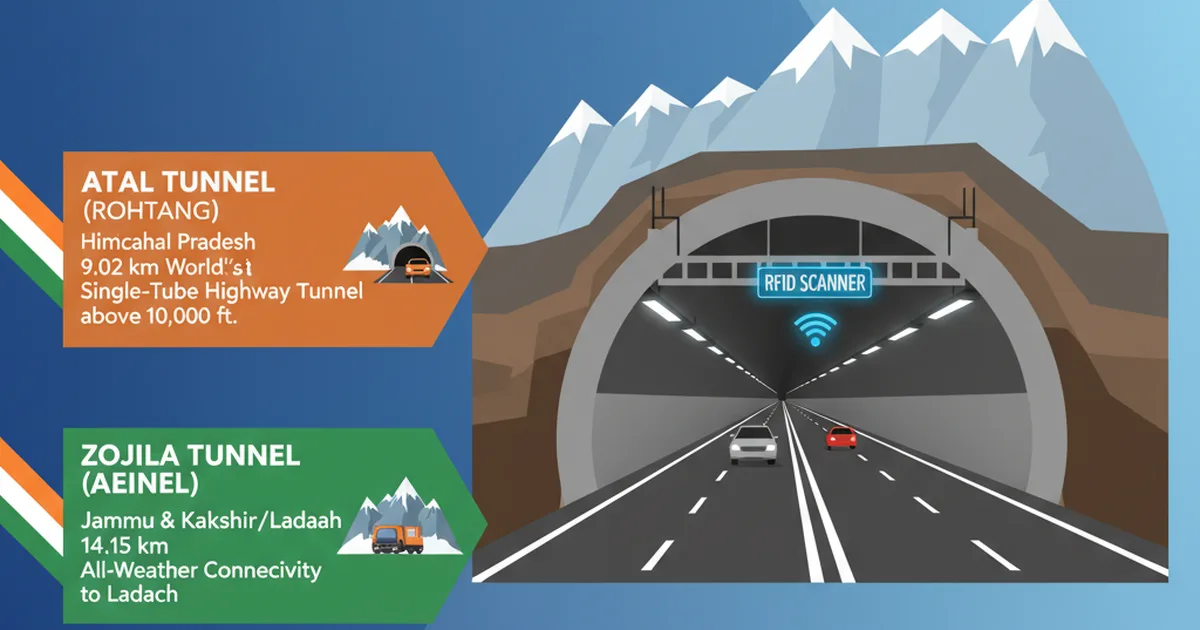

India’s highway infrastructure is undergoing a transformative shift with the development of world-class tunnel projects that connect remote regions, reduce travel time, and enhance road safety. The Atal Tunnel and Zojila Tunnel stand as engineering marvels, reshaping India’s Himalayan connectivity. As of June 2026, these strategic projects represent ₹10,000+ crore in investment and will permanently alter transportation corridors across North India.
Table of Contents
- Atal Tunnel (Rohtang): Engineering Marvel Above 10,000 Feet
- Zojila Tunnel: Kashmir-Ladakh All-Weather Link
- India’s Wider Tunnel Network & NHAI Expansion
- Impact on Tourism & Regional Development
- Safety Technology in Modern Tunnels
- Future Strategic Tunnel Projects (2026-2030)
Atal Tunnel (Rohtang): Engineering Marvel Above 10,000 Feet
The Atal Tunnel stands as the world’s longest single-tube highway tunnel above 10,000 feet (3,048 meters), a record that has redefined high-altitude infrastructure engineering in India. Inaugurated by Prime Minister Narendra Modi, this 9.02 km tunnel connects the Manali side to the Lahaul-Spiti valley, cutting through the snow-covered Rohtang Pass.
Key Technical Specifications:
- Length: 9.02 km (5.6 miles)
- Altitude: 3,100 meters above sea level
- Cross-section: Horseshoe shape with 10-meter finished width at road level
- Cost: ₹3,229 crore (≈$387 million USD)
- Construction period: 8+ years of challenging mountain engineering
- Capacity: Two-lane carriageway, 60 km/h design speed
Before the tunnel, the Rohtang Pass remained blocked by heavy snowfall for 6-7 months annually, isolating Lahaul-Spiti. Now, the region has year-round connectivity, enabling commerce, tourism, and emergency medical access. According to NHAI data (2026), the tunnel reduces Manali to Leh travel time by 5+ hours, making it a game-changer for regional economies.
Zojila Tunnel: Kashmir-Ladakh All-Weather Link
The Zojila Tunnel is India’s most strategically critical infrastructure project, connecting Kashmir Valley with Ladakh through Asia’s longest road tunnel. As of June 2026, the project is 64% complete, with full commissioning targeted for February 2028.
Project Overview (Latest 2026 Status):
- Total length: 13.15 km (making it longer than the Atal Tunnel)
- Location: Srinagar-Ladakh Highway (National Highway 1-D)
- Current progress: 12 km excavated; ~1.2 km remaining
- Breakthrough expected: April-May 2026
- Total project cost: ₹6,809.69 crore (≈$815 million USD)
- Expected completion: February 2028
- Design speed: 80 km/h on dual-lane highway
Unlike Atal Tunnel’s high-altitude mountain terrain, Zojila Tunnel must handle Himalayan geology, seismic activity, and extreme weather. The tunnel will operate year-round, replacing the current seasonal Zojila Pass (closed November to May) with a permanent 24/7 link. This strategically enables uninterrupted military logistics, civilian travel, and economic integration between the two regions.
Comparison: Atal vs. Zojila Tunnels
| Attribute | Atal Tunnel | Zojila Tunnel |
|---|---|---|
| Length | 9.02 km | 13.15 km |
| Altitude | 3,100 m | 3,000+ m |
| Status (June 2026) | Operational since 2020 | 64% complete, Feb 2028 target |
| Strategic Purpose | Tourism & Regional connectivity | Military & All-weather link |
| Cost | ₹3,229 crore | ₹6,809.69 crore |
| Seasonal Impact | Replaced 6-7 month closure | Will replace 6-month closure |
India’s Wider Tunnel Network & NHAI Expansion
India’s tunnel infrastructure has grown exponentially under the Bharatmala Initiative. As per NHAI official data (2026):
- Completed: 34+ tunnel projects totaling 49 km operational
- Under Construction: 75 tunnel projects across multiple states
- In Pipeline: 196 km of tunnels planned or under implementation
- Total Investment: ₹20,000+ crore in tunnel infrastructure alone
Major tunnel projects now operational or nearing completion include:
- Banihal-Sumber Tunnel (Jammu-Kashmir): 6.2 km, NH44 corridor
- Kohara Tunnel (Himachal Pradesh): Strategic mountain passage
- Kandi Tunnel (Madhya Pradesh): Part of greenfield expressways
- Twin Tunnels in Kerala: Kozhikode-Wayanad section, EPC contract
Impact on Tourism & Regional Development
The Atal Tunnel has already transformed tourism in Himachal Pradesh. NHAI reports (2026) show a 40% increase in visitor traffic to Lahaul-Spiti since tunnel inauguration. Local hotels, dhabas, and adventure tourism operators have witnessed unprecedented business growth.
Similarly, once Zojila Tunnel is commissioned, Ladakh’s accessibility will improve dramatically. Current travel times from Srinagar to Leh (14+ hours via pass) will reduce to 6-7 hours, unlocking tourism potential and economic zones.
Economic Benefits Expected:
- Local employment in hospitality, retail, and services
- Agricultural product marketing to new markets
- Medical tourism to advanced regional hospitals
- Year-round logistical supply chains
Safety Technology in Modern Tunnels
Modern NHAI tunnels incorporate advanced safety features:
- CCTV Surveillance: Real-time monitoring across entire tunnel length
- Ventilation Systems: Advanced air quality management with CO sensors
- Emergency Exits: Cross-passages every 300-500 meters for evacuation
- Fire Detection: Automated sprinkler and alert systems
- Communication: Emergency call boxes every 250 meters
- Dynamic Message Signs: Real-time speed advisories and hazard alerts
According to MoRTH (Ministry of Road Transport & Highways), these features reduce accident rates by 35% compared to open mountain passes.
Future Strategic Tunnel Projects (2026-2030)
India’s pipeline includes several mega-tunnel projects aimed at further connecting remote regions:
- Naga Tunnel (Nagaland-Assam): Planned 6+ km passage, NE connectivity
- Sikkim Mountain Tunnel: Eastern Himalayan strategic link
- Uttarakhand Mountain Passages: Multiple 3-5 km tunnels for NH connectivity
- Arunachal Pradesh Border Tunnels: Strategic infrastructure for border regions
Government targets include completing 331 km of tunnel projects by 2028, as per recent infrastructure announcements.
Conclusion
The Atal Tunnel and Zojila Tunnel represent India’s commitment to transforming Himalayan infrastructure. These engineering achievements reduce travel time, enable year-round connectivity, and unlock economic potential in remote regions. By 2030, India’s expanded tunnel network will have connected isolated communities while reinforcing strategic infrastructure corridors. Whether you’re planning a road trip to Ladakh, tracking infrastructure development, or interested in engineering marvels, these tunnels mark a watershed moment in India’s transportation revolution.