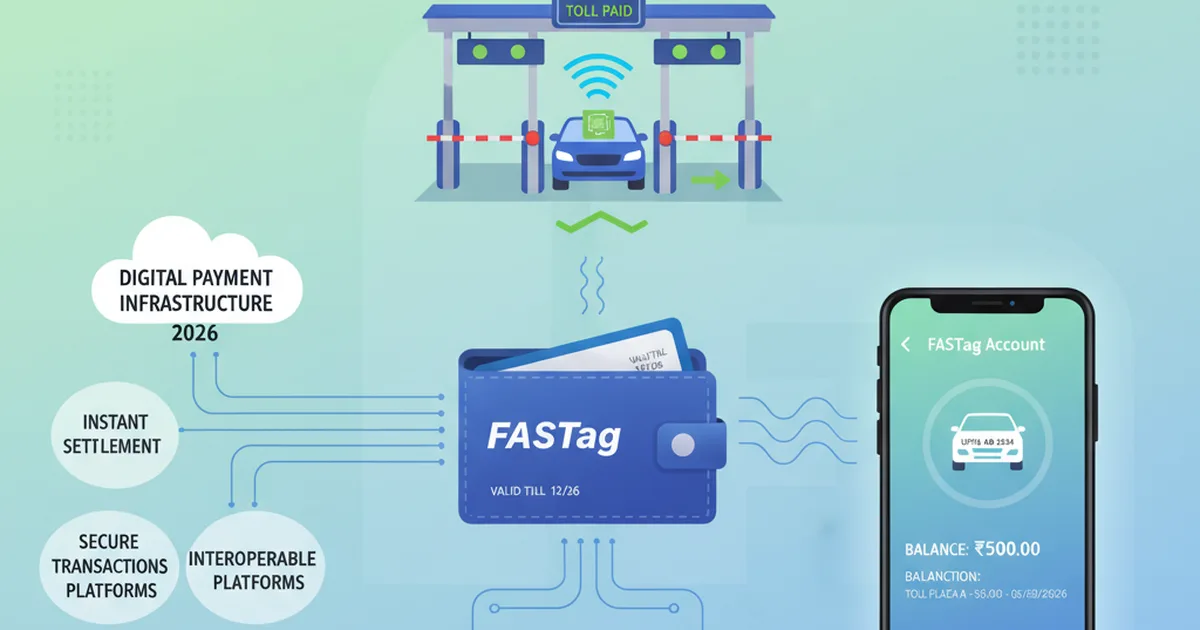

From April 1, 2026, all Indian national highway toll plazas have gone 100% digital. No cash is accepted anymore — only FASTag RFID cards and UPI payments are valid. Understanding FASTag recharge methods, troubleshooting common issues, and optimizing toll savings is now essential for every road traveler. This comprehensive 2026 guide covers everything you need to know to navigate India’s digital toll ecosystem smoothly.
Table of Contents
- What is FASTag? Understanding RFID Toll Technology
- 24+ Banks Offering FASTag in India
- 7 Ways to Recharge Your FASTag in 2026
- Setting Up Auto-Recharge (UPI AutoPay)
- Troubleshooting: FASTag Not Working at Toll Plaza
- FASTag vs. UPI: Which Toll Payment Method is Better?
What is FASTag? Understanding RFID Toll Technology
FASTag is an electronic toll collection (ETC) system operated by NPCI (National Payments Corporation of India) in partnership with NHAI (National Highways Authority of India). It uses RFID (Radio Frequency Identification) technology embedded in a small plastic tag affixed to your vehicle’s windshield.
How FASTag Works:
- The RFID tag contains a unique identifier linked to your bank account or prepaid wallet
- At the toll plaza, an RFID reader detects your tag (no need to stop)
- Your toll amount is automatically deducted from your account
- You receive a digital receipt via SMS or your bank’s app
FASTag was introduced in 2016, but it became mandatory for all vehicles in December 2019. As of June 2026, over 2.5 crore (25 million) FASTag tags are active across India’s toll network.
Key Benefits:
- No queuing at toll plazas — reduces travel time by 30-40%
- Automatic deductions — no manual payment hassle
- Digital receipts and expense tracking
- Toll discounts for regular travelers (up to 10% on some corridors)
- 24/7 toll payments — works round the clock
24+ Banks Offering FASTag in India (Updated 2026)
FASTag is issued by 24+ NPCI-empanelled banks and payment service providers. Here’s the complete list:
| Bank/Provider | Issuance Channel | Recharge Options |
|---|---|---|
| State Bank of India (SBI) | Online, Branch, ATM | UPI, Net Banking, Mobile App |
| HDFC Bank | Online, Branch, Partner Outlets | UPI, Credit/Debit Card, App |
| ICICI Bank | Online, Branch | Net Banking, Mobile App, UPI |
| Axis Bank | Online, Branch, Kiosk | UPI, Net Banking, Card |
| Kotak Mahindra Bank | Online, Branch | Net Banking, Mobile App, UPI |
| IDFC FIRST Bank | Online, Partner Outlets | UPI, Online, Mobile App |
| Bank of Baroda (BoB) | Online, Branch | Net Banking, UPI, App |
| Canara Bank | Online, Branch | Net Banking, UPI, Mobile App |
| YES Bank | Online, Branch | Net Banking, UPI, App |
| Federal Bank | Online, Branch, ATM | UPI Virtual ID, Net Banking |
| IndusInd Bank | Online, Branch | Net Banking, UPI, App |
| Other Issuers | Online, Kiosks | Multiple options |
Note: Most banks offer FASTag free of charge if you have an active savings or current account with them. Third-party FASTag issuers like IHMCL charge ₹100-200 for tag issuance.
7 Ways to Recharge Your FASTag in 2026
1. UPI Payment (Fastest Method)
UPI is now the fastest way to recharge FASTag. NPCI provides a unique UPI Virtual ID for each FASTag account.
Steps:
- Open any UPI app (Google Pay, PhonePe, Paytm, WhatsApp Pay, etc.)
- Select “Send Money”
- Enter your FASTag UPI Virtual ID (format: netc.VEHICLE_NUMBER@fbl for Federal Bank users, or bank-specific)
- Enter recharge amount (₹500-₹10,000 recommended)
- Confirm and pay — amount credited instantly
This method is instant and requires no login to bank portals.
2. Net Banking (Most Common)
Log into your bank’s internet banking portal and recharge directly.
Steps:
- Visit your bank’s website and log in with credentials
- Search for “FASTag Recharge” or “Toll Payment”
- Enter vehicle number and amount
- Confirm OTP and pay
- Receive SMS confirmation instantly
3. Mobile Banking App
Most banks now offer dedicated FASTag recharge options in their mobile apps.
Major apps: SBI YONO, HDFC Bank Mobile App, ICICI Bank iMobile, Axis Bank app, Kotak Mobile
4. NPCI FASTag Portal (www.npci-fastag.com)
Recharge directly through the official NPCI FASTag portal without needing to log into your bank.
Process:
- Visit npci-fastag.com
- Enter your FASTag tag number
- Choose amount and payment method
- Complete payment via debit card or net banking
5. Bank ATMs (Limited Availability)
Some banks like SBI and Federal Bank allow FASTag recharge at ATM machines (primarily for their account holders).
6. Payment Apps (Paytm, PhonePe, Google Pay)
Third-party payment apps have integrated FASTag recharge as a service.
Steps:
- Open the payment app
- Search “FASTag” or “Toll Recharge”
- Enter tag details and amount
- Proceed with payment
- Confirmation via SMS
7. IHMCL (Indian Highway Management Co. Limited) Toll Booths
Recharge at authorized IHMCL toll booth kiosks across major highways. This is useful if you’re traveling and suddenly need to top up.
Recharge Amount Recommendation
| Usage Pattern | Recommended Recharge | Monthly Cost (Approx) |
|---|---|---|
| Occasional (2-4 toll trips/month) | ₹500-1,000 | ₹400-800 |
| Regular (10-15 toll trips/month) | ₹2,000-3,000 | ₹1,500-2,500 |
| Frequent (Daily commute) | ₹5,000-10,000 | ₹3,000-7,000 |
Setting Up Auto-Recharge (UPI AutoPay)
The smartest way to manage FASTag is setting up automatic recharge via UPI AutoPay. NPCI introduced this feature in 2024, and it’s now widely available.
How to Enable UPI AutoPay:
- Open your UPI app (Google Pay, PhonePe, etc.)
- Go to “Manage Mandates” or “Subscriptions”
- Select “Add New Mandate”
- Enter your FASTag UPI Virtual ID
- Set recharge amount (₹500 or more recommended)
- Set trigger: “Recharge when balance falls below ₹100” (customizable)
- Authorize the mandate with OTP
Once enabled, your FASTag account automatically recharges whenever balance drops below your set threshold. This ensures you never face a low-balance situation at toll plazas.
Troubleshooting: FASTag Not Working at Toll Plaza
According to NHAI data (June 2026), FASTag failure rate is only 2-3%, but here are the most common issues and fixes:
Issue 1: Tag Not Detected (Red Light at Toll Gate)
Causes: Improper windshield placement, accumulated dirt on tag, expired tag
Solutions:
- Ensure tag is placed on the windshield’s right side, clearly visible
- Clean the RFID tag regularly with a soft, dry cloth (avoid harsh soaps)
- Avoid applying window tint or metallic coatings over the tag
- Check tag expiry date — tags are valid for 5 years
Issue 2: Insufficient Balance
Solution: Recharge immediately via any method listed above. At some plazas, toll operators may temporarily allow manual payment if your balance is negative, but you’ll be charged a penalty of ₹100-200.
Issue 3: Account Blacklisted or Suspended
Causes: Multiple toll evasions, unpaid toll dues exceeding ₹5,000
Solution: Contact your issuing bank immediately. Pay pending toll dues + penalty. Banks typically resolve blacklisting within 24 hours.
Issue 4: Technical Glitch (Tag Appears Faulty)
Steps to Resolve:
- Request a replacement tag from your bank (usually free)
- If on highway, toll operators can issue temporary receipt — settle later
- Report to NHAI complaint center: 1860-889-9999
Issue 5: Duplicate Deduction (Charged Twice)
What to Do:
- Collect your toll receipt (SMS or printed)
- Contact your issuing bank within 7 days
- Provide details: date, toll plaza, deduction amount
- Banks typically issue refund within 3-5 business days
According to NHAI, duplicate deductions account for <1% of all transactions and are almost always refunded.
FASTag vs. UPI: Which Toll Payment Method is Better?
As of April 2026, toll plazas accept both FASTag RFID and UPI payments. Here’s a comparison:
| Feature | FASTag | UPI Payment |
|---|---|---|
| Setup Time | 2-3 days (after account opening) | Instant (if you have UPI app) |
| Processing Speed | 2-3 seconds (RFID read) | 10-15 seconds (QR scan + payment) |
| Cost | Free (after issuance) | Free |
| Toll Discounts | Up to 10% on some routes | No discounts currently |
| Convenience | No need to carry phone or wallet | Requires smartphone + internet |
| Vehicle Linking | Permanent (one tag per vehicle) | Flexible (can use any vehicle) |
| Best For | Frequent travelers, daily commuters | Occasional travelers, rental vehicles |
Recommendation: If you travel highways regularly, FASTag is superior due to discounts and speed. For occasional travel, UPI is more flexible since you don’t need to maintain a separate account.
Conclusion
FASTag and UPI-based toll payments have made India’s highway system significantly more efficient. With 24+ banks offering FASTag and 7+ recharge methods available, keeping your account topped up is hassle-free. Set up UPI AutoPay for maximum convenience, troubleshoot issues using the guide above, and enjoy seamless toll-free travels on India’s national highways. Whether you’re a daily commuter or occasional traveler, digital toll payments are now the standard across all 800+ toll plazas nationwide.