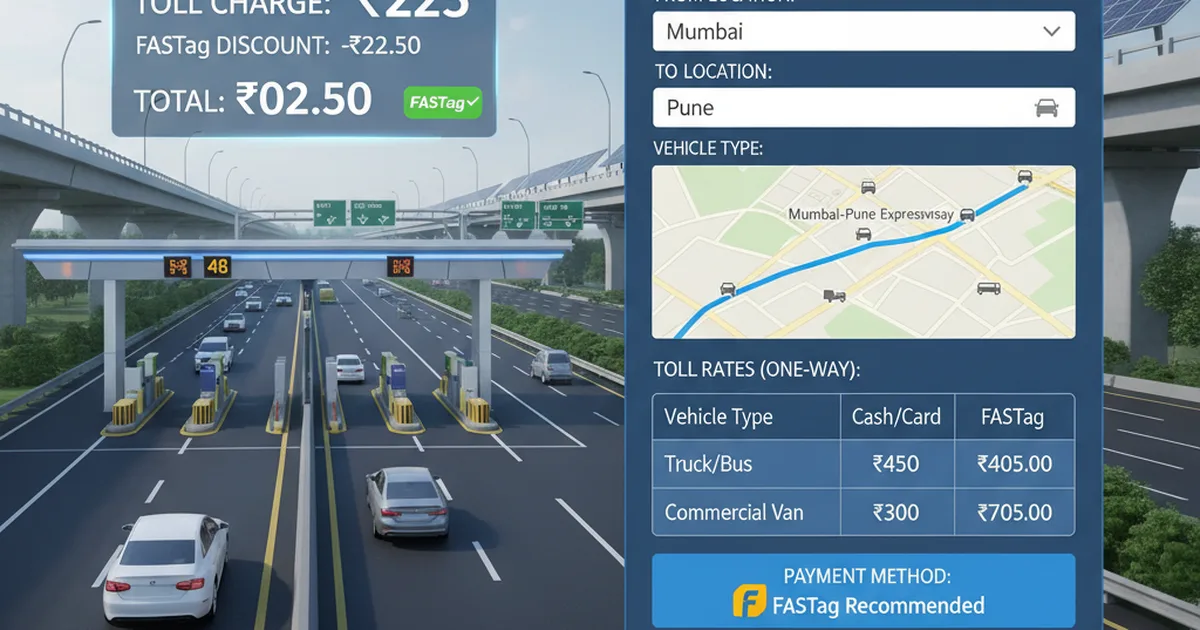

Calculating expressway toll charges in India can be confusing — toll rates vary by vehicle type, expressway corridor, and payment method (FASTag vs. cash). In 2026, with FASTag becoming mandatory and rates updated annually, knowing how to estimate your toll costs before your trip is essential. This guide walks you through the toll calculation process, provides real rates for major expressways, and shows you how to use online toll calculators to plan your budget.
How Toll Charges Are Calculated in India
Indian expressway tolls are calculated based on three main factors: vehicle classification, distance traveled, and payment method. NHAI (National Highways Authority of India) classifies vehicles into seven categories — 2-wheelers, 3-wheelers, cars/jeeps, light commercial vehicles (LCV), medium commercial vehicles, heavy commercial vehicles, and multi-axle vehicles. Each category has a different per-km toll rate.
The toll charged is calculated as: Rate per km × Distance traveled × Vehicle class multiplier. For example, a car traveling 100 km on the Delhi–Mumbai Expressway at ₹2.25 per km would pay approximately ₹225 (plus entry/exit plaza charges). From April 1, 2026, NHAI implemented a 5% toll increase across major corridors, so rates are 5% higher than 2025 levels.
FASTag vs. Cash Payment — Rate Differences
FASTag (Fast Automatic Scanning Tag) offers a 10–15% discount on toll charges compared to cash payments. As of April 2026, toll plazas no longer accept cash on most national highways — FASTag is now mandatory. A car paying with FASTag on a ₹100 toll plaza might pay ₹85–₹90, while cash-paying vehicles (on remaining legacy routes) pay full price. FASTag annual renewal for 2026–27 costs ₹3,075, up from ₹3,000 in 2025.
👉 Also read: FASTag guide 2026 — recharge and troubleshoot
Toll Rates by Vehicle Type — Major Expressways 2026
Toll rates are standardized across NHAI expressways but may vary slightly by section or expressway. Below is a breakdown of typical rates for major expressways in 2026, with FASTag applied.
| Vehicle Type | Rate per Km (FASTag) | 100 km Toll (Approx) | 200 km Toll (Approx) |
|---|---|---|---|
| Car / Jeep | ₹2.00–₹2.50 | ₹200–₹250 | ₹400–₹500 |
| Light Commercial Vehicle (LCV) | ₹3.50–₹4.50 | ₹350–₹450 | ₹700–₹900 |
| Medium Commercial Vehicle (MCV) | ₹5.50–₹7.00 | ₹550–₹700 | ₹1,100–₹1,400 |
| Heavy Truck (HCV) | ₹8.00–₹10.00 | ₹800–₹1,000 | ₹1,600–₹2,000 |
| Motorcycle / Scooter | ₹1.00–₹1.25 | ₹100–₹125 | ₹200–₹250 |
Note: Rates are approximate and vary by expressway corridor and section. Delhi–Mumbai Expressway rates are higher (₹2.20–₹2.50 per km) due to PPP funding. Rates updated April 1, 2026.
👉 Also read: NHAI national highway expansion 2026
Step-by-Step: How to Use Online Toll Calculators
Several free online tools help calculate your expressway toll instantly. The most popular are TollGuru, ApnaCalculator, and Google Maps (with toll visualization). Here’s how to use them:
Method 1: TollGuru Toll Calculator
Visit tollguru.com/toll-calculator-india. Enter your origin city and destination city, select your vehicle type, choose “FASTag” as payment method, and the tool instantly shows total toll costs, fuel consumption estimates, and trip duration. TollGuru also breaks down tolls by each toll plaza so you see exactly where you’re paying. It supports all major expressways including Delhi–Mumbai, Yamuna, Purvanchal, and Amritsar–Jamnagar.
Method 2: Google Maps Toll Feature
Open Google Maps, enter your route, tap “Directions,” and look for a “View toll” option. Google Maps shows total toll cost and breaks it down by expressway section. However, Google Maps doesn’t account for FASTag discounts — the toll shown is for cash payment, so subtract 10–15% for FASTag. This method is convenient for quick estimates during navigation.
Method 3: NHAI Official Toll Portal
Visit the NHAI toll information database at nhai.gov.in and search for individual toll plazas. While less convenient than automated calculators, NHAI’s official data is the most accurate. You can also download the “NHAI FASTag” app, which allows you to view toll history and calculate future tolls based on your registered vehicle.
👉 Also read: highway safety tips for long drives
Toll Rates for Popular Expressway Corridors
Delhi–Mumbai Expressway (1,386 km)
The Delhi–Mumbai Expressway has the highest toll rates due to PPP (Public-Private Partnership) funding. A car driving the full 1,386 km from Delhi to Vapi (just before Mumbai) pays approximately ₹3,000–₹3,500 in FASTag tolls. The rate is ₹2.20–₹2.50 per km depending on the section (Jaipur–Udaipur-Vadodara stretch is higher). Entry at Kherli toll plaza (Delhi side) and exits at Bhilwara, Udaipur, Fatehpur, and Vapi are major toll points.
Purvanchal Expressway (340.8 km)
Running from Lucknow to Ghazipur, the Purvanchal Expressway charges ₹1.50–₹1.80 per km for cars. A full 340 km journey costs approximately ₹500–₹550 in tolls with FASTag. The expressway has toll plazas at Chand Sarai, Azamgarh, and Ballia. Since it was inaugurated in 2021, it carries heavy freight traffic and is well-maintained.
Yamuna Expressway (165.64 km)
Connecting Noida to Agra, the Yamuna Expressway charges ₹1.80–₹2.10 per km. The toll structure is divided into three sections (Noida to Jewar, Jewar to Mathura, Mathura to Agra), each with its own toll plaza. A full Noida–Agra journey costs approximately ₹280–₹320 for a car. This is one of India’s first PPP expressways and remains the shortest route to Agra from Delhi/NCR.
Amritsar–Jamnagar Economic Corridor (phases)
Multiple phases of this 1,300+ km corridor are under construction or recently completed (as of 2026). Initial sections charge ₹1.50–₹2.00 per km for cars. Once fully operational, the entire corridor toll for a car could exceed ₹2,000. Currently, rates are still being finalized for new sections.
How to Reduce Expressway Toll Costs
1. Use FASTag and Get the Discount
FASTag now provides a mandatory 10–15% discount on all NHAI expressways and is the fastest way to pass toll plazas. FASTag can be obtained from ICICI Bank, Axis Bank, HDFC Bank, or HDFC. Activation takes 5 minutes online, and the tag arrives within 3–5 days. Cost: ₹100–₹300 for the tag plus ₹3,075 annual fee (renewals are automatic if auto-debit is set up).
2. Plan Routes to Minimize Toll Sections
In some cases, taking state highways or older national highways can reduce toll costs, though travel time increases. For example, Delhi to Agra via state highways (5–6 hours) avoids the Yamuna Expressway toll (₹280–₹320) but takes 3 hours longer. Evaluate trade-offs: is saving ₹300 worth 3 extra hours of driving?
3. Check for Toll Exemptions
Certain vehicles are exempted from tolls: ambulances, military convoys, national disaster relief vehicles, and government vehicles. If you qualify, carry relevant documentation. Additionally, electric vehicles (EVs) get a 50% toll discount on selected NHAI stretches with tunnels, bridges, and flyovers as per government policy (effective 2026).
4. Use Monthly or Annual Toll Passes
For frequent commuters, NHAI offers monthly and annual passes. A monthly pass covering unlimited crossings on a single expressway costs ₹1,500–₹2,500 depending on the corridor. Annual passes are available at ₹3,075 (already mentioned for FASTag). These break even if you cross toll plazas more than 10 times per month.
Common Toll Calculation Mistakes to Avoid
Many travelers get surprised by toll charges due to miscalculation. Here are common mistakes: 1) Forgetting FASTag discount — toll calculators often show cash rates; apply 10–15% discount manually. 2) Ignoring entry/exit Plaza multiplier — toll plazas at entries and exits may charge differently. 3) Not accounting for return journey — round-trip tolls are double, unless you use a toll pass. 4) Assuming outdated rates — toll rates increase 5% annually (usually April 1); always check current rates.
FAQs: Expressway Toll Calculators & Charges
Below are detailed answers to frequently asked questions about calculating and paying expressway tolls in India, helping you better plan your road trips and budget.
What is the Average Toll Cost for a 500 km Expressway Journey by Car in 2026?
For 500 km, assuming an average FASTag rate of ₹2.00 per km across most expressways, a car pays approximately ₹1,000. However, this varies significantly by corridor: the Delhi–Mumbai Expressway (higher PPP rates) would cost ₹1,100–₹1,250; the Purvanchal Expressway (government-funded, lower rates) would cost ₹750–₹850. Always use a toll calculator for your specific route to get accurate estimates. Budget ₹1,000–₹1,250 as a general rule for 500 km.
Do Buses and Commercial Vehicles Pay Different Toll Rates Than Cars?
Yes, significantly. Buses (13+ seating capacity) are classified as a separate vehicle category and typically pay 30–40% more than cars. A bus on a ₹100 toll plaza pays ₹130–₹140. Commercial vehicles (LCV, MCV, HCV) pay 75–400% more depending on axle count and GVW (Gross Vehicle Weight). This is why inter-city bus operators add toll surcharges to ticket prices, and trucking companies factor toll costs into freight rates. Heavy commercial vehicles (10+ axles) can pay ₹1,500–₹2,500 on a single major toll plaza.
What Happens If I Lose My FASTag? Can I Still Pay Tolls?
Contact your FASTag issuing bank (ICICI, Axis, HDFC, etc.) immediately to deactivate the lost tag. They’ll issue a replacement within 1–2 days for a ₹100–₹300 replacement fee. Until replacement arrives, you have two options: (1) Pay tolls manually at full cash rate (10–15% higher) using your vehicle registration number, which toll plazas log in their system; (2) If you have auto-debit enabled with your bank, tolls will still be charged automatically using your saved vehicle details. Manual toll payment at full rate is temporary — you won’t be charged the FASTag discount until the replacement tag is activated.
Are Expressway Toll Rates Different During Night Hours or Weekends?
No, NHAI toll rates are uniform 24/7 across all days — nights, weekends, and holidays are charged at the same rate as peak hours. Some state-level toll plazas on older highways may offer off-peak discounts (rare), but expressways under NHAI jurisdiction do not. This standardized pricing makes budgeting predictable regardless of when you travel.
Can I Dispute a Toll Charge if It Seems Overcharged?
Absolutely. If your FASTag shows an unexpected or duplicate debit, contact your issuing bank immediately with your transaction receipt. The bank will investigate using toll plaza lane camera footage and toll transaction records. If you were indeed overcharged (duplicate toll, wrong vehicle category applied, etc.), the amount is refunded within 7–10 days to your bank account. Always keep FASTag transaction receipts for disputes — they contain lane number, time, amount, and vehicle details.
Why Are Toll Rates Higher on Some Expressways Than Others?
Toll rates depend on expressway funding model: PPP (Public-Private Partnership) expressways like Delhi–Mumbai charge higher tolls (₹2.20–₹2.50 per km) to recoup private investment and operating costs over 20–30 year concession periods. Government-funded expressways (built by NHAI with government budgets) charge lower rates (₹1.50–₹1.80 per km). Older expressways (15+ years) also charge less because initial capital investment has been recovered. The newest sections are always most expensive.
Do Electric Vehicles (EVs) Get Toll Discounts on Expressways?
Yes, as of 2026, electric vehicles get a 50% toll discount on selected NHAI expressway stretches that feature tunnels, bridges, flyovers, or elevated sections. This green vehicle incentive is part of India’s EV promotion policy. To claim the discount, you must register your EV’s registration number with NHAI and enable the discount in your FASTag settings. Fuel-based vehicles do not qualify for this discount.
What Vehicles Are Completely Exempt from Toll Charges?
The following vehicles are toll-exempt on most NHAI expressways: ambulances (emergency vehicles with valid registration), military and national security convoys, national disaster relief vehicles, vehicles of constitutional dignitaries (President, Vice President, Judges), and government vehicles on official duty. Non-profit organizations engaged in disaster relief also qualify. Toll-exempt vehicles must carry valid documentation (registration certificate, official ID, etc.). Misrepresenting vehicle status for toll exemption is illegal and results in heavy penalties.
Is It Cheaper to Drive on Expressways or Take Trains and Buses for Long Journeys?
It depends on vehicle occupancy, distance, and comfort priorities. For a family of 4, a car with toll + fuel costs (₹1,500–₹2,000 for 500 km) is often comparable to or cheaper than 4 train tickets in mid-tier coaches. However, trains save on fuel (per-person basis) and offer comfort. Buses are cheapest for budget travelers but slowest. Use toll calculators to estimate expressway costs, then compare with train/bus fares for your specific route and travel dates.
Conclusion
Calculating expressway toll costs is simple once you know the formula: rate per km times distance times vehicle class. Use tools like TollGuru or Google Maps for instant estimates, always apply FASTag discounts, and plan your budget accordingly. With toll rates increasing 5% annually and FASTag now mandatory, investing in a FASTag (₹3,075 annually) saves money if you cross toll plazas more than 15 times per year. For frequent travelers, monthly or annual toll passes provide additional savings.
Pro tip: Before your next long-distance road trip, use an online toll calculator to estimate your total trip cost (fuel + toll + rest stop meals). Compare with train or bus fares — sometimes the expressway toll makes driving the cheaper option, especially for families or groups.
Related Posts: FASTag guide 2026 — recharge and troubleshoot | NHAI national highway expansion 2026 | highway safety tips for long drives | ring roads and bypasses around major cities | Golden Quadrilateral highway guide
Frequently Asked Questions
How do I calculate toll charges before a highway trip?
Use the NHAI One app or TollGuru.com. Enter your origin, destination, and vehicle type to get a plaza-by-plaza toll estimate for any route on India’s national highway network.
What is the FASTag Annual Pass fee for 2026-27?
NHAI revised the FASTag Annual Pass to Rs 3,075 for LMVs (cars, jeeps, vans) for FY2026-27. It covers unlimited crossings at a single designated toll plaza for the year.
Are two-wheelers exempt from toll on expressways?
Two-wheelers are exempt from toll on most NHAI national highways. Some state expressways in Maharashtra and Karnataka charge a nominal fee. Always verify the specific corridor.
What happens if FASTag balance is insufficient at a toll?
You are charged double the applicable toll rate and your tag may be blacklisted. Always maintain at least Rs 500 balance and enable auto-recharge.
How do I dispute a wrong FASTag deduction?
Raise a dispute via your bank’s FASTag app, the NHAI portal fastag.ihmcl.com, or call 1033 within 60 days of the incorrect deduction.
What is distance-based tolling on Indian expressways?
Distance-based tolling charges you only for the distance actually traveled between entry and exit points. The Delhi-Mumbai Expressway uses this model, making it fairer for partial-route users.
Which vehicle class pays the highest toll in India?
7+ axle heavy vehicles (Class 9) pay the highest toll — approximately 6x the base car rate. On a full Delhi-Mumbai Expressway run, such vehicles can pay Rs 20,000 or more in tolls.