
When you book a train ticket on IRCTC and your preferred class is full, you’re placed on a waitlist. But not all waitlists are equal. GNWL, PQWL, RLWL, and TQWL represent four different types of railway reservation queues, each with distinctly different confirmation probabilities. Understanding these codes is critical for Indian rail travelers — according to IRCTC data, approximately 3.39 crore passengers annually hold waitlisted tickets, and many never get confirmed because they booked on the wrong waitlist type. This comprehensive 2026 guide explains the difference between GNWL (General Waiting List), PQWL (Pooled Quota Waiting List), RLWL (Remote Location Waiting List), and TQWL (Tatkal Waiting List), their confirmation chances, and strategies to maximize your odds of getting a confirmed seat.
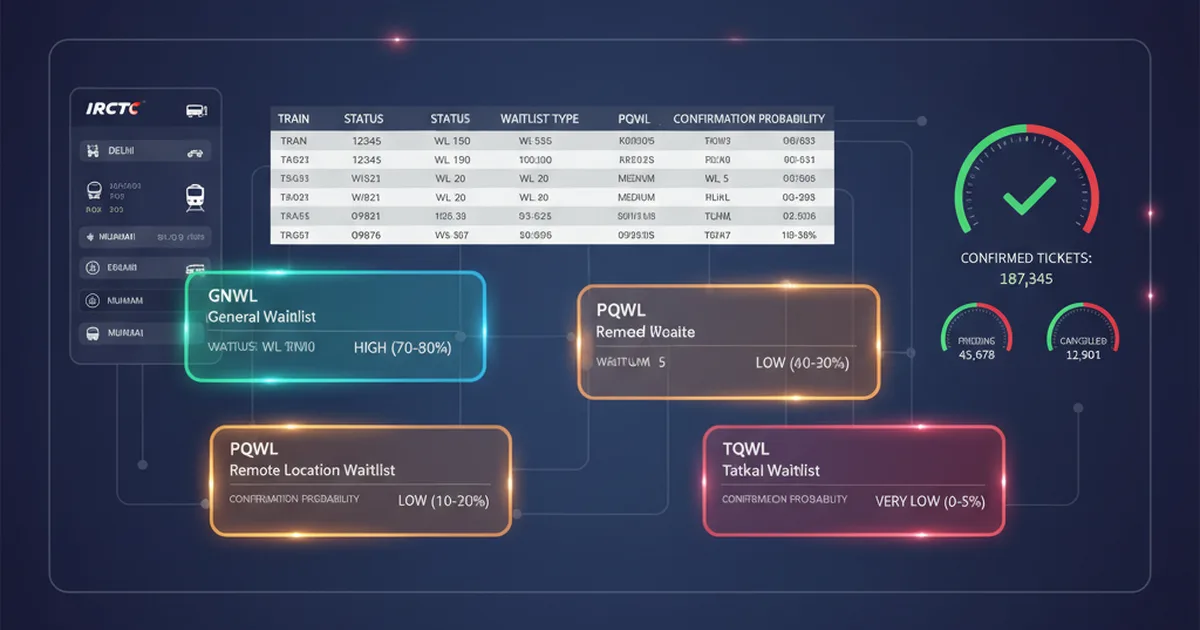
Table of Contents
- Railway Waitlist Basics
- GNWL — General Waiting List
- PQWL — Pooled Quota Waiting List
- RLWL — Remote Location Waiting List
- TQWL, CKWL & Confirmation Hierarchy
- Maximizing Confirmation Chances
- Frequently Asked Questions
Understanding Railway Waitlist Basics
The Indian Railways’ reservation system allocates seats in every train across multiple quota categories to serve diverse passenger needs. The main quotas are: General Quota (available for all passengers booking from any station pair), Pooled Quota (for passengers boarding/alighting at intermediate stations), and Remote Location Quota (for passengers from remote or less-connected stations). When a quota becomes full, additional bookings go into a waitlist — a queue for that specific quota.
Each quota has its own waitlist, and seats are released separately for each queue as confirmed passengers cancel their bookings. The cancellation rate and seat availability vary by quota type — General Quota has the highest cancellation rate (and therefore the best waitlist confirmation chances) because it attracts the broadest range of passengers. Pooled and Remote Location quotas have lower cancellation rates because they serve specialized needs.
A critical point: your waitlist status (e.g., “GNWL 25” or “PQWL 42”) indicates not just which waitlist you’re on, but your position in that queue. Position 1 is better than Position 50, regardless of waitlist type. However, as explained in our detailed article on tatkal booking strategies, the position alone doesn’t guarantee confirmation — the waitlist type itself matters more.
Comparison: Waitlist Types & Confirmation Probability
| Waitlist Type | Code | Who Gets Seats | Confirmation Chances | Typical Position for Confirmation |
|---|---|---|---|---|
| General Waiting List | GNWL | All passengers (any station pair) | Very High (60–90%) | GNWL 1–50 |
| Pooled Quota Waiting List | PQWL | Intermediate station passengers | Moderate (30–60%) | PQWL 1–30 |
| Remote Location Waiting List | RLWL | Remote station passengers | Low (20–40%) | RLWL 1–20 |
| Tatkal Confirmation Waiting List | TQWL | Tatkal class holders | Very Low (5–10%) | TQWL 1–5 only |
GNWL — General Waiting List (Highest Confirmation Probability)
GNWL stands for General Waiting List and represents bookings for the General Quota, available to any passenger booking from the train’s source station to any destination on the route. This is the largest and most accessible quota — typically 60–65% of all seats on a train are reserved under the General Quota. Because of this large pool, the cancellation rate is proportionally higher (as more diverse passengers book and some cancel), which means waitlisted passengers get more opportunities for seat releases.
Confirmation chances for GNWL depend on your position in the queue and days remaining before travel. A GNWL position of 1–20 has approximately 80–90% confirmation chances if you book more than 7 days before travel. GNWL 20–50 still has 60–75% chances, while GNWL 50+ drops to 30–50%. The key rule: GNWL holders have the first claim to all released General Quota seats — only after all GNWL positions are exhausted do seats move to other quotas.
Example scenario: You book a ticket from Mumbai to Delhi in Sleeper Class 7 days before travel and get GNWL 32. Based on historical confirmation trends, about 35–40 seats in Sleeper Class on this route are typically released through cancellations, giving you a strong probability of confirmation. Compare this to the other waitlist types described below, and GNWL is almost always your best option. Our guide on checking PNR status and train confirmation covers tracking your confirmation in real-time.
PQWL — Pooled Quota Waiting List (Moderate Confirmation Chances)
PQWL stands for Pooled Quota Waiting List. This waitlist applies to the Pooled Quota, which consists of seats reserved for passengers boarding or alighting at intermediate stations on the train’s route. For example, if a train runs from Mumbai to Delhi with stops in Indore and Jaipur, passengers traveling from Mumbai to Indore, Indore to Jaipur, or Jaipur to Delhi can access the Pooled Quota.
The Pooled Quota is typically 10–15% of total seats. Because this pool serves more specific travel patterns (intermediate journeys) than the General Quota, the cancellation rate is lower — fewer passengers book intermediate journeys, and those who do are often less likely to cancel. This means PQWL waitlists convert to confirmed seats at lower rates than GNWL.
A PQWL position of 1–15 has approximately 40–60% confirmation chances depending on days before travel. PQWL 15–30 drops to 20–40% chances, and PQWL 30+ rarely confirms. The crucial point: PQWL seats are filled ONLY AFTER all GNWL waitlist positions are exhausted, so PQWL passengers are in a secondary queue. If you book for an intermediate station pair and get PQWL, your chances depend not just on PQWL cancellations but also on how many GNWL passengers ahead of you also want seats. Detailed travel planning tips can be found in our article on comparing transport modes for specific Indian routes.
RLWL — Remote Location Waiting List (Lowest Regular Confirmation)
RLWL stands for Remote Location Waiting List, reserved for passengers boarding from remote or less-connected railway stations. The Indian Railways uses this quota to ensure that residents of smaller towns and rural areas have a fair chance of getting reserved seats. Remote locations include stations in hilly regions, northeastern states, and less-developed areas not well-served by major railway networks.
The Remote Location Quota is typically 5–10% of seats, allocated to a limited set of remote stations. Because bookings from these locations are fewer and passengers from remote areas have high travel intent (they can’t easily switch to road or air transport), the cancellation rate is very low — once a passenger books, they’re committed. This results in significantly lower RLWL confirmation chances compared to GNWL or PQWL.
A RLWL position of 1–10 has approximately 30–50% confirmation chances. RLWL 10–20 drops to 15–30%, and RLWL 20+ rarely confirms. RLWL seats are filled ONLY AFTER all GNWL and PQWL positions are exhausted, making them a tertiary queue. If you’re booking from a remote station and get RLWL, consider alternative travel dates or taking a direct bus/flight if available. For multi-leg journeys, see our guide on comparing train vs road for specific routes to evaluate alternatives.
Confirmation Hierarchy: Which Waitlist Gets Seats First?
| Seat Release Priority | Waitlist Type | Seat Count (% of Total) | Avg Confirmation Rate | Strategy |
|---|---|---|---|---|
| 1st (Highest) | GNWL | 60–65% | 60–90% | Book from source station; wait longer for GNWL to clear |
| 2nd | PQWL | 10–15% | 30–60% | PQWL fills only after GNWL exhausted |
| 3rd | RLWL | 5–10% | 20–40% | RLWL fills last; lowest confirmation odds |
| 4th (Lowest) | TQWL | ~5% | 5–10% | Tatkal class only; confirm very rarely |
TQWL, CKWL & The Complete Waitlist Hierarchy
TQWL stands for Tatkal Quota Waiting List, specific to passengers who booked Tatkal tickets (released 24 hours before departure in AC/1AC classes, 4 hours for Sleeper/General). CKWL is Cancellation Waiting List, created when a canceled confirmed seat is released. TQWL rarely confirms because the Tatkal Quota (5–8% of seats) is already limited, and only passengers who booked Tatkal can access TQWL seats. Your chances are typically 5–10% unless you’re in position 1–3.
The complete confirmation priority hierarchy is: GNWL → PQWL → RLWL → TQWL → CKWL (for direct bookings), and CKWL fills immediately for Tatkal bookings. This means if you’re holding a TQWL 15 ticket, you’ll wait until all GNWL, PQWL, and RLWL queues are exhausted before your position is considered — highly unlikely on most trains. However, CKWL (Cancellation Waiting List) for confirmed bookings — formed when a passenger cancels after getting a confirmed seat — moves relatively fast and can confirm within 24–48 hours.
For a deep dive into booking strategies, check our comprehensive article on tatkal booking tips and tricks, which covers advance bookings, quota selection, and cancellation monitoring.
Strategies to Maximize Your Waitlist Confirmation Chances
Strategy 1 — Book Early & Aim for GNWL: The single best way to get a confirmed seat is to book as soon as IRCTC opens bookings (60 days before travel for General Quota). Early bookers fill general quota seats first and avoid waitlists entirely. If you must book a waitlist ticket, ensure it’s GNWL by booking from the source station (not an intermediate station). A GNWL 10 ticket booked 50 days in advance has a 85%+ confirmation rate.
Strategy 2 — Monitor & Upgrade: Don’t accept a waitlist position passively. Use the IRCTC website or apps like RailYatri and TrainTicketAvailability to monitor your PNR status daily. Many confirma happen 3–14 days before travel as cancellations pile up. If your waitlist is not progressing, cancel and rebook on a different train or class — your refund will process quickly. Strategy 3 — Book Multiple Options: If traveling on a specific date is critical, book waitlist tickets on 2–3 different trains, then cancel the ones you don’t use once one confirms. This increases your overall confirmation probability from 60% to 85%+.
Strategy 4 — Consider Tatkal if GNWL Stalls: If your GNWL position (say, 80+) hasn’t confirmed 3 days before travel, cancel and book Tatkal (released 4 hours before for Sleeper). Tatkal starts with a fresh pool and higher per-ticket confirmation rates. Strategy 5 — Travel on Less Popular Dates: Trains on weekday mornings (Tuesday-Thursday, 6–10 AM departures) and non-holiday periods have significantly lower waitlists and higher confirmation rates. Friday-Sunday evening trains and holiday week trains have the longest waitlists.
For step-by-step IRCTC booking guidance, see our article on complete IRCTC ticket booking guide, which covers the platform interface, payment, and confirmation tracking.
You May Also Like: Tatkal Ticket Booking Tips: 12 Proven Ways to Get Confirmed Tatkal Tickets, How to Check PNR Status & Train Running Status, and How to Book IRCTC Tickets Online: A Complete Step-by-Step Guide.
Frequently Asked Questions
Which waitlist type has the highest confirmation chances?
GNWL (General Waiting List) has the highest confirmation chances, typically 60–90% depending on your position and days before travel. A GNWL 20 ticket usually confirms. PQWL confirmation chances are 30–60%, RLWL 20–40%, and TQWL only 5–10%. Always aim for GNWL by booking from the train’s source station.
What is the difference between GNWL and RLWL?
GNWL (General Waiting List) applies to all passengers booking from any station pair and has the best confirmation probability (60–90%). RLWL (Remote Location Waiting List) applies only to passengers boarding from remote/less-developed stations and has much lower confirmation chances (20–40%). RLWL seats are filled only after all GNWL and PQWL positions are exhausted.
Can a GNWL ticket confirm the day before travel?
Yes, GNWL tickets can confirm even 1–2 days before travel if enough cancellations happen. The closer you get to the journey date, the higher the cancellation rate tends to be as passengers adjust plans. However, don’t rely on last-minute confirmation — if your GNWL hasn’t confirmed 7 days before travel, book backup tickets on other trains.
Is PQWL better than RLWL?
Yes, PQWL is significantly better than RLWL. PQWL confirmation chances are 30–60% vs RLWL’s 20–40%. If you must book an intermediate journey and get PQWL, you have a reasonable chance. RLWL should be a last resort.
What does TQWL mean, and will it confirm?
TQWL is Tatkal Quota Waiting List for passengers who booked Tatkal tickets. Confirmation chances are very low (5–10%) because TQWL is filled only after GNWL, PQWL, and RLWL are exhausted. Generally, only TQWL positions 1–3 confirm. If you’re TQWL 10+, expect not to confirm.
How do I improve my confirmation chances for a waitlisted ticket?
Book early (60 days in advance to get GNWL), book from the source station (not intermediate), monitor your PNR daily using IRCTC or RailYatri app, and consider booking on less popular routes/times (weekday mornings, non-holiday weeks). If your waitlist hasn’t moved 3–5 days before travel, cancel and rebook Tatkal or on an alternative train.
Can I convert a PQWL or RLWL to GNWL?
No, you cannot change your waitlist type once booked. Your waitlist is determined by your booking stations — if you book from an intermediate station, you get PQWL (if available). If you book from a remote station, you get RLWL. To ensure GNWL, you must book a new ticket from the train’s source station.
What is the best strategy if I have both GNWL and PQWL tickets?
Keep both tickets until the GNWL confirms, which it likely will before the PQWL. Once GNWL confirms, immediately cancel the PQWL to get your refund. If the journey is critical and GNWL hasn’t confirmed 3 days before, cancel PQWL as well and rebook Tatkal on the same or alternative trains.