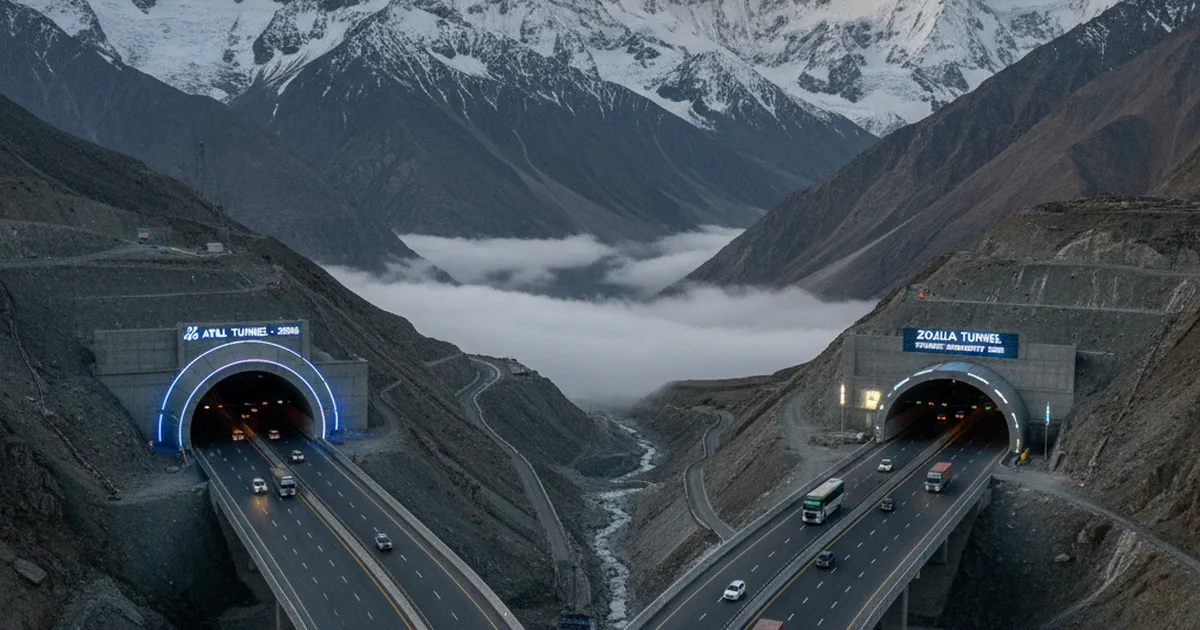

India is undertaking one of the most ambitious road tunnel development programs in Asia. From the strategically vital Atal Tunnel connecting Manali to Ladakh, to the game-changing Zojila Tunnel linking Srinagar to Leh year-round, these engineering marvels are reshaping connectivity across India’s most challenging mountain terrain. As of June 2026, India is constructing 31 major road tunnels at a combined cost of ₹1,400 crore (~$17.5 billion), with multiple projects nearing completion. This guide explores the key tunnel projects, their status, and their impact on road transportation in India.
Table of Contents
- Atal Tunnel: Manali to Ladakh Year-Round Connectivity
- Zojila Tunnel: Asia’s Longest Single-Tube Tunnel
- Z-Morh Tunnel: Complementary Gateway to Kashmir
- Other Major Highway Tunnel Projects in India 2026
- Comparison: Key Indian Highway Tunnels
- Impact on Road Safety & Regional Connectivity
- Frequently Asked Questions
Atal Tunnel: Manali to Ladakh Year-Round Connectivity
The Rohtang Tunnel, officially named Atal Tunnel in honour of former Prime Minister Atal Bihari Vajpayee, is an 8.8 km long tunnel located at an elevation of 3,060 metres in the Pir Panjal Range of Himachal Pradesh. This strategic tunnel connects the Manali-Keylong-Leh highway and is vital for all-weather connectivity to Ladakh and Lahaul-Spiti.
Current Status (as of June 2026): The Atal Tunnel has been operational and is now at full capacity. Expected completion of the golden connection to Leh via the entire highway is targeted for late May to June 2026, though recent reports indicate road conditions between Manali and Leh have faced seasonal challenges due to snow melt and slope stability issues (as reported in April 2026).
Key Facts:
- Length: 8.8 km
- Elevation: 3,060 m (10,000 ft)
- Time Saving: Reduces travel distance by 46 km and drive time by ~7 hours between Manali and Leh
- Cost: ₹940 crore
- Contractor: India’s Border Roads Organization (BRO)
- Technology: Two-lane tunnel with modern safety features including escape routes every 200m
The Atal Tunnel significantly reduces the journey time from 12-14 hours (via Rohtang Pass) to just 3-4 hours, making it ideal for commercial traffic, military operations, and tourism during winter when the pass is snow-locked.
Zojila Tunnel: Asia’s Longest Single-Tube Tunnel
The Zojila Tunnel is one of India’s most strategically important infrastructure projects. Spanning the Srinagar-Leh National Highway (NH-1), this will become Asia’s longest single-tube bi-directional road tunnel and the world’s highest highway tunnel when completed.
Key Specifications:
- Length: 14.2 km (some reports cite 13.15 km)
- Width: 9.5 m
- Height: 7.57 m
- Design: Horseshoe-shaped, single-tube, two-lane tunnel
- Elevation: 2,637 m (8,652 ft)
- Contractor: Megha Engineering & Infrastructures Ltd. (MEIL)
- Total Project Cost: ₹6,800+ crore
- Target Completion: February 2028 (as of June 2026)
Current Status (June 2026): As reported in April 2026, only 1.2 km of excavation remains before tunnel breakthrough. Part One of the project (approach roads, bridges, Nilgrar twin tunnels, and snow gallery components) was successfully completed on 15 March 2025. The project is on track for breakthrough in Q2 2026, with final completion targeted for early 2028.
Strategic Importance: The Zojila Tunnel will provide all-weather connectivity between Srinagar and Leh, eliminating seasonal road closures caused by heavy snowfall. This is critical for military supply lines, regional commerce, and civilian travel to Ladakh during winter months.
Z-Morh Tunnel: Complementary Gateway to Kashmir
The Z-Morh Tunnel is a complementary infrastructure project alongside Zojila. This tunnel further enhances the Srinagar-Leh highway network and is part of the broader NHAI initiative to create redundant, all-weather routes through the Himalayas.
Specifications:
- Length: 6.5 km
- Strategic Role: Bypasses snow-prone mountain passes
- Target Completion: 2027-2028 timeframe
- Combined Cost (Zojila + Z-Morh): Part of the larger NHAI budget allocation
Both tunnels working together will create a robust network capable of handling year-round traffic between Srinagar and Leh, strengthening India’s strategic presence in the region.
Other Major Highway Tunnel Projects in India 2026
Beyond Atal and Zojila, India is investing heavily in tunnel infrastructure across Himachal Pradesh, Jammu & Kashmir, and the Northeast:
Shimla Bypass Tunnel (Himachal Pradesh)
- Total Length: 27.4 km (includes multiple tunnel sections)
- Primary Tunnel: Twin-tube tunnel sections to divert through-traffic away from Shimla city
- Cost: ₹2,100+ crore
- Status: Under construction (completion expected 2026-2027)
Chenani–Nashri Tunnel (Jammu & Kashmir)
- Length: 9.2 km
- Technology: Advanced New Austrian Tunnelling Method (NATM)
- Benefit: Reduces travel distance between Jammu and Srinagar by 30 km
- Status: Operational since 2017, now undergoing capacity upgrades
Banihal Tunnel (Jammu & Kashmir)
- Length: 8.45 km
- Status: Operational; part of the NH-44 corridor
- Purpose: Bypasses the snowfall-prone Pir Panjal Range
Nationwide Tunnel Development (2024-2026): According to the Ministry of Road Transport & Highways (MoRTH), India is planning to construct 74 new tunnels spanning 273 km across various states, with investments estimated at over ₹45,000 crore. Of these, 20 tunnels in Jammu & Kashmir and 11 in Ladakh alone are being built at a cost of ₹1,400 crore.
Comparison: Key Indian Highway Tunnels
| Tunnel Name | Length (km) | Location | Elevation (m) | Status (June 2026) | Key Benefit |
|---|---|---|---|---|---|
| Atal Tunnel (Rohtang) | 8.8 | Himachal Pradesh | 3,060 | Operational | 7-hour time saving, Manali-Leh connectivity |
| Zojila Tunnel | 14.2 | Jammu & Kashmir | 2,637 | Breakthrough imminent (1.2 km left) | All-weather Srinagar-Leh link |
| Z-Morh Tunnel | 6.5 | Jammu & Kashmir | ~2,500 | Under construction | Redundancy & capacity for high-altitude passes |
| Shimla Bypass (tunnels) | 27.4 (total) | Himachal Pradesh | ~2,200 | 70% complete | Bypasses city, improves traffic flow |
| Chenani–Nashri Tunnel | 9.2 | Jammu & Kashmir | ~2,000 | Operational (upgrades ongoing) | 30 km distance saving |
Impact on Road Safety & Regional Connectivity
Safety Improvements: Tunnel highways eliminate exposure to avalanches, rockfalls, and extreme weather that claim hundreds of lives annually on mountain passes. The Rohtang Pass, for example, sees dozens of accidents each year due to landslides and snow conditions. The Atal Tunnel has already saved countless lives.
Economic Benefits:
- Enables year-round commercial traffic and tourism to Ladakh and Himachal Pradesh
- Reduces logistics costs for supply chains to border regions
- Supports military mobilization in strategically important areas
- Opens new markets for local businesses in Lahaul-Spiti and Kashmir
Tourism Impact: With all-weather connectivity, tourism to Ladakh is projected to increase by 40-50% by 2027. The Atal Tunnel already attracts thousands of vehicles monthly, supporting hotels, restaurants, and adventure businesses along the route.
Strategic Importance: These tunnels strengthen India’s military and civilian presence in border regions, enhancing national security and sovereignty in sensitive areas like Ladakh and Kashmir.
Key Takeaways
- The Atal Tunnel is now operational, cutting 7 hours off the Manali-Leh journey
- Zojila Tunnel will be Asia’s longest single-tube tunnel, with breakthrough expected by mid-2026
- India’s 31 high-altitude tunnels project cost ₹1,400 crore and will reshape Himalayan connectivity
- These projects improve safety, enable year-round travel, and support economic and military objectives
- MoRTH is investing in 74 new tunnels (273 km) nationwide by 2028
India’s tunnel infrastructure development represents a major leap in modern highway engineering. With the Atal Tunnel already transforming travel to Ladakh and Zojila nearing breakthrough, the next 2-3 years will see unprecedented investment in mountain road connectivity.