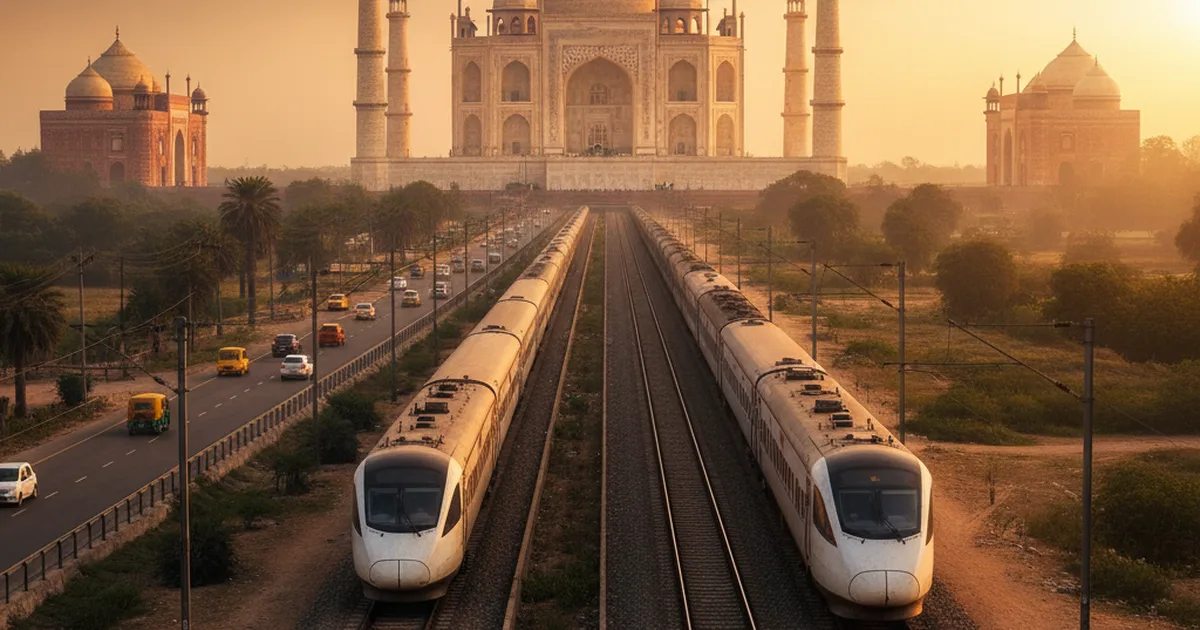

Everything you need to plan a seamless trip from India’s capital to the city of the Taj Mahal — whether you prefer the speed of a Gatimaan Express or the freedom of the Yamuna Expressway.
Updated: March 2026~200 km · ~2.5–3 hrs by road~180 km · ~100 min by trainDay-trip friendly
Route at a Glance
Road Distance ~200–210 km (Yamuna Expressway)
Rail Distance ~180 km (Hazrat Nizamuddin → Agra Cantt)
Drive Time 2.5 – 3.5 hours
Train Time (Fastest) 100 minutes (Gatimaan Express)
Best Time to Visit October – March
Taj Mahal Closed On Every Friday
If there is one trip every traveller visiting India should make, it is the journey from Delhi to Agra. Roughly 200 kilometres separate the nation’s political capital from the home of the world’s most iconic monument — the Taj Mahal. And the beauty of this route is that it is genuinely one of the easiest, most well-connected corridors in the country, whether you prefer the rhythm of a fast train window or the open road of a brand-new expressway.
This guide covers everything you need to plan a smooth Delhi–Agra trip in 2026: the best trains, driving route details, must-see stops, packing tips, and the top sights once you arrive. Whether you are visiting for a day or staying overnight, consider this your complete roadmap.
Why the Delhi–Agra Route Is a Traveller’s Favourite
This corridor has been one of the most-travelled routes in India for centuries — and for good reason. Agra was the seat of the Mughal Empire, and Delhi was its twin capital. The ancient Mughal Road that once connected them is today served by modern expressways and high-speed trains, making it easier than ever to make the trip.
For international visitors, it is often a core part of the famous Golden Triangle circuit (Delhi – Agra – Jaipur). For domestic travellers, it remains a favourite weekend getaway, a family day trip, or a quick cultural escape from the bustle of the capital. The mix of road and rail options means you can truly tailor the experience to your schedule.
Pro Tip Many experienced travellers take the Gatimaan Express in the morning (arriving in Agra by 10 AM) and drive back via the Yamuna Expressway in the evening. This lets you enjoy both modes of travel in a single day.
Going by Train: The Fastest Way to Agra
The train is widely regarded as the most efficient way to make the Delhi–Agra journey. No traffic jams, no toll stops, and a central drop-off point that keeps you close to the major monuments. India’s rail network offers several trains on this route, ranging from the ultra-fast Gatimaan Express to budget-friendly options like the Taj Express.
If you love exploring India by rail, this route pairs wonderfully with other iconic journeys. From discovering the lifeline Delhi–Mumbai rail corridor to scenic mountain escapes like the Delhi to Shimla railway trip, India’s train network rewards those who take the time to explore it.
Top Trains on the Delhi–Agra Route
| Train Name | Departure | Journey Time | Key Feature |
|---|---|---|---|
| Gatimaan Express Fastest | Hazrat Nizamuddin | ~100 minutes | India’s fastest train on this route (up to 160 km/h) |
| Shatabdi Express | New Delhi | ~2 hours | Premium, fully air-conditioned, meals included |
| Taj Express | Hazrat Nizamuddin | ~2.5 hours | Budget-friendly, popular with day-trippers |
| Intercity Express | New Delhi | ~2–2.5 hours | Multiple daily departures, affordable fares |
Booking Your Ticket
Tickets can be booked on the official IRCTC website or mobile app. For premium trains like the Gatimaan Express, book at least 1–2 weeks in advance during the tourist season (October to March), as these trains fill up quickly. If you are a foreign tourist, the tourist quota on IRCTC allows you to book tickets at reservation counters at major railway stations — which can be handy if the online quota is exhausted.
Keep your PNR number handy after booking. Not sure how to read your ticket status? The guide to PNR status and what it means for your train journey has everything explained in simple terms.
Driving to Agra: The Yamuna Expressway Experience
If you prefer four wheels to a train compartment, the road trip to Agra via the Yamuna Expressway is one of India’s great driving routes. Stretching 165 km between Greater Noida and Agra, the Yamuna Expressway is a six-lane access-controlled highway that offers a smooth, fast, and relatively stress-free drive.
Starting from central Delhi, you will typically head east towards Noida and then onto the expressway. The total journey from most Delhi hotels to Agra city centre is roughly 200–210 km, taking between 2.5 and 3.5 hours depending on departure time and traffic.
Yamuna Expressway: Key Facts for Drivers
- Speed Limit: 100 km/h for cars and light vehicles
- Toll Plazas: Multiple toll booths; total one-way toll for a car is approximately ₹400–₹500
- Fuel Stations: Available at regular intervals along the expressway
- Rest Areas: Well-maintained rest stops with food courts and washrooms
- Night Driving: Technically possible but not recommended due to fog in winter months and overspeeding risks
Fans of Indian road trips will recognise how this expressway compares to others across the country. Those who have explored routes like the Delhi–Mumbai Expressway will find the Yamuna Expressway much shorter and more manageable, making it ideal for a day trip rather than a multi-day drive. If long highway drives are your thing, the Delhi to Manali road trip is another extraordinary route worth adding to your list.
Best Time to Start Your Drive
For a day trip, aim to leave Delhi between 5:30 AM and 7:00 AM. This gets you to Agra before the heat of the day and well before the tourist crowds build up at the Taj Mahal. Avoid weekday morning rush hours from central Delhi, and check expressway traffic advisories during long weekends and national holidays when the road sees significantly higher volumes.
Road vs. Rail: Which Should You Choose?
Both options are genuinely excellent — the choice really comes down to your priorities for the trip.
🚆 Choose the Train If…
- You want the fastest, most relaxed journey
- You dislike dealing with traffic or navigation
- You are travelling solo or as a couple
- You enjoy the experience of Indian rail travel
- You want to arrive close to the monuments (Agra Cantt station is central)
- You are on a tight schedule or day trip
🚗 Choose the Road If…
- You want to stop at Mathura or Vrindavan on the way
- You are travelling with a large family or group
- You prefer the flexibility of your own schedule
- You enjoy expressway drives
- You are combining Agra with a longer road trip
- You want to carry more luggage comfortably
Unmissable Stops Between Delhi and Agra
One of the biggest advantages of driving is the ability to stop at historically and spiritually significant towns along the way. The stretch between Delhi and Agra passes through some of India’s most storied geography.
Mathura — The Birthplace of Lord Krishna
Located approximately 145 km from Delhi and just 58 km short of Agra, Mathura is one of the holiest cities in Hinduism. The Krishna Janmabhoomi Temple (birthplace of Lord Krishna), the Dwarkadhish Temple, and the ghats along the Yamuna River are the key highlights. Budget 1.5–2 hours here if you plan to stop.
Vrindavan — The Land of Temples
Just 15 km from Mathura, Vrindavan is famous for its hundreds of ancient temples and the devotional culture that surrounds it. The Banke Bihari Temple, ISKCON Temple, and Prem Mandir are particularly popular with visitors of all faiths. Vrindavan and Mathura together make for a beautiful half-day detour.
Fatehpur Sikri — The Ghost Capital
About 40 km west of Agra on the road back towards Jaipur, Fatehpur Sikri is a UNESCO World Heritage Site and one of the most magnificently preserved Mughal ghost cities in the world. Built by Emperor Akbar in the 16th century and mysteriously abandoned shortly after, its red sandstone palaces and mosques are breathtaking. This stop works best as an add-on if you are spending more than one day in the Agra region.
Top Things to See and Do in Agra
The Taj Mahal
No introduction needed. Built by Mughal Emperor Shah Jahan as a monument of love for his wife Mumtaz Mahal, the Taj Mahal is one of the seven wonders of the modern world — and it lives up to every bit of the hype. Visit at sunrise for golden-hour light and fewer crowds. The monument is closed on Fridays.
Agra Fort
Often overshadowed by the Taj Mahal, Agra Fort is a UNESCO World Heritage Site in its own right. The massive red sandstone fort served as the seat of Mughal power and offers stunning views of the Taj Mahal from its towers. Allow at least 2 hours to explore it properly.
Mehtab Bagh
For one of the most dramatic views of the Taj Mahal, head to Mehtab Bagh — a Mughal-era garden directly across the Yamuna River. The sunset view of the Taj from here is absolutely spectacular and far less crowded than the main entrance.
Itmad-ud-Daulah (Baby Taj)
This beautifully ornate white marble mausoleum was built before the Taj Mahal and is believed to have inspired several of its architectural elements. It is smaller, quieter, and often called the “Jewel Box” of Mughal architecture. A hidden gem worth the short drive from central Agra.
Kinari Bazaar
For shopping, Kinari Bazaar near Jama Masjid is the place to pick up marble inlay work, leather goods, Agra’s famous petha sweets, and brass figurines. Bargaining is expected and half the fun.
Essential Travel Tips for Your Delhi–Agra Trip
🌤️
Best Season to Visit
October to March offers pleasant weather. Avoid May–June when temperatures can cross 45°C. The monsoon (July–September) brings fewer crowds but heavy humidity.
🎟️
Book Tickets in Advance
Both train tickets and Taj Mahal entry tickets (especially the ₹50 sunrise slot) should be booked ahead during the tourist season. Use IRCTC and the ASI official portal.
👟
Wear Comfortable Shoes
You will walk a lot — from car parks to the Taj Mahal gate alone is nearly 500 metres. Comfortable, flat-soled shoes are essential. Shoe covers are provided at the Taj entrance.
💧
Stay Hydrated
Carry a refillable water bottle. Bottled water is available near most attractions but overpriced. Sealed snacks are easier than finding good food near some monuments mid-tour.
📸
Photography Tips
For the classic Taj Mahal reflection shot, visit after sunrise when the light is golden and the reflecting pool crowds are thin. Tripods require a special permit.
🚌
Local Transport in Agra
Auto-rickshaws, e-rickshaws, and app-based cabs (Ola/Uber) are all available. For monument hopping, a pre-booked cab for the day (₹600–₹900) is the most convenient option.
Should You Stay Overnight in Agra?
If time allows, staying overnight in Agra is absolutely worth it. You get the chance to visit the Taj Mahal at both sunrise and sunset, experience the city after the day-trip crowds have cleared, and explore Fatehpur Sikri at a relaxed pace the next morning. Agra has an excellent range of accommodation, from heritage hotels with Taj views to clean and affordable guesthouses in the city centre.
Agra also makes a natural staging point if you are doing the classic Golden Triangle Tour (Delhi–Agra–Jaipur) — a future guide we are working on that will cover the full circuit in detail.
Did You Know? The Taj Mahal is one of the few monuments in India that offers a separate night viewing experience — on full moon nights and the two nights before and after. Tickets are limited and must be booked in advance through the ASI (Archaeological Survey of India) website.
Road Safety on the Yamuna Expressway
The Yamuna Expressway is one of India’s safest highways by design, but it is important to drive responsibly. Speed cameras are operational throughout, and the expressway authority enforces limits strictly. Fog during winter mornings (December–January) can significantly reduce visibility, so always check weather forecasts before departing. Night driving is best avoided during foggy season.
- Do not stop on the main carriageway; use designated emergency lay-bys only
- Keep headlights on during low-visibility conditions
- Avoid using mobile phones while driving — police presence is consistent
- Do not overtake from the left lane; the expressway follows standard lane discipline
- Carry your vehicle registration and insurance documents
Frequently Asked Questions
What is the distance between Delhi and Agra by road? ▾
The distance between Delhi and Agra by road is approximately 200–210 km via the Yamuna Expressway. Under normal traffic conditions, the drive takes around 2.5 to 3.5 hours, making it one of the most convenient day-trip routes in North India.
Which is the best train from Delhi to Agra? ▾
The Gatimaan Express is widely considered the best train from Delhi (Hazrat Nizamuddin) to Agra Cantt, covering the distance in just about 100 minutes at speeds up to 160 km/h. The Shatabdi Express and Taj Express are also popular and comfortable options.
Is it better to go to Agra by road or by train? ▾
Both options have their advantages. The train is faster, stress-free, and avoids traffic jams, making it ideal for a quick day trip. A road trip via the Yamuna Expressway gives you the flexibility to stop at places like Mathura and Vrindavan along the way. Many travellers choose to go by train and return by road, or vice versa, to experience both.
Can I visit the Taj Mahal and return to Delhi on the same day? ▾
Yes, absolutely. The Delhi–Agra route is one of the most popular day-trip corridors in India. If you take the early-morning Gatimaan Express or Shatabdi Express, you can comfortably visit the Taj Mahal, Agra Fort, and even Mehtab Bagh before returning to Delhi the same evening.
What are the toll charges on the Yamuna Expressway from Delhi to Agra? ▾
The Yamuna Expressway has multiple toll plazas between Delhi and Agra. For a standard car (4-wheeler), the approximate total toll is around ₹400–₹500 for a one-way trip. Charges vary depending on vehicle type and may be updated periodically by the expressway authority.
What places can I visit near Agra besides the Taj Mahal? ▾
Agra has several incredible attractions beyond the Taj Mahal. These include Agra Fort (a UNESCO World Heritage Site), Fatehpur Sikri (a magnificent Mughal ghost city about 40 km away), Mehtab Bagh (for a stunning sunset view of the Taj), Itmad-ud-Daulah (often called the Baby Taj), and the Kinari Bazaar for shopping.
What is the speed limit on the Yamuna Expressway? ▾
The Yamuna Expressway has a maximum speed limit of 100 km/h for cars and light vehicles. Speed cameras are installed along the route, and authorities strictly enforce these limits, especially after several high-speed accidents in the past. Always drive within the posted limits and avoid night driving if possible.
📚 More Travel Guides from Road Rail Infra
- Delhi to Shimla Railway Trip Guide
- Delhi to Manali Road Trip Guide
- Delhi–Mumbai Expressway Road Trip
- New Delhi to Mumbai Train Route
- PNR Status: Complete Guide
- Mumbai to Goa Konkan Railway Guide
- Kalka to Shimla Train Route
- Mumbai to Goa Coastal Drive Guide
Frequently Asked Questions
What are the train options from Delhi to Agra?
Top trains: Gatimaan Express (100 min, fastest), Taj Express, Agra Shatabdi, and Yamuna Express. Gatimaan is the fastest at 160 km/h and runs between Hazrat Nizamuddin and Agra Cantt.
How long does the drive from Delhi to Agra take?
Via Yamuna Expressway (165 km), the drive takes 2.5-3 hours in normal traffic. Avoid Friday evenings and holiday weekends when it can extend to 4-5 hours.
Which is faster — Delhi to Agra by train or road?
The Gatimaan Express at 100 minutes beats any road journey. By car via Yamuna Expressway, expect 2.5-3 hours minimum. Train is clearly faster.
What is the toll on Yamuna Expressway for Delhi to Agra?
Cars pay approximately Rs 415 one-way on the Yamuna Expressway. FASTag is mandatory; non-FASTag vehicles pay double.
What is special about the Gatimaan Express?
Gatimaan Express is India’s fastest train at 160 km/h, connecting Hazrat Nizamuddin to Agra Cantt in 100 minutes. It has only Chair Car and Executive Chair Car classes with onboard meals included.
Is same-day Agra trip possible from Delhi?
Yes. Take the early morning Gatimaan Express, visit Taj Mahal, Agra Fort, and Mehtab Bagh, and return on the evening Gatimaan or a road self-drive. A comfortable day trip is very doable.
Can I combine Delhi-Agra road and rail trip?
Yes. A popular option is driving one way via Yamuna Expressway (enjoying the scenic route and stopping at Mathura) and returning by train, or vice versa.
Comments (2) on "Delhi to Agra: The Complete Road & Rail Trip Guide (2026)"
Comments are closed.