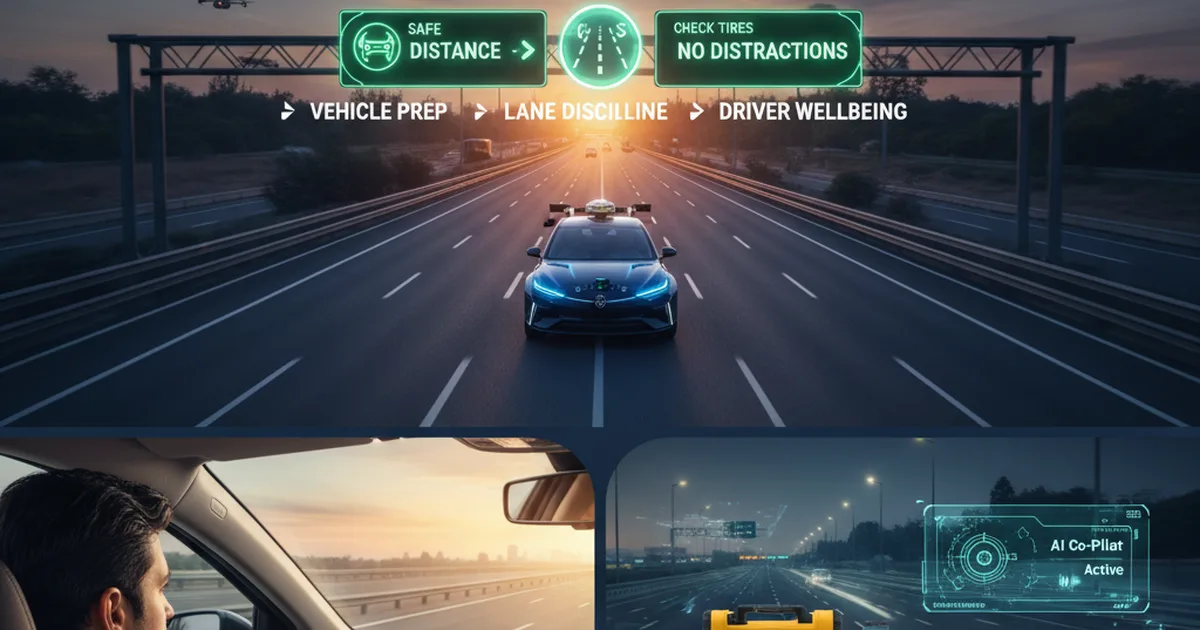

India’s national highway network has grown to over 1,46,000 km as of 2026 — yet the country still accounts for nearly 11% of global road fatalities despite having just 1% of the world’s vehicles. According to MoRTH’s Road Accidents in India 2025 report, over 1.55 lakh people lose their lives on Indian roads every year, with national highways alone accounting for 35.7% of all crash fatalities. As expressways get faster and longer, following proven highway safety tips for long drives has never been more critical. In this guide, we cover everything — from pre-trip vehicle checks and lane discipline to fatigue management, emergency protocols, and the latest 2026 safety regulations — so you can drive smarter and arrive safely.
Table of Contents
- Pre-Trip Vehicle Safety Checklist
- Speed Limits and Lane Discipline on Indian Expressways
- Fatigue Management: How to Stay Alert on Long Drives
- Driving Safely in Rain, Fog, and Extreme Heat
- FASTag, Toll Plazas, and Safe Merging
- Emergency Protocols: What to Do After a Breakdown or Accident
- Night Driving Safety on Indian Highways
- Conclusion
- Frequently Asked Questions
Pre-Trip Vehicle Safety Checklist
The most preventable accidents on India’s highways begin before the journey even starts — with skipped vehicle checks. MoRTH data shows that tyre failure and brake malfunction together account for over 12% of highway accidents annually. Before any long drive on an expressway, run through these checks:
- Tyres: Check tread depth (minimum 1.6mm legal limit), tyre pressure including the spare, and look for sidewall cracks. Overloaded or underinflated tyres are a leading cause of blowouts at highway speeds.
- Brakes: Test responsiveness in a safe area. Spongy brakes or pulling to one side need immediate attention before you hit the expressway.
- Engine oil, coolant, brake fluid: Check levels and top up as needed. A breakdown in the middle of the Delhi–Mumbai Expressway on a summer day is a serious safety risk.
- Lights: Headlights, tail lights, indicators, and hazard lights must all be fully functional — especially for drives that may extend into the night.
- Wipers and washer fluid: Critical for monsoon season on highways where sudden downpours drastically reduce visibility.
- Emergency kit: First-aid box, reflective triangle, torch, jumper cables, and a basic toolkit should always be in your boot on highway journeys.
NHAI recommends checking fuel levels at least 50 km before the last known fuel station on your route, as fuel station gaps on some expressways can exceed 80 km. Use the NHAI One app or Google Maps to identify fuel stops, rest areas, and emergency services along your route before departing.
Speed Limits and Lane Discipline on Indian Expressways
Speeding is responsible for 74.4% of all road accidents and 72.2% of highway fatalities in India, according to research published in the Safety journal. India’s access-controlled expressways have clearly defined speed limits that are actively enforced through speed cameras and overhead gantries in 2026.
| Vehicle Type | Max Speed (Expressway) | Max Speed (4-lane NH) | Max Speed (2-lane NH) |
|---|---|---|---|
| Cars & light vehicles | 120 km/h | 100 km/h | 80 km/h |
| SUVs & MPVs | 100 km/h | 100 km/h | 80 km/h |
| Trucks & buses | 80 km/h | 80 km/h | 60 km/h |
| Three-wheelers | Not permitted | 50 km/h | 40 km/h |
| Two-wheelers | Not permitted | 60 km/h | 60 km/h |
Lane discipline is equally critical. The left lane is for slow-moving vehicles; the middle lane for normal travel; the right (fast) lane is strictly for overtaking — you must move back left after passing. Hogging the right lane is a punishable offence under the Motor Vehicles Act 2019 and causes tailgating and road rage incidents. On expressways like the Delhi–Mumbai Expressway, multi-lane traffic flows at over 100 km/h, making improper lane changes extremely dangerous.
Fatigue Management: How to Stay Alert on Long Drives
Driver fatigue is one of the most underreported causes of highway accidents in India. The National Crime Records Bureau estimates that drowsy driving contributes to 10–15% of all fatal highway crashes. Fatigue impairs reaction time as severely as a blood alcohol level of 0.05% — the legal limit in most Indian states.
Follow the 2-hour rule: take a break of at least 15–20 minutes after every 2 hours of driving. On long expressway drives — such as the popular weekend road trips from Delhi, Mumbai, or Bengaluru — plan rest stops at NHAI-approved wayside amenities, which now feature food, fuel, restrooms, and rest areas at roughly 50–80 km intervals on major expressways.
- Avoid driving between 2 AM and 6 AM — the body’s circadian rhythm hits its lowest alertness point during this window.
- Share driving with a co-driver on journeys exceeding 400 km.
- Do not rely on caffeine alone — it masks fatigue without restoring cognitive function.
- If you feel your eyes getting heavy, pull over at the next rest area immediately. A 20-minute power nap restores alertness more effectively than any stimulant.
Driving Safely in Rain, Fog, and Extreme Heat
India’s varied climate creates distinct hazards across seasons. Each requires specific adaptations to stay safe on the highway.
| Weather Condition | Key Risks | Safety Measures | Speed Reduction |
|---|---|---|---|
| Heavy Rain (Monsoon) | Aquaplaning, reduced braking, poor visibility | Switch to low beam, increase following distance to 4 seconds | Reduce speed by 30–40% |
| Dense Fog (Winter NH) | Zero visibility, rear-end collisions | Use fog lights, hazard lights if stationary, follow cat’s eyes | Max 40–60 km/h |
| Extreme Heat (Summer) | Tyre blowouts, engine overheating, driver dehydration | Check tyre pressure (heat expands), carry 2L water per person | Maintain safe speed, avoid noon peak |
| Strong Crosswinds | Vehicle drift, especially SUVs and trucks | Firm two-hand grip, reduce speed, avoid overtaking trucks | Reduce speed by 15–20% |
Winter fog is particularly deadly on North Indian highways — NH-44 (Delhi to Amritsar) and NH-19 (Delhi to Kolkata) record dozens of pile-up accidents every December–January. If visibility drops below 50 metres, pull off the road at the next rest area rather than continuing.
FASTag, Toll Plazas, and Safe Merging
Toll plazas are accident hotspots — sudden braking, lane-changing, and distracted drivers looking for cash all create dangerous conditions. Since April 2024, FASTag is mandatory on all national highways, with non-FASTag vehicles charged double the toll rate. NHAI data shows FASTag adoption reached 97.6% by March 2026, significantly reducing plaza congestion. Our complete FASTag guide for 2026 covers recharging, troubleshooting, and which banks offer the best cashback deals.
At toll plazas, always slow down well in advance — the speed limit within 100 metres of a toll booth is 20 km/h on most expressways. Stay in your lane while your FASTag is read, and avoid changing lanes after the gantry sensor activates. After the plaza, accelerate gradually rather than flooring the throttle immediately — oncoming traffic merges from multiple lanes.
You can estimate your total toll cost before any trip using online calculators. Our expressway toll calculator guide explains how FASTag charges are calculated by vehicle class, distance, and plaza location — useful for budgeting long trips across NHAI expressways.
Emergency Protocols: What to Do After a Breakdown or Accident
Knowing what to do in the first five minutes after a breakdown or accident can save lives — including your own.
In case of breakdown:
- Move the vehicle as far left as possible — onto the hard shoulder or emergency lane.
- Switch on hazard lights immediately.
- Place the reflective triangle at least 50 metres behind the vehicle.
- All passengers should exit from the left side and stand behind the crash barrier — never on the road.
- Call NHAI’s 24×7 helpline: 1033. Response time target on major expressways is under 30 minutes.
In case of accident:
- Do not move injured persons unless there is immediate fire or flood risk — improper movement can worsen spinal injuries.
- Call 112 (unified emergency) or 108 (ambulance) immediately.
- The Motor Vehicles (Amendment) Act 2019 provides Good Samaritan protection — you cannot be detained by police or held liable for helping an accident victim.
- Document the scene (photos, vehicle numbers) for insurance purposes.
- Contact your motor insurance company within 24 hours of the incident.
Night Driving Safety on Indian Highways
Night driving on Indian highways carries disproportionate risk. While only 30% of highway travel occurs after dark, over 45% of fatal accidents happen at night, per MoRTH’s 2025 data. The combination of reduced visibility, glare from oncoming vehicles, and fatigue makes night driving on two-lane national highways especially hazardous.
- Use headlights correctly: Switch to low beam when an oncoming vehicle is within 150 metres. High beam blinding causes an estimated 3,000+ accidents per year on Indian NHs.
- Follow the “See and Be Seen” rule: Ensure your tail lights, reflectors, and number plate light are working. Dark-coloured vehicles with faulty tail lights are almost invisible at night.
- Watch for unlit vehicles and livestock: Two-lane NHs through rural areas regularly have unlit carts, cattle, and pedestrians on the road after dark.
- Prefer expressways for night travel: Access-controlled expressways like city ring roads and bypass expressways have no cross-traffic or pedestrians, making them significantly safer than ordinary NHs at night.
Conclusion
India’s highways are becoming faster, longer, and better-equipped every year — but they still demand full driver attention and preparation. The data is unambiguous: most highway fatalities are preventable. By running a proper pre-trip check, maintaining lane discipline, managing fatigue proactively, and knowing your emergency protocols, you dramatically reduce your risk. Whether you’re planning a weekend road trip, a business drive, or a cross-country journey, these highway safety tips for long drives in India should be part of every trip preparation. Drive with confidence — and arrive safely.
You May Also Like: Best Weekend Road Trips from Delhi, Mumbai & Bengaluru 2026, FASTag Guide 2026 — Recharge, Troubleshoot & Save, and NHAI National Highway Expansion 2026: Projects & Progress.
Frequently Asked Questions
Frequently Asked Questions
What is the speed limit for cars on Indian expressways in 2026?
The speed limit for cars and light motor vehicles on access-controlled expressways in India is 120 km/h. On 4-lane national highways it is 100 km/h, and on 2-lane highways 80 km/h. Speed cameras are actively enforced on major expressways.
How do I call for help on an NHAI expressway if my car breaks down?
Call NHAI’s 24×7 helpline 1033 for roadside assistance on national highways and expressways. You can also call 112 (unified emergency). NHAI targets a response time of under 30 minutes on major expressways.
Is it safe to drive at night on Indian national highways?
Night driving on 2-lane NHs carries significant risk due to unlit vehicles, livestock, and pedestrians. Access-controlled expressways are safer at night as they have no cross-traffic. Always use correct headlight etiquette, check your tail lights, and avoid driving between 2–6 AM if possible.
How often should I take breaks on a long drive in India?
The recommended rule is a break of at least 15–20 minutes after every 2 hours of continuous driving. On expressways, NHAI-approved wayside amenities are located roughly every 50–80 km on major corridors.
What documents must I carry on a highway drive in India?
You must carry: valid driving licence, vehicle registration certificate (RC), motor insurance certificate (valid), Pollution Under Control (PUC) certificate, and FASTag linked to the vehicle. Digital copies via DigiLocker or mParivahan app are legally accepted.
What is the Good Samaritan law in India for highway accidents?
The Motor Vehicles (Amendment) Act 2019 provides Good Samaritan protection. If you help an accident victim on the highway, you cannot be detained by police, asked to pay medical costs, or held liable for the victim’s condition. This protection encourages bystanders to assist without fear.
What should I do if a tyre blows out at highway speed?
Do not brake hard or jerk the steering wheel. Grip the wheel firmly with both hands, ease off the accelerator gradually, and steer straight. Let the vehicle slow down naturally before gently steering to the hard shoulder. Sudden braking during a blowout at speed causes loss of control.