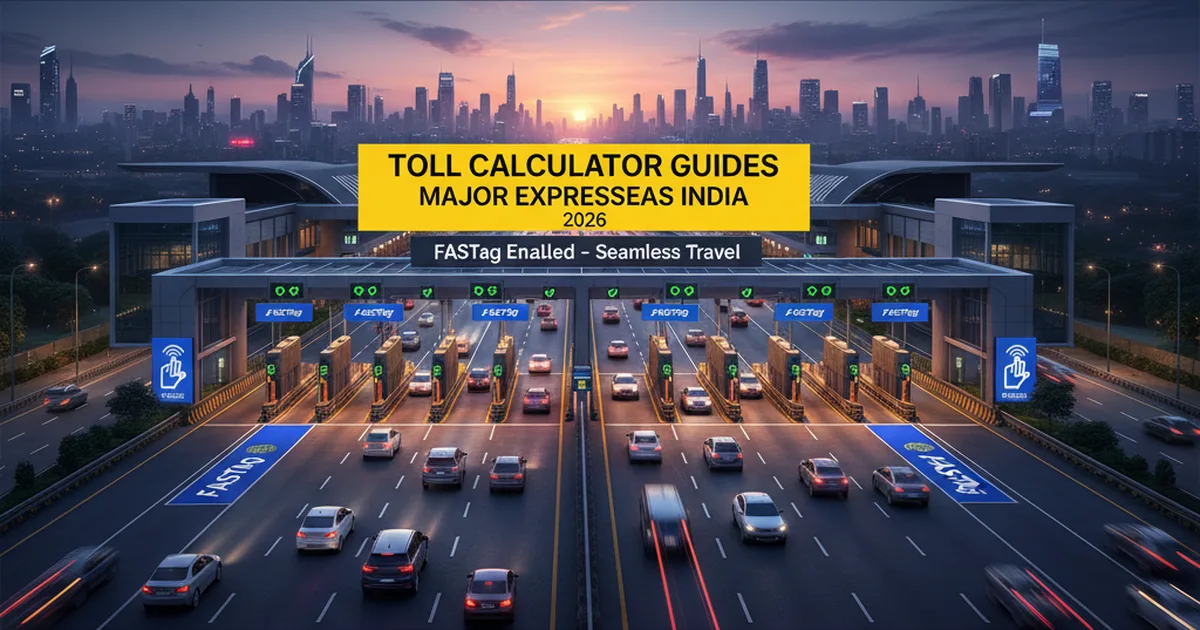

Planning a long drive on India’s expressways in 2026? Knowing your toll costs in advance can save you from unpleasant surprises — especially after NHAI revised FASTag Annual Pass fees to ₹3,075 for FY2026–27 and introduced toll hikes of ₹5–₹15 per trip on major national highway corridors from April 1, 2026. India currently has over 855 toll plazas on national highways, collecting over ₹50,000 crore in toll revenue annually. This comprehensive expressway toll calculator guide explains exactly how FASTag charges are calculated, which tools to use, vehicle-wise toll rates across India’s top expressways, and how to minimise your toll expenditure on long highway journeys.
Table of Contents
- How FASTag Calculates Toll Charges
- Toll Rates on India’s Major Expressways 2026
- Best Online Expressway Toll Calculators
- Vehicle Class-wise FASTag Toll Rates
- Monthly and Annual FASTag Passes: Are They Worth It?
- How to Reduce Your Toll Costs Legally
- FASTag Deduction Issues and Troubleshooting
- Conclusion
- Frequently Asked Questions
How FASTag Calculates Toll Charges
FASTag is a Radio Frequency Identification (RFID) sticker affixed to your vehicle’s windshield. When you approach a toll plaza on a national highway or expressway, an overhead antenna reads the tag in under 2 seconds and automatically deducts the applicable toll amount from your prepaid FASTag wallet. The charge is determined by three factors: vehicle class, distance traveled (on distance-based toll systems), and the specific toll plaza fee schedule as notified by NHAI under the National Highways Fee (Determination of Rates and Collection) Rules, 2008.
India uses two toll collection models: barrier-based tolling (fixed fee at each plaza regardless of entry point) and distance-based tolling (you pay only for the distance traveled between entry and exit points). The Delhi–Mumbai Expressway uses distance-based tolling — a key reason it is preferred for freight logistics, as operators pay proportionally rather than fixed per-plaza rates. For a complete breakdown of how charges work on the DM Expressway, our Delhi–Mumbai Expressway road trip guide covers entry/exit points and expected toll costs in detail.
Toll Rates on India’s Major Expressways 2026
NHAI revises toll rates annually on April 1 based on the Wholesale Price Index (WPI). The 2026 revision saw increases of 3–5% across most corridors. Below are the approximate one-way toll costs for a standard car (Class 4 / LMV) on India’s most-used expressways:
| Expressway / Corridor | Length | Car (One Way) | Truck/Bus (One Way) | Toll Model |
|---|---|---|---|---|
| Delhi–Mumbai Expressway (NH-48 stretch) | 1,386 km | ~₹1,200–₹1,500 | ~₹3,800–₹4,500 | Distance-based |
| Yamuna Expressway (Delhi–Agra) | 165 km | ₹415 | ₹1,270 | Barrier-based |
| Purvanchal Expressway (Lucknow–Ghazipur) | 340 km | ₹670 | ₹2,070 | Barrier-based |
| Agra–Lucknow Expressway | 302 km | ₹590 | ₹1,830 | Barrier-based |
| Mumbai–Pune Expressway | 94 km | ₹310 | ₹970 | Barrier-based |
| Bengaluru–Mysuru Expressway | 117 km | ₹295 | ₹925 | Barrier-based |
| Hyderabad ORR (full loop) | 158 km | ₹360 | ₹1,095 | Distance-based |
Note: Rates are approximate for FY2026–27 and subject to change. Always verify current rates via the NHAI One app or the official NHAI portal (nhai.gov.in) before your trip.
Best Online Expressway Toll Calculators
Several tools let you estimate your total toll cost before hitting the road. Here are the most reliable options available in India in 2026:
- NHAI One App: The official app from the National Highways Authority of India. Enter your origin, destination, and vehicle type to get a route-wise toll estimate. Also shows real-time traffic, rest areas, and emergency contacts.
- TollGuru: A dedicated India toll calculator that supports all vehicle classes, shows FASTag vs. cash rates, and integrates fuel cost estimation for complete trip budgeting.
- Google Maps: Shows approximate toll costs on highway routes when you select driving directions. Especially accurate on major NHAI corridors.
- ApnaCalculator Toll Tax Tool: A simple web-based calculator useful for quick estimates on common highway routes across all Indian states.
For trips on UP expressways like the Purvanchal or Bundelkhand corridors, our expressway updates guide lists current status, entry/exit points, and typical journey times that affect your total toll spend.
Vehicle Class-wise FASTag Toll Rates
NHAI classifies vehicles into fee categories under the National Highways Fee Rules. The fee multiplier per class, relative to a standard car (Class 4), is as follows:
| Vehicle Class | Examples | Fee Multiplier vs Car | FASTag Monthly Pass |
|---|---|---|---|
| Class 4 (LMV) | Car, jeep, van | 1× (base rate) | ₹6,255 |
| Class 5 | Light commercial vehicle (LCV) | 1.5× | ₹8,500 |
| Class 6 | Bus, truck (2-axle) | 2× | ₹12,500 |
| Class 7 | 3-axle commercial vehicle | 3× | ₹18,750 |
| Class 8 | 4–6 axle truck | 4.5× | ₹26,000+ |
| Class 9 | 7+ axle vehicle | 6× | ₹35,000+ |
Two-wheelers and three-wheelers are exempt from toll on most national highways, though some state expressways (Maharashtra, Karnataka) charge a nominal fee. Always check the specific expressway’s fee notification before assuming exemption.
Monthly and Annual FASTag Passes: Are They Worth It?
NHAI offers Monthly Passes and Annual Passes for frequent commuters on specific toll plazas or corridors. The FASTag Annual Pass for FY2026–27 is priced at ₹3,075 for LMVs — a flat fee for unlimited single-plaza crossings at a designated toll booth for the entire financial year. This is ideal for daily commuters who use the same toll plaza regularly (e.g., the Mumbai–Pune Expressway or Yamuna Expressway daily commuters).
For occasional highway travellers doing 3–4 long trips per year, the standard pay-per-use FASTag is more economical. Monthly passes at ₹6,255 for cars make financial sense only if you make more than 20 plaza crossings per month at a standard ₹310+ toll rate. Understanding this break-even point helps you plan smarter — especially relevant if you frequently use city ring roads and bypasses for logistics. Our ring roads and bypasses guide lists which city bypasses have FASTag toll plazas and current fee structures.
How to Reduce Your Toll Costs Legally
There are several legitimate ways to keep your toll costs down without skipping payment:
- Use a FASTag with cashback: Several banks (HDFC, ICICI, SBI, Paytm) offer 0.5–2.5% cashback on FASTag transactions as part of their loyalty programmes. Over a year of regular highway driving, this can add up to ₹500–₹2,000 in savings.
- Buy the Annual Pass for your regular route: If you commute daily through one toll plaza, the ₹3,075 annual pass is almost always cheaper than paying per trip.
- Maintain adequate FASTag balance: A FASTag with insufficient balance triggers the “blacklist” fee — you pay double the toll rate plus a penalty. Maintain at least ₹500 buffer at all times.
- Choose distance-based toll corridors: If your journey doesn’t cover the full expressway, distance-based corridors like the Delhi–Mumbai Expressway only charge you for the distance you actually travel — unlike barrier-based systems that charge fixed amounts regardless of how far you go.
- Travel during off-peak hours: While toll rates don’t change by time of day, off-peak travel avoids queue time at plazas, saving fuel costs that can equal or exceed the toll amount itself on congested stretches.
FASTag Deduction Issues and Troubleshooting
Common FASTag problems on expressways — and their solutions:
- Tag not reading at barrier: Usually a dirty or damaged tag. Clean with a dry cloth. If the tag is behind a metallic film or heat-reflective windshield coating, it may need repositioning to the top-centre of the glass.
- Double deduction at same plaza: Occurs when the vehicle stops twice within the sensor range. Raise a dispute within 30 days via your issuing bank’s FASTag app or the NHAI FASTag portal (fastag.ihmcl.com).
- Wrong vehicle class deducted: If the plaza deducts a higher vehicle class fee, you can dispute via the Toll-Free Helpline 1033 or the NHAI FASTag grievance portal within 60 days.
- FASTag blacklisted despite balance: This typically happens when the minimum wallet balance (usually ₹100–₹200 depending on bank) is not maintained. Recharge and contact your bank to whitelist.
For a complete guide to recharging, linking, and troubleshooting your FASTag across all major banks, read our FASTag guide 2026 — it covers HDFC, ICICI, SBI, Paytm, and 20+ other issuing banks with step-by-step instructions.
Conclusion
Knowing your expressway toll costs before you travel is no longer optional — it’s smart financial planning. With NHAI’s annual toll revisions, distance-based pricing on new corridors, and the FASTag Annual Pass restructuring in FY2026–27, staying updated saves real money. Use the NHAI One app or TollGuru to estimate your route costs, maintain adequate FASTag balance to avoid blacklist penalties, and consider monthly or annual passes if you’re a frequent corridor user. India’s highway infrastructure is world-class and getting better — make sure your trip planning matches that quality.
You May Also Like: Highway Safety Tips for Long Drives in India 2026, NHAI National Highway Expansion 2026: Projects & Progress, and Golden Quadrilateral Highway: Complete Route & Travel Guide.
Frequently Asked Questions
Frequently Asked Questions
How do I calculate my total FASTag toll cost for a highway trip?
Use the NHAI One app or TollGuru.com — enter your origin, destination, and vehicle type. These tools calculate the total toll cost plaza-by-plaza based on the latest FY2026–27 NHAI fee schedule. Google Maps also shows approximate toll costs on major highways.
What is the FASTag Annual Pass price for FY2026–27?
The NHAI FASTag Annual Pass for FY2026–27 is priced at ₹3,075 for LMVs (cars, jeeps, vans). It covers unlimited crossings at a single designated toll plaza for the full financial year — ideal for daily commuters on the same route.
Are two-wheelers exempt from toll on Indian expressways?
Two-wheelers are exempt from toll on most NHAI national highways. However, some state-operated expressways in Maharashtra and Karnataka charge a nominal fee. Always verify the specific expressway’s fee notification, as exemptions vary by corridor.
What happens if my FASTag balance is low at a toll plaza?
If your FASTag balance is insufficient, you will be charged double the applicable toll rate at the cash lane. Your tag may also be blacklisted. Always maintain at least ₹500 balance, and enable auto-recharge via your bank’s FASTag app.
How do I dispute a wrong FASTag deduction?
Raise a dispute within 30–60 days via your issuing bank’s FASTag app, the NHAI FASTag portal at fastag.ihmcl.com, or by calling the Toll-Free Helpline 1033. Keep your FASTag transaction SMS as proof of the incorrect deduction.
What is the difference between barrier-based and distance-based tolling?
Barrier-based tolling charges a fixed fee at each plaza regardless of where you entered the expressway. Distance-based tolling (used on the Delhi–Mumbai Expressway) calculates your charge based on the actual distance traveled between your entry and exit points — fairer for partial-route users.
Which expressway has the highest toll in India?
The Delhi–Mumbai Expressway has the highest aggregate toll cost for a single corridor — approximately ₹1,200–₹1,500 for a car covering the full 1,386 km. However, on a per-kilometre basis, some shorter urban expressways with high land acquisition costs can have higher rates.