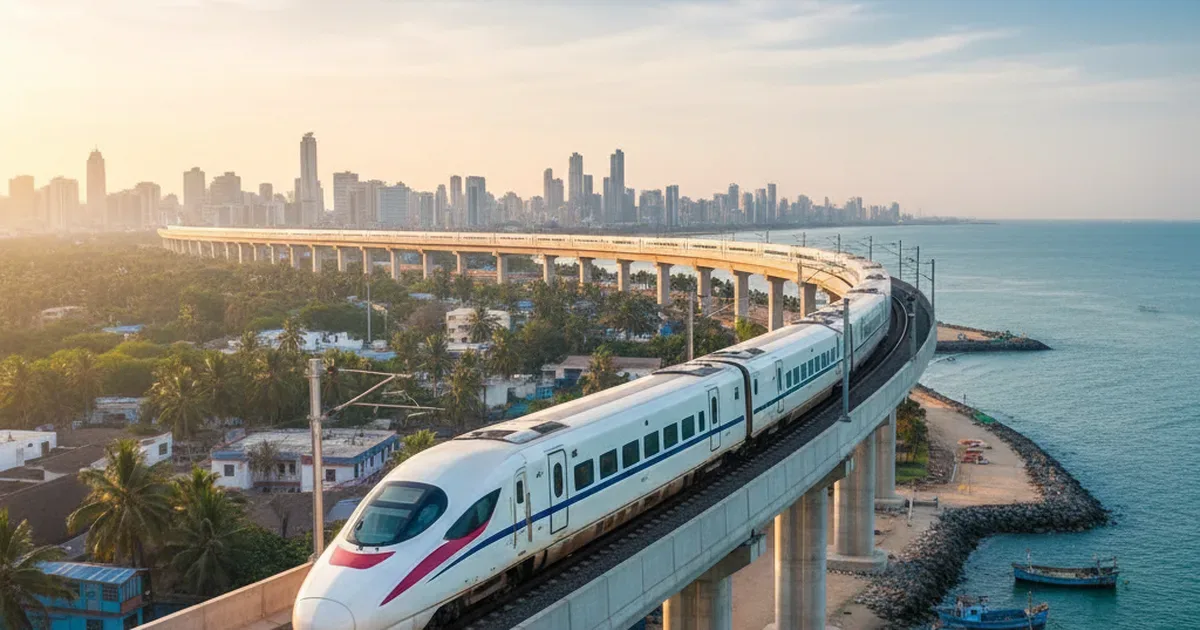

There is something genuinely historic happening along the 508-kilometer stretch between Mumbai and Ahmedabad right now. Concrete piers line the horizon for hundreds of kilometres. Tunnel-boring machines are pushing through Maharashtra’s rocky hillsides. Station foundations are rising on both ends of the corridor. India’s first bullet train — a project that has been debated, delayed, and doubted — is unmistakably being built.
As of March 2026, the Mumbai–Ahmedabad High Speed Rail (MAHSR) project has crossed several construction milestones that suggest the project is in its most active phase yet. Whether you’re curious about when it will open, how fast it will travel, or what the route actually looks like, this guide has the latest answers.
What Is the Mumbai–Ahmedabad Bullet Train Project?
The Mumbai–Ahmedabad High Speed Rail Corridor is a 508-km rail line being developed by the National High Speed Rail Corporation (NHSRC), a wholly owned subsidiary of Indian Railways. When complete, it will be India’s first true high-speed rail line — designed to run trains at a top speed of 350 km/h, cutting travel time between Mumbai and Ahmedabad to around two hours, compared to the current six-to-seven hours by conventional express trains.
The project uses Japan’s iconic Shinkansen technology, backed by a ₹88,087 crore (approximately $12 billion USD) low-interest loan from the Japan International Cooperation Agency (JICA) at just 0.1% interest. The corridor passes through Maharashtra, Gujarat, and the Union Territory of Dadra & Nagar Haveli, connecting two of India’s most economically productive states.
💡 Why it matters: India’s railway network moves over 23 million passengers a day — but no line currently exceeds 160 km/h in regular service. The bullet train corridor would place India on the same map as Japan, France, and China in terms of high-speed rail capability, and is expected to generate significant economic spillovers along the entire corridor.
If you’re curious about how India’s conventional freight infrastructure is simultaneously being upgraded, our deep-dive on the Dedicated Freight Corridor updates for 2026 covers the parallel transformation happening on the cargo side of Indian Railways.
Route Map and the 12 Planned Stations
The bullet train corridor begins in the heart of Mumbai’s financial district — the Bandra-Kurla Complex (BKC) — and terminates at Sabarmati on the outskirts of Ahmedabad. Between the two endpoints, twelve stations are planned:
- Mumbai (BKC) — Underground terminus
- Thane
- Virar
- Boisar
- Vapi
- Billimora
- Surat — the project’s commercial centrepiece in Gujarat
- Bharuch
- Vadodara
- Anand / Nadiad
- Ahmedabad
- Sabarmati — northern terminus
Of the twelve stations, eight fall within Gujarat — which explains why the Gujarat section has seen significantly faster construction progress than the Maharashtra end, where land acquisition disputes caused delays stretching into 2021.
Construction Progress as of March 2026
This is where things get genuinely impressive. The NHSRC and Railway Minister Ashwini Vaishnaw confirmed in late March 2026 that all 1,389.5 hectares of land required for the project has been acquired, all statutory clearances obtained, and all 1,651 utilities shifted along the corridor — a logistical challenge that once seemed insurmountable.
Here are the headline construction numbers as of March 2026:
- 430 km of piers erected along the elevated viaduct
- 341 km of girders placed — forming the actual track deck
- 174 km of track bed laid and ready
- 153 km of overhead electric mast structures installed
- 4.8 km of the 21-km undersea tunnel completed (between Ghansoli and Shilphata)
In simpler terms: the skeleton of the bullet train’s elevated railway is largely complete across the Gujarat section. The focus is now shifting to the more complex Maharashtra works, including tunnels, river bridges, and the underground BKC station.
The Undersea Tunnel: India’s Most Ambitious Underground Engineering
Perhaps the most remarkable engineering element of the entire project is the 21-km undersea tunnel running below Thane Creek in Maharashtra. This tunnel, which will carry the high-speed line from BKC through to Shilphata, is one of the longest underwater tunnels in Asia when measured by scope and technical complexity. As of March 2026, roughly 4.8 km of this tunnel has been completed.
Separately, the project has achieved two mountain tunnel breakthroughs in Palghar in early 2026 — the MT-5 tunnel (January 2) and the MT-6 tunnel (February 4), the latter being 454 metres long and excavated using the New Austrian Tunnelling Method (NATM). Seven mountain tunnels and one undersea tunnel are part of the overall 27.4-km tunnel network along the corridor.
Station-by-Station Construction Status (March 2026)
The Gujarat stations are significantly ahead of their Maharashtra counterparts. Here’s the current status at each station:
| Station | State | Current Status |
|---|---|---|
| Sabarmati | Gujarat | Platform slab & roof in progress |
| Ahmedabad | Gujarat | Structural works complete |
| Anand / Nadiad | Gujarat | Structural works complete |
| Vadodara | Gujarat | Structural & finishing works in progress |
| Bharuch | Gujarat | Structural works complete |
| Surat | Gujarat | Works in progress |
| Billimora | Gujarat | Works in progress |
| Vapi | Gujarat / DNH | Works in progress |
| Boisar | Maharashtra | Foundation advanced; structural started |
| Virar | Maharashtra | Early-stage works |
| Thane | Maharashtra | Early-stage works |
| BKC Mumbai | Maharashtra | Foundation nearly complete; base slab started |
River Bridges: Five Completed, More Underway
The corridor crosses several major rivers as it winds northward through Maharashtra and Gujarat. As of March 2026, bridges over five rivers — the Meshwa, Vishwamitri, Kim, and Mindhola rivers — have been fully completed. Work is actively underway on the larger crossings, including:
- Narmada River Bridge — 1,366 metres long, one of the corridor’s largest crossings
- Vaitarna River Bridge — 2,320 metres long, the longest bridge on the corridor
- Sabarmati River Bridge — sub-structure complete; superstructure work underway
- Mahi and Tapi River Bridges — at advanced stages of construction
One standout moment in early 2026 came when the project completed the launch of a 130-metre span of a 230-metre-long continuous steel bridge over National Highway-64 near Kanthariya village in Bharuch, Gujarat — one of the more technically complex crossings on the route.
The Trains: Shinkansen Meets Make in India
The MAHSR corridor will initially operate Japan’s E5 series Shinkansen rolling stock, with full technology transfer forming a core part of the bilateral deal. But in a significant development for India’s manufacturing ambitions, the Integral Coach Factory (ICF) in Chennai has been contracted to design and manufacture two indigenous train sets based on the Vande Bharat platform.
These domestically built trains are being engineered to cruise at an average speed of 250 km/h with a maximum speed of 280 km/h — somewhat lower than the Shinkansen’s full capability, but still a dramatic leap for Indian rail travel. BEML Ltd was awarded the sub-contract in September 2024, and delivery of the first prototype is expected in 2026, with rail trials to follow. Each coach is estimated to cost around ₹27.86 crore.
Want to understand how India’s railway manufacturing ecosystem is evolving more broadly? Our overview of Jammu & Kashmir rail projects covers another frontier where Indian Railways is pushing engineering limits — this time through the Himalayas.
Challenges: Delays, Cost Overruns, and Diplomatic Headwinds
No infrastructure project of this scale comes without complications, and the Mumbai–Ahmedabad bullet train has had more than its share. A few key challenges are worth understanding:
Maharashtra Land Acquisition Delays
Land acquisition in Maharashtra stalled significantly between 2019 and 2021, largely due to political opposition from the then state government. Work accelerated only after the political situation changed in 2022, but the delay had already set the project back by two to three years and contributed to an additional depot being needed — three instead of the usual two for a 508-km corridor.
Rising Project Costs
As of March 2026, after spending roughly 53% of the original estimated budget, reports indicate the total project cost has risen by approximately 83% from the initial estimate — largely due to land value appreciation during the acquisition delays and changes in scope.
Japan-India Relations and Funding
Tensions in the Japan-India diplomatic relationship have introduced some uncertainty around additional financing, with the expectation that cost overruns beyond the original JICA loan will need to be covered by the Indian government rather than through additional Japanese lending.
What the Bullet Train Will Actually Mean for Travelers
When operational, the Mumbai–Ahmedabad bullet train promises to cut travel time between the two cities from roughly six hours (by express train) to under two hours. That is a transformation in accessibility comparable to what the Konkan Railway did for coastal travel — but at an entirely different speed.
Speaking of which, the current best rail connection between Mumbai and destinations further south remains the scenic Konkan Railway route. If you’re planning a journey right now, our guide to the Mumbai to Goa train via the Konkan Railway covers everything from booking tips to the best seats for sea views.
Beyond travel time, the bullet train corridor is expected to catalyze economic development in mid-sized cities like Surat, Vadodara, and Bharuch — cities that have historically been bypassed by premium infrastructure investment in favour of the two metros at either end.
For travellers interested in what high-quality rail travel already looks like between major Indian cities, the Delhi to Agra road and rail trip guide offers a useful reference point — particularly the Gatimaan Express, which currently holds the record as India’s fastest operating train at 160 km/h.
🔮 Looking ahead: The MAHSR project is just the beginning. India has identified multiple other high-speed corridors for future development, including Delhi–Varanasi, Mumbai–Nagpur, and Delhi–Ahmedabad routes. As these projects advance, a dedicated guide to India’s complete high-speed rail network and future corridor timeline will be published here on RoadRailInfra.com.
Expected Timeline and What Comes Next
The project’s overall completion target is 2028–29 for the full 508-km corridor. The physical progress tracked by the Ministry of Statistics and Programme Implementation (MoSPI) stood at 56% as of November 2025, suggesting a meaningful acceleration will be needed through 2026 and 2027 to meet the target.
Key milestones to watch for in the coming months:
- Completion of the BKC underground station base slab and structural progress
- Advancement of the 21-km undersea tunnel boring operations
- Delivery and trials of the first indigenous ICF-built train set
- Completion of the Vaitarna and Narmada river bridges
- First trial runs on a completed Gujarat section — widely anticipated as the first visible proof-of-concept
The Bottom Line
India’s Mumbai–Ahmedabad bullet train is no longer a promise on paper — it is steel and concrete rising across two states. The numbers tell a confident story: 430 km of piers, 341 km of girder work, five river bridges completed, and two mountain tunnels already punched through Maharashtra’s hills. Delays and cost pressures remain real, but the trajectory in early 2026 is unmistakably forward. When this corridor opens — and it will — it will do more than just move people faster. It will mark India’s arrival as a high-speed rail nation.
Frequently Asked Questions
When will the Mumbai–Ahmedabad bullet train be completed?
The full 508-km corridor is targeted for completion by 2028–29. A partial section within Gujarat may become operational earlier. Progress stood at 56% as of November 2025, and construction has accelerated significantly through early 2026.
How fast will the bullet train travel between Mumbai and Ahmedabad?
The corridor is designed for a maximum speed of 350 km/h. Regular operational speed will be around 320 km/h for Shinkansen trains, and 250–280 km/h for the indigenous ICF-built train sets. This will reduce the journey from roughly six hours to approximately two hours.
What technology is being used in the bullet train project?
The project uses Japan’s Shinkansen technology — rolling stock, signalling, and design standards — under a technology transfer arrangement. Simultaneously, India’s Integral Coach Factory (ICF) is building two domestically designed train sets based on the Vande Bharat platform. Which stations are on the Mumbai–Ahmedabad bullet train route?
The 12 planned stations are: Mumbai (BKC), Thane, Virar, Boisar, Vapi, Billimora, Surat, Bharuch, Vadodara, Anand/Nadiad, Ahmedabad, and Sabarmati. Eight of these fall within Gujarat.
What is the 21-km undersea tunnel in the bullet train project?
The bullet train corridor includes a 21-km underwater tunnel running from Mumbai’s Bandra-Kurla Complex (BKC) to Shilphata in Maharashtra, crossing beneath Thane Creek. It is one of the longest and most technically complex undersea tunnels in Asia. As of March 2026, approximately 4.8 km has been completed.
What is the total cost of the Mumbai–Ahmedabad bullet train project?
The original estimated cost was approximately ₹1.1 lakh crore (around $15 billion USD). As of March 2026, cost estimates have risen by approximately 83% due to land acquisition delays and scope changes. The project is primarily funded through a ₹88,087 crore JICA loan at 0.1% interest.
Will there be more bullet train corridors in India after Mumbai–Ahmedabad?
Yes. India has identified several future high-speed corridors including Delhi–Varanasi, Delhi–Ahmedabad, Mumbai–Nagpur, Delhi–Amritsar, and Mumbai–Hyderabad. Feasibility studies are at various stages, but the Mumbai–Ahmedabad project is expected to provide the template — and the institutional knowledge — for all future corridors.
Frequently Asked Questions
What is the Mumbai-Ahmedabad Bullet Train project?
The Mumbai-Ahmedabad High Speed Rail (MAHSR) is India’s first bullet train corridor — 508 km connecting Mumbai to Ahmedabad in approximately 2 hours. It uses Japanese Shinkansen technology and is funded by Japan International Cooperation Agency (JICA).
When will the Mumbai-Ahmedabad Bullet Train be ready?
The full corridor is targeted for completion by 2027. The first operational section from Surat to Bilimora (50 km) is expected to open by 2026. Construction has faced delays due to land acquisition challenges.
What is the expected bullet train fare?
The Government of India has indicated fares will be competitive with air travel for the same route. Estimated base fare is approximately Rs 3,000-4,000 for the full Mumbai-Ahmedabad journey.
What speed will the India bullet train run at?
The MAHSR will run at a design speed of 350 km/h with an operational speed of 320 km/h — matching the E5 Series Shinkansen specifications used on Japan’s Tohoku Shinkansen.
How many stations will the bullet train stop at?
The Mumbai-Ahmedabad bullet train will stop at 12 stations: Mumbai BKC, Thane, Virar, Boisar, Vapi, Bilimora, Surat, Bharuch, Vadodara, Anand/Nadiad, Ahmedabad, and Sabarmati.
What is the NHSRCL?
National High Speed Rail Corporation Limited (NHSRCL) is the special purpose vehicle created by the Government of India to build and operate the bullet train project. It is equally owned by the Central Government, Maharashtra, and Gujarat.
How long is the undersea tunnel section of the bullet train?
The MAHSR includes a 21 km undersea tunnel section under Thane Creek — the first undersea rail tunnel in India — connecting Mumbai’s BKC station to the Thane area.
Comment (1) on "Mumbai–Ahmedabad Bullet Train Progress 2026: Construction Update, Stations & What to Expect"
Comments are closed.