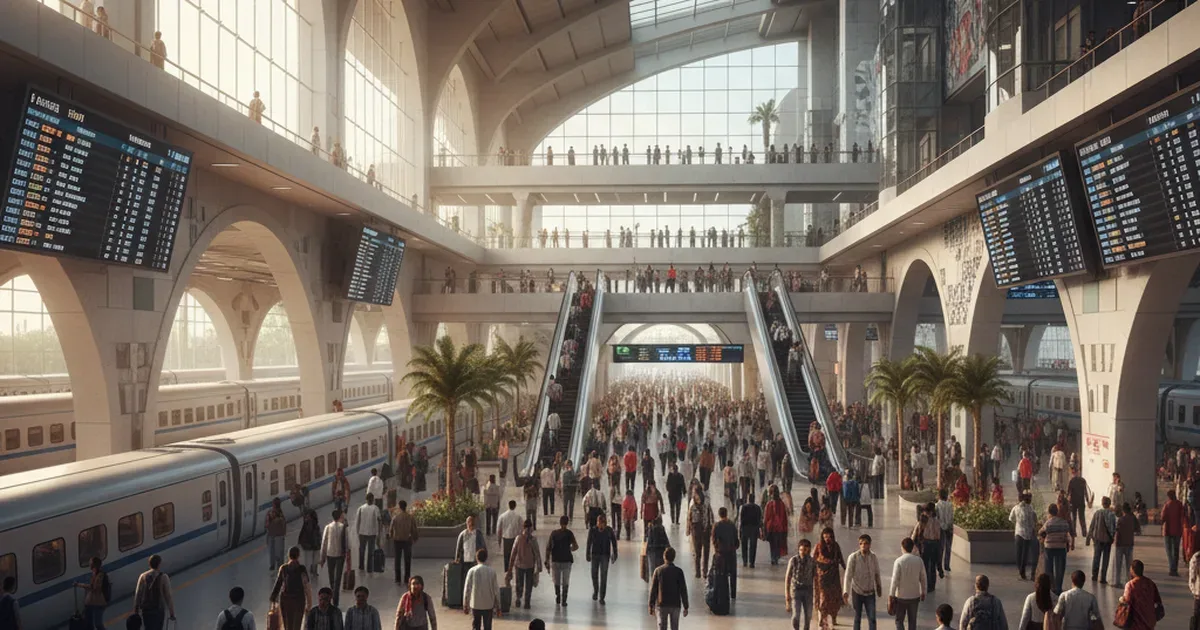

For most of India’s history, railway stations were functional but far from comfortable. Crowded platforms, outdated waiting rooms, and ageing infrastructure were the norm at hundreds of stations across the country. That picture is changing — fast. Under the Amrit Bharat Station Scheme (ABSS), Indian Railways has launched the most ambitious station redevelopment programme the country has ever seen, targeting over 1,300 stations for a complete transformation. And as of early 2026, the results are already visible.
Whether you travel regularly on the New Delhi to Mumbai route or occasionally hop on a regional express, there’s a good chance one of the stations along your journey is either already upgraded or actively under renovation. Here’s everything you need to know.
What Is the Amrit Bharat Station Scheme?
Launched in December 2022 by the Ministry of Railways, the Amrit Bharat Station Scheme is a long-term, master-plan-driven approach to modernising India’s railway stations. Unlike earlier, piecemeal renovation programmes, the ABSS treats each station as an evolving project — with phased upgrades tailored to its size, daily footfall, and local identity.
The scheme isn’t just about aesthetics. The core philosophy is to turn railway stations into genuine “city centres” — spaces that integrate transport, commerce, culture, and community. Think wide, airy concourses, roof plazas, food courts, children’s play areas, digital information kiosks, and “One Station One Product” stalls showcasing local crafts and produce.
Key Goal: Every redeveloped station should offer passengers an experience comparable to a modern airport — without losing the character and soul of the region it serves.
The ABSS builds on earlier efforts like the Adarsh Railway Station Scheme (2009) and the Rani Kamalapati redevelopment in Bhopal — but operates at a scale that dwarfs all previous programmes combined.
How Many Stations Have Been Upgraded So Far?
The pace of redevelopment has picked up significantly. Foundation stones for the first 508 stations were laid in August 2023, followed by 553 more in February 2024. By December 2025, 155 stations had been fully modernised, with active construction ongoing at 1,182 others across the country.
A landmark moment came on 22 May 2025, when Prime Minister Narendra Modi virtually inaugurated 103 redeveloped stations spanning 18 states in a single event held in Bikaner, Rajasthan. The redevelopment of these 103 stations cost over ₹1,100 crore. Stations inaugurated included Saharanpur (Uttar Pradesh), Orchha (Madhya Pradesh), Parel (Mumbai), and Munirabad and Dharwad in Karnataka — a cross-section that shows just how geographically diverse the scheme is.
Which States Are Getting the Most New Stations?
The ABSS has a clear mandate to spread benefits across the country, but some states are naturally ahead given their dense rail networks. Here’s a breakdown of stations identified for redevelopment by state:
| State | Stations Identified | Notable Stations |
|---|---|---|
| Uttar Pradesh | 157 | Ayodhya Dham, Gomti Nagar, Bareilly City |
| Maharashtra | 132 | Parel, Pune, Chinchpokli, Devlali |
| West Bengal | 94 | Multiple stations across the state |
| Gujarat | 87 | Bhuj, Ahmedabad, Dwarka |
| Bihar | 86 | Muzaffarpur, Karpoorigram |
| Rajasthan | 82 | Udaipur, Bikaner |
| Madhya Pradesh | 80 | Orchha, Bhopal (Rani Kamalapati) |
What Will the New Stations Actually Look Like?
This is where the ABSS gets genuinely exciting. Rather than applying a one-size-fits-all design template, the scheme mandates that every station’s architecture draw from the culture and heritage of its region. The result? A network of stations that feel distinctly Indian — not interchangeable boxes.
- Ahmedabad Station — inspired by the Modhera Sun Temple, with intricate geometric patterns on the facade
- Dwarka Station (Gujarat) — designed around the iconic Dwarkadheesh Temple
- Puri Station (Odisha) — echoes the architecture of the Jagannath Temple
- Madurai & Rameswaram (Tamil Nadu) — draw from the Meenakshi and Ramanathaswamy temples respectively
- Udaipur Station (Rajasthan) — features a dome inspired by the grandeur of Umaid Bhawan Palace
- Gurugram Station (Haryana) — carries a sleek IT-city theme befitting its identity
- Bhuj Station (Gujarat) — blends modernity with Kutchi craft traditions; building work over 75% complete as of late 2025
These aren’t just symbolic gestures — they give travellers a genuine sense of place the moment they step into a station. If you’ve ever taken the scenic Mandapam to Rameswaram route via Pamban Bridge, you’ll appreciate how fitting it is that Rameswaram station is being designed around its magnificent temple.
Key Facilities at Redeveloped Stations
So what exactly will passengers get at a renovated station? The upgrades go well beyond a fresh coat of paint. Here are the core amenities being introduced or significantly improved:
🚶
Passenger Flow
Wider entrances, separate entry/exit points, improved signage, and roof plazas to reduce congestion
♿
Accessibility
Lifts and escalators on all platforms, tactile paths, and accessible toilets across all upgraded stations
📶
Connectivity
Free high-speed Wi-Fi, CCTV surveillance, and digital passenger information display systems
🍽️
Food & Retail
Food courts, branded F&B options, One Station One Product kiosks, and children’s play areas
☀️
Sustainability
Solar power plants, rainwater harvesting systems, green landscaping, and eco-friendly waste management
🏛️
Heritage Design
Architecturally inspired facades rooted in the culture and monuments of each station’s region
Spotlight: India’s First World-Class Station
Before the ABSS came into full swing, one station quietly set the benchmark for everything that followed. Rani Kamalapati Railway Station in Bhopal — formerly known as Habibganj — was rebuilt under a public-private partnership and is widely regarded as India’s first truly world-class railway station. Modelled on Germany’s Heidelberg Station, it features an integrated bus terminal, a high-end hotel, premium retail, and the kind of passenger experience that was once unimaginable at an Indian rail hub.
Rani Kamalapati proved the concept. The ABSS is now taking it to over a thousand stations across the country.
Station Redevelopment & the Bigger Railway Picture
Station upgrades don’t exist in isolation — they’re part of a sweeping modernisation of Indian Railways as a whole. The same years that have seen the ABSS ramp up have also witnessed the rollout of Vande Bharat Express services, Amrit Bharat Express trains for non-AC passengers, and the near-completion of landmark infrastructure like the Chenab Bridge in Jammu & Kashmir.
The Dedicated Freight Corridor upgrades are freeing passenger line capacity, which means more trains and faster services through newly upgraded stations. Meanwhile, the engineering milestones achieved on the Jammu & Kashmir rail projects and the expansion into the Northeast India railway network mean that station redevelopment is reaching corners of the country that were previously underserved.
This is interconnected progress. Better stations attract more passengers. More passengers justify better trains. Better trains need upgraded tracks and stations. The cycle is now firmly in motion.
What’s Coming Next in 2026 and Beyond?
The redevelopment story is far from over. Several major stations — including New Delhi Railway Station, Ahmedabad, and Chhatrapati Shivaji Maharaj Terminus (CSMT) in Mumbai — are approved for redevelopment and will define the next chapter of this transformation. These are among the busiest and most iconic stations in the country, and their upgrades will be closely watched.
In 2026, Indian Railways has also signalled that the Vande Bharat Sleeper will become operational, targeting long-distance AC travellers on busy corridors. As trains get faster and more comfortable, the pressure on station infrastructure to match that quality will only grow — further accelerating the pace of the ABSS.
On the regional side, watch for further progress at stations in Bihar (Muzaffarpur, due for completion in the 2025–26 fiscal year), Gujarat (Bhuj, over 75% complete), and the six major Maharashtra stations — Pune, Hadapsar, Khadki, Shivajinagar, Uruli Kanchan, and Alandi — currently in their final development planning stages.
India-wide high-speed rail station planning is also on the horizon as the Mumbai–Ahmedabad bullet train corridor progresses. The new greenfield stations being designed for this project will represent an entirely different class of rail infrastructure in India.
🚆 Planning a Train Journey?
Many of the routes passing through newly redeveloped stations are covered in our detailed travel guides. Check out some of the most-read routes on RoadRailInfra:
- Mumbai to Goa – Konkan Railway Travel Guide
- New Delhi to Mumbai – Complete Train Route Guide
- Mandapam to Rameswaram via Pamban Bridge
- Mettupalayam to Ooty – Nilgiri Mountain Railway
Frequently Asked Questions
Q. What is the Amrit Bharat Station Scheme?
A. The Amrit Bharat Station Scheme (ABSS) is a national mission launched by India’s Ministry of Railways in December 2022. Its goal is to redevelop and modernise 1,337 railway stations across the country with airport-like amenities, heritage-inspired architecture, and sustainable infrastructure such as solar power and rainwater harvesting.
Q. How many railway stations have been redeveloped so far?
A. As of December 2025, 155 stations have been fully modernised under the Amrit Bharat Station Scheme, with active redevelopment work underway at 1,182 more stations across India.
Q. Which states have the most stations being redeveloped?
A. Uttar Pradesh leads with 157 stations identified for redevelopment, followed by Maharashtra (132), West Bengal (94), Gujarat (87), Bihar (86), Rajasthan (82), and Madhya Pradesh (80).
Q. What facilities will the new redeveloped stations have?
A. Redeveloped stations will feature wider entrances, modern waiting halls, upgraded toilets, escalators, lifts, free Wi-Fi, CCTV, food courts, children’s play areas, ‘One Station One Product’ kiosks, solar power plants, and rainwater harvesting systems.
Q. Which is India’s first world-class railway station?
A. Rani Kamalapati Railway Station in Bhopal (formerly Habibganj) is widely regarded as India’s first world-class railway station. Rebuilt under a public-private partnership on the lines of Germany’s Heidelberg station, it offers an airport-like passenger experience with a hotel, premium retail, and integrated bus connectivity.
Q. Will station designs reflect local culture?
A. Yes — this is one of the defining features of the scheme. Each station’s architectural design is inspired by the local culture, heritage, and landmarks of its region. Ahmedabad station references the Modhera Sun Temple; Dwarka draws from the Dwarkadheesh Temple; Udaipur features a dome inspired by Umaid Bhawan Palace.
The Bottom Line
India’s railway station transformation is one of the largest infrastructure undertakings in the world right now. More than 1,300 stations — each with its own cultural identity, local heritage, and passenger needs — are being reimagined from the ground up. The result will be a rail network where the journey doesn’t just begin when the train moves, but from the moment you step through the station gates.
Whether you’re a daily commuter, a heritage rail enthusiast, or simply someone who wants to understand where Indian infrastructure is headed, the Amrit Bharat Station Scheme is a story worth following closely.
Explore more of India’s evolving rail landscape through our guides to Dedicated Freight Corridor updates, the epic Jammu & Kashmir rail projects, and the remarkable expansion of the Northeast India railway network.
Frequently Asked Questions
How many new railway stations is India building?
Under the Amrit Bharat Station Scheme launched in 2023, Indian Railways is upgrading over 1,300 stations across India with modern amenities, better accessibility, and improved passenger facilities.
What is the Amrit Bharat Station Scheme?
Amrit Bharat is a continuous improvement programme for railway stations. It covers roof plazas, better lighting, improved waiting areas, enhanced accessibility for disabled passengers, and aesthetic upgrades aligned with local heritage.
Which is the most modern railway station in India?
Rani Kamlapati (Bhopal), Sir M Visvesvaraya Terminal (Bengaluru), and the redeveloped New Delhi station (under construction in 2026) are among India’s most modern stations with airport-style amenities.
What amenities do upgraded Indian railway stations have?
Modern stations feature air-conditioned waiting halls, food courts, free Wi-Fi, improved restrooms, lifts and escalators, EV charging, baby care rooms, digital signage, and dedicated areas for Divyangjan (differently-abled passengers).
When will New Delhi railway station redevelopment complete?
The New Delhi railway station redevelopment is a mega project with an estimated cost of over Rs 6,500 crore. Phase 1 completion is targeted for 2027, with the full project expected by 2029-30.
What is the roof plaza concept in Indian railway stations?
Roof plazas are commercial and transit spaces built over railway tracks, inspired by airports. They allow passengers to access platforms from multiple sides and house retail, food, and hospitality facilities.
How do I track railway station redevelopment progress?
NRSA (National Rail and Station Authority) updates are published on indianrailways.gov.in. The PM GatiShakti portal also tracks major infrastructure projects including station upgrades.
Comments (2) on "India’s New & Renovated Railway Stations (2026): The Transformation You Need to Know About"
Comments are closed.