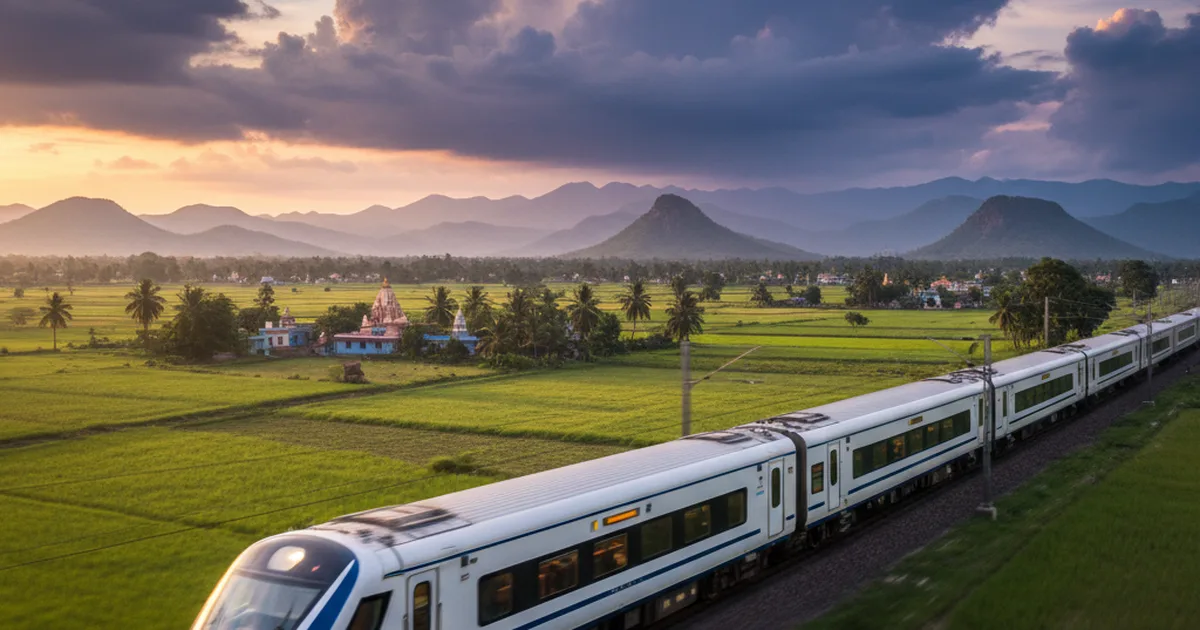

India’s homegrown semi-high-speed train is no longer a bold experiment — it is the backbone of a new era for Indian Railways. Here is your complete guide to Vande Bharat Express: what it offers, where it runs, what passengers are saying, and how far the network will grow.
130+ Trains in service (2026) 160 km/h Design top speed 100% Made in India 500+ Target trains by 2027
What Is the Vande Bharat Express?
The Vande Bharat Express — originally known as Train 18 during its development — is India’s first self-propelled, indigenously designed semi-high-speed passenger train. It was conceptualised, engineered, and built entirely within India by the Integral Coach Factory (ICF) in Chennai, making it a landmark achievement under the government’s Make in India programme.
Unlike conventional Indian trains that rely on a separate locomotive at one end, Vande Bharat uses distributed traction — motors are spread across multiple coaches, giving it faster acceleration, smoother deceleration, and the ability to reverse direction without any shunting. It first entered revenue service in February 2019 between New Delhi and Varanasi, and the network has expanded dramatically ever since.
Did you know? The original Vande Bharat prototype was built in just 18 months and at a fraction of the cost of comparable imported trains. The entire project cost approximately ₹100 crore per trainset — significantly lower than European or Japanese equivalents.
If you want to understand how India’s broader railway modernisation picture fits together, our overview of Indian Railways infrastructure is a great place to start.
Onboard Experience: What Is It Like to Ride Vande Bharat?
Step into a Vande Bharat coach and the difference from a typical Indian express train is immediately apparent. The interior is bright, clean, and well-designed, drawing comparisons to European intercity trains rather than the older Shatabdi or Rajdhani stock.
Key Features Passengers Love
- Automatic sliding doors at coach entrances — no more manually wrestling heavy doors open at stations.
- Rotatable seats in Executive Chair Car (EC) class so you can always face your direction of travel.
- GPS-based passenger information displays showing the next station, speed, and estimated arrival time in real time.
- Onboard Wi-Fi on most routes, available free of charge.
- Bio-vacuum toilets similar to those found on aircraft — maintained considerably cleaner than older rolling stock.
- Controlled diffused lighting and larger windows for a more pleasant travel environment.
- Catering service included in the ticket fare — meals are served at your seat in both Chair Car (CC) and Executive Chair Car classes.
Travel writers and regular commuters alike have noted a distinct uplift in comfort. On routes like Chennai to Bengaluru, the Vande Bharat has become the default premium choice for business travellers, cutting journey time meaningfully while offering a far more comfortable onboard environment than older intercity trains.
A Word on the Catering
Meals are supplied by IRCTC-approved vendors and are included in the base ticket price. The quality has been a mixed bag in early passenger reviews — the food itself has gradually improved on heavily patronised routes, though some less-travelled corridors still see inconsistent service. It is worth managing expectations: think functional, hygienic railway catering rather than fine dining.
Top Vande Bharat Express Routes in 2026
As of early 2026, Vande Bharat trains cover most major city pairs and several regional routes across India. Here are some of the most popular and well-reviewed corridors:
| Route | Approx. Distance | Journey Time | Starting Fare (CC) |
|---|---|---|---|
| New Delhi – Varanasi | ~759 km | ~8 hrs | ~₹1,015 |
| New Delhi – Katra (Vaishno Devi) | ~655 km | ~8 hrs | ~₹1,015 |
| Mumbai – Ahmedabad | ~492 km | ~5.5 hrs | ~₹865 |
| Chennai – Bengaluru | ~362 km | ~5 hrs | ~₹775 |
| Howrah – New Jalpaiguri | ~570 km | ~6 hrs | ~₹935 |
| Mumbai – Shirdi | ~296 km | ~5 hrs | ~₹695 |
| New Delhi – Ajmer | ~441 km | ~6 hrs | ~₹820 |
| Secunderabad – Visakhapatnam | ~721 km | ~8.5 hrs | ~₹990 |
The Howrah–New Jalpaiguri corridor is particularly exciting for train enthusiasts — it connects Kolkata to the gateway for the legendary Darjeeling Himalayan Railway toy train journey, meaning travellers can now complete the full journey from Kolkata to Darjeeling in impressively quick time.
Booking tip: Always check your PNR status after booking a Vande Bharat ticket — particularly on popular routes like Delhi–Varanasi during festival seasons, as seats fill up quickly and waitlist movement matters.
Vande Bharat vs Shatabdi Express: Which Should You Choose?
For many years, Shatabdi Express was the gold standard for daytime intercity travel in India. Vande Bharat has now clearly surpassed it on almost every metric that matters to a passenger.
- Speed: Vande Bharat accelerates faster and maintains higher average speeds on most routes.
- Comfort: Wider seats, better air conditioning, and a quieter ride thanks to distributed traction motors.
- Punctuality: Vande Bharat trains tend to have better on-time performance, partly because they operate on tighter priority scheduling.
- Technology: The infotainment, GPS displays, and automatic doors are genuinely superior to what Shatabdi offers.
- Fare: Vande Bharat fares are slightly higher on comparable routes, but the premium is modest for the quality step-up.
For travellers planning a trip from Delhi southward, the contrast becomes especially clear on the Delhi–Agra corridor, where upgraded trains have set a new benchmark for speed on one of the country’s busiest intercity stretches.
Vande Bharat Expansion Plans: What’s Coming by 2027?
The Indian government has been vocal about its ambitions for Vande Bharat. The original target was 400 trainsets by 2024, a deadline that slipped due to manufacturing and infrastructure constraints — but the pipeline remains very robust heading into 2026 and 2027.
Vande Bharat Sleeper: The Game-Changer
The most anticipated development is the Vande Bharat Sleeper version, which will extend the train’s reach to overnight long-distance routes currently served by Rajdhani Express. These trainsets will include 1AC, 2AC, and 3AC accommodation with an improved ride quality over older Rajdhani coaches, and are designed for sustained operation at 160 km/h on upgraded track sections.
Vande Metro: Short-Distance Urban Connectivity
A scaled-down version called Vande Metro is being designed for short intercity distances — think corridors under 200 km between smaller cities and their surrounding towns. These trainsets will have higher seating density and faster turnaround times, filling a gap between heavy metro systems and mainline express trains.
Route Expansion Highlights
- Several Vande Bharat services are planned for the Northeast — extending connectivity to Assam, Tripura, and beyond, building on the network discussed in our guide to Northeast India Railways.
- New services connecting Jammu to Srinagar are expected once the USBRL project’s final tunnels open — a development closely tied to the progress covered in the Jammu & Kashmir rail projects overview.
- High-demand coastal routes like **Vande Bharat on the Konkan corridor** are being studied — the scenic Mumbai to Goa Konkan Railway route is frequently mentioned as a candidate given its strong tourist and business demand.
Infrastructure context: Vande Bharat’s speed potential is closely tied to track upgrades. The Dedicated Freight Corridor (DFC) programme is freeing up existing mainline tracks for higher-speed passenger services — a structural shift that will directly benefit Vande Bharat expansion in the medium term.
Is Vande Bharat Express Worth the Fare?
Short answer: yes, for most travellers. The slightly higher ticket price compared to regular express trains buys a meaningfully better experience — faster travel, cleaner coaches, included meals, and technology that feels genuinely modern rather than retrofitted.
For business travellers or anyone who values their time, the Executive Chair Car on routes like Howrah to Chennai provides an environment that can compete with budget air travel for shorter city pairs — with zero airport friction and a city-centre-to-city-centre advantage that flights simply cannot match.
The one area where Vande Bharat still trails the best global high-speed trains is raw speed in regular service. India’s tracks, even after ongoing upgrades, do not yet allow sustained 160 km/h operations across most corridors. That ceiling will rise as infrastructure investments — from track upgrades to new signalling systems — come online through the late 2020s. Vande Bharat is being built for a network that is still under construction, which means its best performance is still ahead of it.
Future Content to Watch
As the Vande Bharat network grows, we’ll be covering key routes and developments in depth. Planned future guides include:
- **Vande Bharat Sleeper Complete Guide** — classes, fares, and routes
- **Delhi to Varanasi Vande Bharat Travel Guide**
- **Vande Bharat vs Rajdhani: Which Is Better for Long Trips?**
- **India High-Speed Rail (Bullet Train) Project Update**
Frequently Asked Questions About Vande Bharat Express
What is the Vande Bharat Express?Vande Bharat Express is India’s first indigenously designed and manufactured semi-high-speed train, built under the Make in India initiative. It operates at speeds up to 160 km/h and features modern amenities including automatic doors, GPS-based passenger information displays, onboard Wi-Fi, and bio-vacuum toilets.
How fast does the Vande Bharat Express go? Vande Bharat Express has a design speed of 160 km/h, though operational speeds on most routes average between 100–130 km/h depending on track conditions. The newer Vande Bharat Sleeper version is designed for sustained 160 km/h operations on upgraded corridors.
Which are the most popular Vande Bharat Express routes?
The most popular Vande Bharat routes include New Delhi–Varanasi, New Delhi–Katra (Mata Vaishno Devi), Mumbai–Ahmedabad, Chennai–Bengaluru, Howrah–New Jalpaiguri, and Mumbai–Shirdi. As of 2026, over 130 Vande Bharat trains operate across India.
How do I book a Vande Bharat Express ticket?
Vande Bharat Express tickets can be booked through the IRCTC website (irctc.co.in), the IRCTC Rail Connect mobile app, or at any authorised railway ticket counter. Online booking opens 60 days before the date of travel.
What is the fare for Vande Bharat Express?
Fares vary by route and class. For the Delhi–Varanasi route, the Executive Chair Car (EC) fare is approximately ₹1,855 and the Chair Car (CC) fare is approximately ₹1,015. Fares on shorter routes are lower. Vande Bharat does not have sleeper or general coaches in the current Chair Car version.
Will Vande Bharat Express get sleeper coaches?
Yes. Indian Railways is rolling out the Vande Bharat Sleeper version for overnight long-distance routes. These trains will include 3AC, 2AC, and 1AC accommodation and are expected to progressively replace older Rajdhani-style rakes on key corridors.
Is Vande Bharat Express better than Shatabdi?
Yes, in most measurable ways. Vande Bharat Express is faster, more energy-efficient, and offers better onboard features than the older Shatabdi Express. It uses self-propulsion technology (no separate locomotive) and delivers superior passenger amenities including better seating, cleaner toilets, and modern infotainment systems.
Frequently Asked Questions
How many Vande Bharat trains are running in India in 2026?
As of 2026, over 136 Vande Bharat Express trains are operational across India, serving routes in nearly every state. Indian Railways plans to have 400+ Vande Bharat trains by 2025-26.
What is the maximum speed of Vande Bharat Express?
Vande Bharat Express has a design speed of 180 km/h and an operational speed of 130-160 km/h on most current routes, depending on track quality.
What amenities does Vande Bharat have?
Vande Bharat has automatic doors, GPS-based passenger information system, CCTV, modular bio-toilets, diffused lighting, onboard Wi-Fi (on select routes), and rotating seats in Chair Car.
What classes are available on Vande Bharat?
Vande Bharat has two classes: Executive Chair Car (EC) and Chair Car (CC). There are no sleeper classes as it is designed as a day train for journeys under 8-10 hours.
How do I book Vande Bharat tickets?
Book via IRCTC at irctc.co.in or the IRCTC Rail Connect app. Vande Bharat tickets go on sale 60 days in advance. Tatkal is available from 10 AM one day prior.
Is Vande Bharat faster than Shatabdi?
Yes. Vande Bharat is faster than Shatabdi trains on most comparable routes due to quicker acceleration (0-100 km/h in 52 seconds), higher top speed, and fewer stops.
What is Vande Bharat Sleeper?
Vande Bharat Sleeper is an upcoming version with AC sleeper berths for overnight journeys. Trials began in 2024, with commercial deployment expected by 2025-26 on long-distance routes.
Comments (3) on "Vande Bharat Express – Routes, Review & Expansion Plans"
Comments are closed.